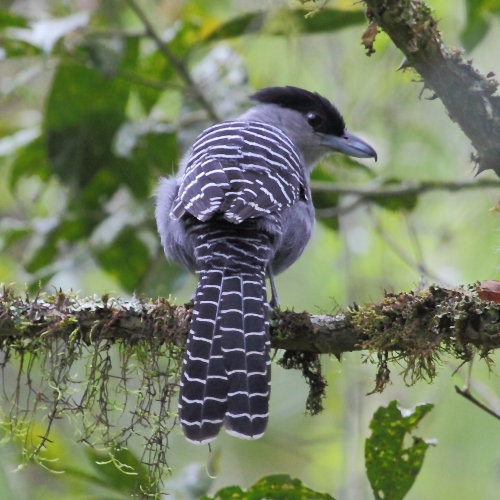
Slate-colored Antbird
Schistocichla schistacea
Order: Passeriformes / Family: Thamnophilidae

Wikimedia Commons
About the Slate-colored Antbird
The Slate-colored Antbird (Schistocichla schistacea) is a striking member of the Thamnophilidae family, recognized for its uniform gray plumage that harmonizes with the shaded understory of tropical forests. This bird is primarily found in the lowland and foothill forests of the Amazon Basin, spanning countries like Brazil, Peru, and Colombia. Its presence is particularly noted in areas where the forest floor is thick with leaf litter and fallen branches, creating a perfect backdrop for its foraging activities. As an understory specialist, the Slate-colored Antbird plays a crucial role in the ecosystem by controlling insect populations, which it hunts with precision and skill. This species is non-migratory, maintaining its territory year-round, which reflects the rich and stable food supply available in its habitat. The Slate-colored Antbird's role extends to seed dispersal, indirectly supporting forest regeneration by preying on insects that harm seeds. This bird's ecological significance is amplified during the rainy season when insect populations peak, and the bird's feeding habits become even more vital.
The Slate-colored Antbird belongs to the family Thamnophilidae, within the order Passeriformes. These birds typically live average 5-8 years with a maximum recorded of 10 years..
How to Identify a Slate-colored Antbird
Adult Slate-colored Antbirds display a consistent slate-gray coloration across their plumage, devoid of the contrasting patterns seen in many related species. This uniformity provides excellent camouflage in the dimly lit forest understory. Males and females are similar in appearance, though females may exhibit slightly browner tones, particularly on the chest. Juvenile birds resemble adults but show a more muted gray, lacking the subtle sheen of mature birds. In flight, the Slate-colored Antbird maintains a low profile, with short, rounded wings that allow for agile maneuvering through dense foliage. Its perching posture is typically horizontal, with a tail held level, which aids in identifying it amid the undergrowth. Comparatively, similar species like the Spot-backed Antbird can be distinguished by their more prominent spotted patterns and different vocalizations.
Having trouble telling birds apart? Upload a photo to our bird identification tool for an instant species match.
Slate-colored Antbird Habitat and Range
Preferred Habitat
The Slate-colored Antbird thrives in humid tropical forests, particularly within the Amazon Basin. It prefers dense undergrowth, often found near watercourses where vegetation is thickest. This species occupies elevations ranging from sea level to approximately 1,500 meters. Seasonal shifts in habitat use are minimal due to the bird's non-migratory nature, although it may move slightly in response to localized changes in food availability. Unlike some antbirds, the Slate-colored Antbird shows no affinity for urban or suburban areas, remaining strictly tied to pristine or minimally disturbed forest environments.
Geographic Range
The breeding and year-round range of the Slate-colored Antbird is primarily confined to the Amazon Basin, including countries such as Brazil, Peru, Colombia, and Bolivia. It does not exhibit long-distance migratory behavior, remaining within its established territories throughout the year. Populations are densest in well-conserved rainforest areas, where habitat conditions are optimal. The distribution is patchy, following the availability of suitable understory conditions, with notable concentrations in regions like the western Amazon basin and adjacent foothills.
Want to know which birds visit your area? Browse our backyard birds by location guides for region-specific species lists.
What Does the Slate-colored Antbird Eat?
The diet of the Slate-colored Antbird consists mainly of insects and other small arthropods. It specializes in catching ants, beetles, and spiders, which it skillfully extracts from leaf litter and low vegetation. During the wet season, when insect biomass increases, the antbird's diet becomes more diverse, including occasional small lizards and amphibians. Foraging involves a methodical search through the undergrowth, often following army ant swarms to catch prey fleeing the advancing ants. Feeding primarily occurs during the early morning and late afternoon, when temperatures are cooler and insect activity is high.
Slate-colored Antbird Behavior and Social Structure
Slate-colored Antbirds exhibit a territorial and monogamous social structure, with pairs defending their territories from intruders. They demonstrate aggressive behavior toward other antbird species and potential threats. Courtship displays are subtle, involving mutual preening and vocalizations. Though largely solitary or seen in pairs, these birds may join mixed-species flocks, especially during non-breeding periods, to enhance foraging success. Their response to predators involves remaining motionless, blending into the shadows of the forest floor. Daily activities peak at dawn and dusk, as these are optimal times for foraging and territory defense.
Slate-colored Antbird Nesting and Reproduction
The nesting behavior of the Slate-colored Antbird involves constructing a well-hidden cup-shaped nest, built close to the ground in dense vegetation. The nest is crafted from plant fibers, leaves, and other natural materials. Clutch size typically consists of two eggs, which both parents incubate over a period of approximately 14 days. Fledging occurs about 12-14 days after hatching, with both parents continuing to feed and protect the young for several weeks post-fledging. The pair usually raises one brood per year, although successful re-nesting may occur if the first attempt fails.
Slate-colored Antbird Sounds and Vocalizations
The primary song of the Slate-colored Antbird is a series of clear, whistling notes delivered at a steady tempo, often described as a repetitive 'whee-whee-whee' sound. These vocalizations are used both for territory defense and mate attraction. Call notes tend to be sharp and metallic, serving as alarms or contact calls. During the dawn chorus, their song is a prominent feature of the soundscape, merging with the calls of other forest inhabitants.
Interesting Facts About the Slate-colored Antbird
- 1Slate-colored Antbirds often follow army ant swarms, capitalizing on prey flushed out by these voracious insects.
- 2Despite their name, Slate-colored Antbirds do not rely exclusively on ants for food, displaying a broad insectivorous diet.
- 3This species maintains territories year-round, unlike many birds that migrate seasonally.
- 4The Slate-colored Antbird's call is among the most frequently heard sounds in its forest habitat at dawn.
- 5Studies suggest that the Slate-colored Antbird's presence is an indicator of forest health, due to its sensitivity to habitat changes.
- 6The species plays an essential role in insect population control, contributing to the ecological balance of its environment.
- 7Slate-colored Antbirds exhibit a strong preference for undisturbed forest environments, avoiding areas impacted by human activity.
Slate-colored Antbird Conservation Status
Currently, the Slate-colored Antbird is classified as Least Concern by the IUCN. Populations are considered stable, although habitat destruction poses a potential threat. Conservation efforts focus on protecting large tracts of Amazon forest to ensure the survival of this and other understory species. Historical data suggests that while the species' range has remained relatively constant, local populations may fluctuate with changes in forest cover and quality.