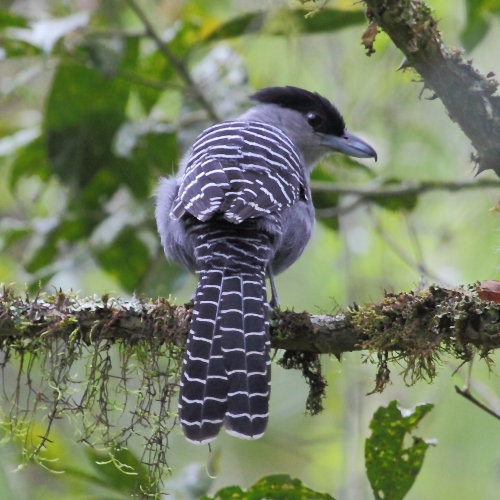
Slender Antbird
Rhopornis ardesiacus
Order: Passeriformes / Family: Thamnophilidae

Wikimedia Commons
About the Slender Antbird
The Slender Antbird, scientifically known as Rhopornis ardesiacus, is a striking member of the Thamnophilidae family. This avian species is primarily found in the Atlantic Forest of eastern Brazil, a biodiversity hotspot crucial for its survival. The bird's habitat is restricted to this specific region, encompassing the states of Bahia and Minas Gerais. The Slender Antbird's presence in such a limited geographic area makes it a subject of significant conservation interest. Beyond its striking appearance, this bird plays a vital role in its ecosystem. As an insectivore, it helps control insect populations, maintaining ecological balance within its forest environment. During the breeding season, which typically occurs from September to December, the Slender Antbird becomes particularly active. Males engage in elaborate courtship displays to attract females, showcasing their agility and the unique coloration of their plumage. Outside of the breeding season, these birds exhibit more solitary behaviors, often seen foraging alone or in pairs. The Slender Antbird's ecological role extends to its interactions with other species. It often follows swarms of army ants, taking advantage of the insects flushed out by the ants' movement. This behavior highlights its adaptability and specialization within its niche. The bird's reliance on the Atlantic Forest underscores the critical need for habitat preservation. Deforestation and habitat fragmentation pose significant threats to its population. Conservation efforts focus on protecting the remaining forest areas and promoting reforestation initiatives. Overall, the Slender Antbird embodies the importance of preserving biodiversity in the Atlantic Forest, serving as both an indicator of environmental health and a testament to the intricate web of life within this unique ecosystem.
The Slender Antbird belongs to the family Thamnophilidae, within the order Passeriformes. These birds typically live average 5-7 years, with a maximum recorded of 9 years..
How to Identify a Slender Antbird
Identifying the Slender Antbird involves noting its distinctive slate-gray plumage, which covers most of its body. The bird measures approximately 15-16 cm in length, and its slender build is complemented by a narrow tail and delicate bill. Both males and females share similar plumage, making gender distinction challenging without close observation. Juveniles, however, display slightly browner tones compared to adults, gradually acquiring full adult coloration as they mature. While observing these birds, one might confuse them with similar-sized antbirds. However, the Slender Antbird's unique coloration and body shape set it apart. In flight, it presents a streamlined silhouette, with rapid wingbeats and a low, direct path through the forest. When perched, the Slender Antbird often adopts an upright posture, enhancing the perception of its slender appearance. The bird's subtle yet distinct features require careful observation, particularly in its densely vegetated habitat where visibility can be limited. Its behavior of following ant swarms can also aid in identification, as this is a common trait among members of its family. The Slender Antbird's calls further assist in identification, often serving as a reliable cue in dense forest environments where visual confirmation may be challenging.
Having trouble telling birds apart? Upload a photo to our bird identification tool for an instant species match.
Slender Antbird Habitat and Range
Preferred Habitat
The Slender Antbird inhabits the Atlantic Forest in eastern Brazil, particularly within Bahia and Minas Gerais. This region is characterized by dense, humid subtropical and tropical forest ecosystems. The bird prefers lowland and montane forest areas, typically found at elevations ranging from 200 to 1,000 meters. Within its habitat, the Slender Antbird favors areas with dense undergrowth, where it can forage and nest. Seasonal habitat shifts are minimal, as these birds are non-migratory and maintain territories year-round. While urbanization is not a significant factor in its range, habitat fragmentation due to agriculture and logging poses threats. Conservation of continuous forest tracts is essential for this species' survival. In terms of habitat preference, the Slender Antbird avoids open areas and is rarely seen in secondary growth forests, highlighting its reliance on mature forest ecosystems.
Geographic Range
The Slender Antbird's range is restricted to the Atlantic Forest in eastern Brazil. It predominantly resides in the states of Bahia and Minas Gerais, with its distribution closely tied to the forest remnants in these areas. This bird does not undertake long migrations, making it a resident species with a highly localized range. Population density hotspots are primarily within protected areas where forest cover is intact. The bird's limited range and habitat specificity make it vulnerable to environmental changes. Unlike more widespread species, the Slender Antbird does not venture beyond its forest home, underscoring the importance of conservation efforts within its native range. The bird's presence serves as an indicator of forest health, as it thrives only in well-preserved habitats.
Want to know which birds visit your area? Browse our backyard birds by location guides for region-specific species lists.
What Does the Slender Antbird Eat?
The Slender Antbird is an insectivore, with a diet primarily consisting of ants, beetles, and other small invertebrates. Seasonal changes have minimal impact on its diet, as it relies on a consistent supply of insects within its forest habitat. The bird employs a specialized foraging technique known as ant-following. It trails army ant swarms, capturing insects that are disturbed by the ants' movement. This method allows the Slender Antbird to exploit prey that would otherwise remain hidden. Prey size varies, although the bird typically targets small to medium-sized insects. Foraging occurs throughout the day, with peak activity in the early morning and late afternoon. The Slender Antbird's foraging strategy showcases its adaptation to life in the dense undergrowth of the Atlantic Forest, where visibility can be limited and prey capture requires agility and precision.
Slender Antbird Behavior and Social Structure
The Slender Antbird exhibits a range of behaviors that reflect its adaptation to the forest environment. Socially, it tends to be solitary or found in pairs, particularly during the breeding season. Territorial behavior is pronounced, with males defending their territories through song and physical displays. Courtship involves males performing elaborate displays to attract females, often involving vocalizations and visual shows of their plumage. Flocking behavior is uncommon, as these birds do not form large groups. Response to predators involves a combination of cryptic behavior and rapid escape flights. The bird's daily activity patterns include active foraging during cooler parts of the day, with periods of rest during the hottest hours. Its interactions with other species, particularly during ant-following, highlight its ecological role and specialization. The Slender Antbird's behaviors, from territorial displays to foraging strategies, emphasize its reliance on the complex forest ecosystem, where it contributes to the intricate balance of predator and prey dynamics.
Slender Antbird Nesting and Reproduction
Nesting habits of the Slender Antbird reflect its adaptation to forest life. The bird constructs cup-shaped nests using twigs, leaves, and plant fibers, typically positioned in dense undergrowth close to the ground. Nests are often concealed by surrounding vegetation, providing protection from predators. The average clutch consists of two to three eggs, with both parents sharing incubation duties. The incubation period lasts approximately 14-16 days, followed by a fledging period of around 12-14 days. Parental care extends beyond fledging, as adults continue to feed and protect their young until they achieve independence. The Slender Antbird is known for having one brood per year, a strategy that aligns with the limited breeding season in its forest habitat. The bird's nesting behavior underscores its reliance on intact forest environments, where suitable nesting sites and food resources are available.
Slender Antbird Sounds and Vocalizations
The Slender Antbird's vocalizations are an essential aspect of its behavior. Its primary song consists of a series of clear, melodious notes delivered in a rhythmic pattern. The pitch is moderate, with a quality that carries well through dense forest. Call notes are shorter and sharper, often used for communication between mates or during territorial disputes. Alarm calls are more abrupt and harsh, signaling the presence of potential threats. During the dawn chorus, the Slender Antbird's song adds to the symphonic cacophony of the forest, often marking the boundaries of its territory. Its vocal repertoire aids in identification, particularly when visual confirmation is challenging in its densely vegetated habitat.
Interesting Facts About the Slender Antbird
- 1The Slender Antbird was first described in 1831 by the renowned naturalist Johann Baptist von Spix.
- 2This bird's scientific name, Rhopornis ardesiacus, refers to its slate-gray coloration, with 'ardesiacus' meaning 'slate' in Latin.
- 3Unlike many birds, the Slender Antbird exhibits minimal sexual dimorphism, with males and females appearing nearly identical.
- 4The Slender Antbird's reliance on ant swarms for foraging is an excellent example of symbiotic behavior in bird species.
- 5The Atlantic Forest, home to the Slender Antbird, has been reduced to less than 15% of its original size due to deforestation.
- 6The Slender Antbird is one of several species endemic to the unique and diverse Atlantic Forest biome.
- 7Because of its limited range and specific habitat requirements, the Slender Antbird is considered an indicator species for forest health.
Slender Antbird Conservation Status
The Slender Antbird is currently classified as Vulnerable by the IUCN, with its population trend considered to be decreasing. Primary threats include habitat loss due to deforestation and fragmentation, driven by agricultural expansion and logging. Conservation efforts focus on protecting remaining forest areas and implementing reforestation initiatives. Historical population changes have seen declines paralleling the loss of its Atlantic Forest habitat. Ongoing efforts by conservation organizations aim to preserve this critical ecosystem, ensuring the survival of the Slender Antbird and other endemic species. Protecting large tracts of forest and promoting sustainable land-use practices remain crucial for the future of this rare and specialized bird.