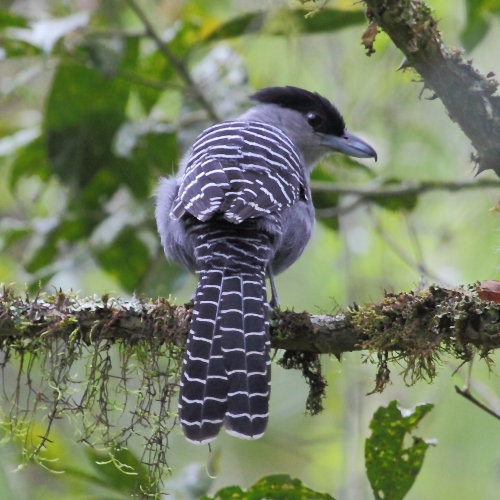
Sooty Antbird
Myrmeciza fortis
Order: Passeriformes / Family: Thamnophilidae

Wikimedia Commons
About the Sooty Antbird
The Sooty Antbird (Myrmeciza fortis) plays a significant ecological role in the dense, humid rainforests of South America, particularly within the Amazon Basin. This bird is an integral part of the complex ecosystem, primarily inhabiting lowland forests in countries such as Brazil, Peru, Colombia, and Venezuela. The Sooty Antbird is often found in the understory, where it forages for insects and other small invertebrates. It benefits from a symbiotic relationship with army ants, opportunistically feeding on the insects that flee from the ants’ relentless march. This behavior not only ensures a consistent food supply but also contributes to controlling insect populations, thus maintaining ecological balance.
Beyond its feeding habits, the Sooty Antbird is crucial for seed dispersal, aiding in the propagation of various plant species within its habitat. While not a primary seed disperser, its role becomes evident as it moves through the forest, inadvertently carrying seeds and contributing to the forest’s regeneration. Despite their drab appearance, these antbirds are important indicators of forest health. Their presence suggests a well-functioning ecosystem, as they rely on pristine, undisturbed forest environments.
Seasonally, the Sooty Antbird does not engage in long migrations, preferring to remain within its established territories throughout the year. However, minor local movements may occur in response to variations in food availability, particularly during the wet season when insect populations are at their peak. This sedentary nature emphasizes the bird’s dependency on stable environmental conditions, making it susceptible to habitat destruction and fragmentation. Conservation efforts thus focus not only on preserving the vast tracts of rainforest but also on maintaining the intricate web of life that sustains species like the Sooty Antbird.
The Sooty Antbird belongs to the family Thamnophilidae, within the order Passeriformes. These birds typically live average 5-7 years, with a maximum recorded of 9 years..
How to Identify a Sooty Antbird
Identifying the Sooty Antbird requires a keen eye, as its dark, sooty plumage offers excellent camouflage in its shadowy forest habitat. Adult males display a primarily black appearance with subtle brown highlights, especially visible under direct light. Females, on the other hand, exhibit a more subdued coloration, with brownish tones dominating their plumage, making them less conspicuous than their male counterparts. Juveniles appear similar to females but may have slightly lighter underparts.
The Sooty Antbird's robust build is a distinguishing feature, with a body length averaging around 18 cm. It possesses a stout bill, well-suited for its insectivorous diet. When observing the bird in flight, its silhouette is compact, with rounded wings and a short tail, adapted for agile movement through dense vegetation.
Confusion with other antbirds is possible, particularly with species like the White-shouldered Antbird. However, the absence of distinctive white markings on the Sooty Antbird helps differentiate it. Observers should also note its characteristic perching posture, often seen clinging to vertical branches within the dense understory, a behavior that aids in its identification.
Having trouble telling birds apart? Upload a photo to our bird identification tool for an instant species match.
Sooty Antbird Habitat and Range
Preferred Habitat
The Sooty Antbird thrives in the dense, humid lowland rainforests of the Amazon Basin. It prefers undisturbed primary forests, where the understory provides ample cover and foraging opportunities. Typically found at elevations ranging from sea level to 500 meters, this bird is a permanent resident of its habitat, showing minimal seasonal shifts.
While primarily associated with the lush interiors of forests, the Sooty Antbird can occasionally be found in secondary growth areas, provided these regions offer sufficient cover and food resources. Urban presence is virtually nonexistent, as the species relies heavily on the complex structure and biodiversity of rainforest ecosystems.
The bird’s habitat selection underscores its need for intact forest environments, making it particularly vulnerable to deforestation and habitat degradation. Conservation efforts target these habitats to ensure the continued survival of species like the Sooty Antbird, which plays a critical role in the ecological balance of its environment.
Geographic Range
The Sooty Antbird's range is restricted to the vast Amazon Basin, extending across several South American countries. It is predominantly found in Brazil, particularly within the states of Amazonas and Pará. Its distribution also includes parts of Peru, Colombia, and Venezuela, with populations scattered through the dense lowland forests.
This species does not undertake long-distance migrations. Instead, it makes minor local movements in response to environmental changes, such as fluctuations in food availability or habitat conditions. The bird's preference for stable, humid environments further limits its range, confining it to areas where primary forests remain largely untouched.
Population density hotspots are primarily within regions of the Amazon that have experienced minimal human disturbance. However, ongoing deforestation poses a significant threat to these habitats, potentially leading to range contractions if conservation measures fail to protect these critical areas.
Want to know which birds visit your area? Browse our backyard birds by location guides for region-specific species lists.
What Does the Sooty Antbird Eat?
The Sooty Antbird's diet primarily consists of insects and other small invertebrates, which it skillfully hunts within the dense forest understory. Its feeding strategy often involves following swarms of army ants. As these predators move through the forest, they flush out various insects from the leaf litter, providing the Sooty Antbird with abundant foraging opportunities.
During different seasons, particularly the wet season, the availability of insects increases, allowing the bird to exploit a wider range of prey. Although primarily insectivorous, the Sooty Antbird may occasionally consume small fruits or seeds, especially when other food sources are scarce.
Foraging typically occurs during the cooler morning and late afternoon hours, when the bird actively searches for food. Its method involves short, purposeful hops and flights, interspersed with periods of stillness as it scans the leaf litter for movement. This combination of patience and agility makes the Sooty Antbird an effective predator within its ecosystem.
Sooty Antbird Behavior and Social Structure
The Sooty Antbird exhibits a solitary or paired social structure, rarely forming large flocks outside of the breeding season. These birds maintain and defend territories vigorously, using vocalizations and displays to ward off intruders. Courtship involves elaborate displays, where males showcase their plumage and perform subtle dances to attract mates.
When it comes to predators, the Sooty Antbird relies on its cryptic coloration and elusive behavior to avoid detection. It often remains motionless within dense vegetation when threatened, blending seamlessly with its surroundings. Despite its solitary nature, the Sooty Antbird may associate with mixed-species flocks, particularly when foraging along army ant swarms, where the benefits of increased vigilance outweigh the risks of competition.
Daily activities are most pronounced during the morning and late afternoon, aligning with periods of cooler temperatures and heightened insect activity. This crepuscular activity pattern maximizes foraging efficiency while minimizing exposure to predators and the midday heat.
Sooty Antbird Nesting and Reproduction
The Sooty Antbird constructs its nests close to the ground, often within dense vegetation or among the roots of large trees. The nest itself is a modest cup-shaped structure made from leaves, vines, and other plant materials, providing a well-camouflaged site for raising young.
Clutch sizes typically consist of two eggs, which undergo an incubation period of approximately 16 days. Both parents share responsibilities during incubation, taking turns keeping the eggs warm and protected. Once hatched, the chicks remain in the nest for about 12 to 14 days before fledging.
Parental care continues post-fledging, with both parents involved in feeding and protecting the young birds until they become more independent. Sooty Antbirds generally raise one brood per year, although favorable conditions may occasionally allow for a second.
The limited reproductive output and reliance on specific nesting sites highlight the species' vulnerability to habitat changes, emphasizing the importance of maintaining intact forest ecosystems.
Sooty Antbird Sounds and Vocalizations
The Sooty Antbird's vocalizations are distinctive, characterized by a series of sharp, clear whistles that serve as both song and communication. The primary song consists of a repetitive sequence of rising and falling notes, delivered with a rhythm that resonates through the dense forest understory.
In addition to its song, the Sooty Antbird uses various call notes to communicate with its mate or to express alarm. These calls are typically shorter and more abrupt, serving as warnings or as means to maintain contact between individuals.
Alarm calls often increase in frequency and intensity when potential threats are nearby, alerting other birds to the presence of predators. During the dawn chorus, the antbird's song contributes to the vibrant symphony of the rainforest, marking its presence in a sonorous exchange with other avian species.
Comparing its song to familiar sounds, the tonal quality resembles a flute's clear notes, while the rhythm maintains a steady, calming pace, making the bird's vocalizations a memorable aspect of its behavior.
Interesting Facts About the Sooty Antbird
- 1The Sooty Antbird often follows swarming army ants, feeding on insects that flee the ants' advance.
- 2While primarily insectivorous, the Sooty Antbird occasionally eats small fruits, diversifying its diet.
- 3Its vocalizations include a series of sharp, clear whistles, easily recognizable in the dense forest.
- 4The Sooty Antbird's nesting sites are typically low to the ground, often hidden among dense vegetation.
- 5Both male and female Sooty Antbirds participate in incubating eggs and caring for the young.
- 6Despite its elusive nature, the Sooty Antbird is a vital indicator of rainforest health and biodiversity.
- 7The species' dependence on pristine habitats makes it particularly vulnerable to deforestation and habitat loss.
Sooty Antbird Conservation Status
The Sooty Antbird is currently listed as Least Concern by the IUCN, but its population trend is declining. The primary threat is habitat loss due to deforestation in the Amazon Basin, driven by logging, agriculture, and urban expansion. Despite these pressures, the species remains relatively widespread within its range. Conservation efforts focus on preserving large tracts of rainforest and implementing sustainable land-use practices. Protected areas and national parks play crucial roles in safeguarding habitats, allowing the Sooty Antbird and other forest-dependent species to thrive. Historically, population changes have mirrored the health of the Amazon rainforest. As deforestation rates fluctuate, so too do the fortunes of this and other species. Continued conservation efforts are vital to ensure the Sooty Antbird's survival, maintaining its role in the ecosystem and preserving biodiversity in the Amazon.