South Island Kokako
Callaeas cinereus
Order: Passeriformes / Family: Callaeatidae
Wikimedia Commons
About the South Island Kokako
The South Island Kokako, scientifically known as Callaeas cinereus, holds a unique place in New Zealand's avian landscape. Once prevalent across the dense forests of New Zealand's South Island, this medium-sized songbird is now considered critically endangered, if not extinct, by many ornithologists. The bird's historical significance lies in its role as an indicator of forest health, thriving in untouched, ancient woodlands replete with native flora. Its haunting, organ-like calls once echoed through the valleys, serving as a natural soundtrack to New Zealand's lush wilderness. This species belongs to the Callaeatidae family, a group known for their remarkable vocal abilities and complex social behaviors. The South Island Kokako exhibits notable ecological roles within its habitat. It plays a crucial part in seed dispersal, feeding on a variety of fruits and subsequently spreading their seeds, facilitating forest regeneration. This role underscores the species' importance in maintaining the biodiversity of its ecosystem. The bird is primarily associated with temperate rainforests, particularly those with a dense canopy and a rich understory. Its presence in these habitats once indicated a healthy, balanced ecosystem. The South Island Kokako's life cycle and behaviors are intrinsically tied to the changing seasons. During the breeding season, which typically spans from late spring to early summer, the Kokako engages in elaborate vocal duets that serve both as territorial markers and courtship rituals. These interactions are crucial for pair bonding and successful mating. Outside the breeding season, South Island Kokako were known to exhibit a degree of seasonal movement, although not true migration. They would shift their range to follow food availability, moving to lower elevations during harsher winter months. This seasonal adaptability highlights the bird's resilience and its historical ability to thrive in diverse environmental conditions.
The South Island Kokako belongs to the family Callaeatidae, within the order Passeriformes. These birds typically live not well documented due to rarity; estimated up to 15 years..
How to Identify a South Island Kokako
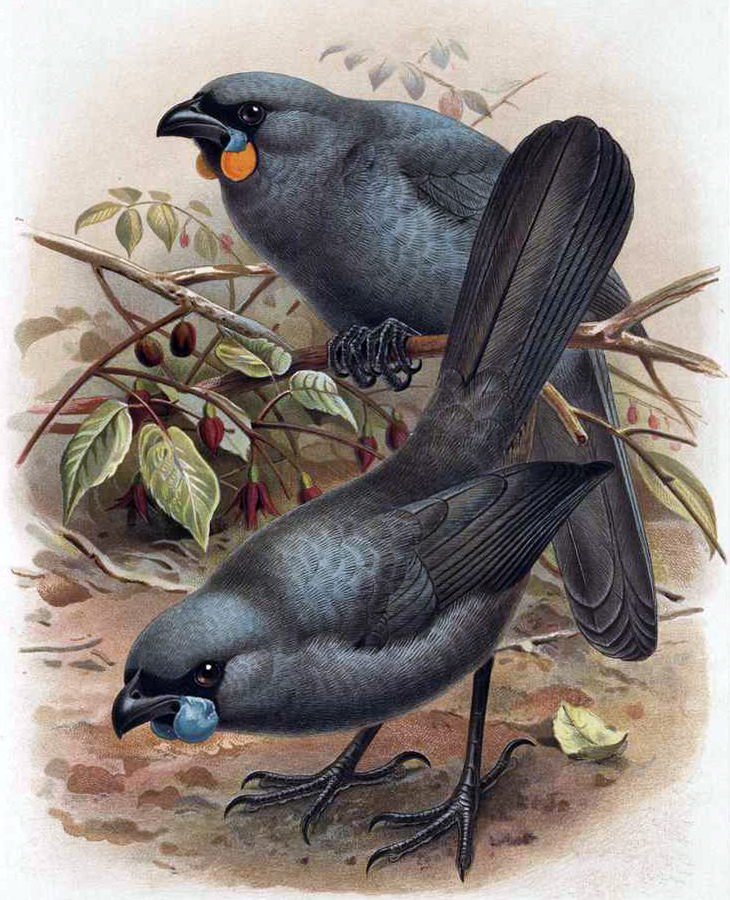
Identifying the South Island Kokako involves recognizing its distinct field marks. Adult South Island Kokako exhibit a striking blue-grey plumage, with a more pronounced bluish hue on the wings and tail. This coloration helps them blend into the dappled shadows of their forest habitat. Juvenile birds tend to have duller plumage, lacking the full vibrancy of adults, which aids in their camouflage from predators. Males and females are similar in appearance, making sex differentiation in the field challenging without behavioral observation. A key feature of the South Island Kokako is its wattles, small and fleshy growths located at the base of the bill, which are a distinguishing characteristic of the species. These wattles are typically a dull blue color, contrasting with the grey feathers. In terms of flight, the South Island Kokako is relatively weak, preferring to glide from branch to branch rather than engage in sustained flight. This behavior is facilitated by its short, rounded wings. When perched, the Kokako exhibits an upright, alert posture, often tilting its head to listen intently to its surroundings. Similar species that might cause confusion include the North Island Kokako, which shares similar plumage but differs in the color and size of its wattles. Unlike its northern counterpart, the South Island Kokako's wattles are smaller and less vibrant. Hence, careful observation of these subtle differences is crucial for accurate identification.
Having trouble telling birds apart? Upload a photo to our bird identification tool for an instant species match.
South Island Kokako Habitat and Range
Preferred Habitat
The South Island Kokako historically inhabited the temperate rainforests of New Zealand's South Island, favoring areas with dense canopy cover and a rich understory. These forests, such as those in Fiordland and the West Coast, offer a variety of native trees like beech, rimu, and kahikatea, providing ample food and shelter. The bird's preferred habitats are typically at mid to low elevations, ranging from sea level up to around 1000 meters. Seasonal habitat shifts were common, with the Kokako moving to lower elevations during the colder months in search of food. Unlike many other bird species, the South Island Kokako did not traditionally occupy urban environments, remaining strictly within forested areas. Its reliance on large tracts of undisturbed forest underscores the importance of conservation efforts aimed at preserving these habitats.
Geographic Range
The historical range of the South Island Kokako encompassed much of New Zealand's South Island, particularly in regions like Fiordland, the West Coast, and parts of Otago and Southland. These areas provided the dense, temperate rainforest environments that the Kokako favored. However, due to habitat destruction and predation by introduced species, its range has dramatically contracted. Today, confirmed sightings are exceedingly rare, and the bird is considered by many to be critically endangered or possibly extinct. Despite this, there are sporadic reports of potential Kokako sightings in remote forest areas, suggesting small populations may remain undetected. The South Island Kokako did not engage in long-distance migration, instead exhibiting local movements within its range to optimize food resources and breeding opportunities. These movements were largely dictated by seasonal changes in food availability and habitat conditions, with the Kokako historically occupying higher elevations during the summer and descending to lower areas in the winter.
Want to know which birds visit your area? Browse our backyard birds by location guides for region-specific species lists.
What Does the South Island Kokako Eat?
The diet of the South Island Kokako primarily consists of fruits, leaves, and insects, reflecting its role as both a frugivore and an insectivore. This diverse diet allows the bird to adapt to seasonal changes in food availability. During the summer and autumn months, the Kokako primarily feeds on the abundant fruits and berries found in its forest habitat, including those of native trees like kahikatea and rimu. In contrast, during the winter, when fruit is scarcer, the bird supplements its diet with leaves, buds, and insects. Foraging typically occurs in the mid to upper levels of the forest canopy, where the Kokako uses its strong bill to pluck fruits and glean insects from foliage. This behavior often involves acrobatic movements as the bird navigates through the branches, demonstrating its agility and adaptability in seeking food. The South Island Kokako usually feeds during the early morning and late afternoon, taking advantage of cooler temperatures and reduced competition with other foraging species.
South Island Kokako Behavior and Social Structure
The South Island Kokako exhibits a range of fascinating behaviors, many of which are tied to its social structure and vocal abilities. As a territorial species, the Kokako is known for its complex vocal duets, which serve both to establish territory boundaries and to strengthen pair bonds. These duets are intricate and melodious, often described as hauntingly beautiful, and can carry through the forest for considerable distances. Kokako pairs remain together throughout the year, exhibiting strong pair bonds that are vital for successful breeding. During the breeding season, males engage in elaborate courtship displays involving vocalizations and posturing to attract and maintain the attention of their mates. Their territorial nature often leads to aggressive interactions with intruding Kokako or other bird species, ensuring the protection of their nesting site and food resources. While generally solitary or found in pairs, the South Island Kokako may occasionally form small family groups, particularly outside of the breeding season. These groups facilitate cooperative foraging and predator vigilance, enhancing survival chances in their challenging environment. Daily activity patterns are largely diurnal, with the Kokako being most active during the cooler parts of the day, such as early morning and late afternoon.
South Island Kokako Nesting and Reproduction
Nesting for the South Island Kokako involves constructing a well-hidden nest within the dense understory of their forest home. The nest is typically cup-shaped and constructed from twigs, leaves, and moss, providing a secure and camouflaged environment for the eggs. Nests are often placed in forked branches of small trees or shrubs, about 2-5 meters above the ground, offering protection from ground-based predators. The typical clutch size ranges from 1 to 3 eggs, which are incubated primarily by the female with the male providing food and assistance. The incubation period lasts approximately 18-20 days, after which the chicks hatch, covered in sparse down. Both parents take an active role in feeding and caring for the young, bringing a diet rich in insects and soft fruits. Fledging occurs after about 30 days, although the young birds remain dependent on their parents for several weeks thereafter. The South Island Kokako is thought to produce one brood per year, although favorable conditions may occasionally allow for a second.
South Island Kokako Sounds and Vocalizations
The South Island Kokako is renowned for its song, considered one of the most beautiful and haunting among New Zealand's birds. Its primary song comprises a series of slow, organ-like notes that resonate through the forest. These notes vary in pitch and intensity, creating a rich, melodic soundscape. The bird also produces a variety of call notes, including soft whistles and clicks, used for communication between mates or signaling alarm. The alarm calls are sharper and more abrupt, indicating the presence of potential threats. During the dawn chorus, the Kokako's song is particularly prominent, with pairs often engaging in duets that showcase their vocal prowess. These vocalizations are not only a delight to human listeners but also serve as a critical component of the bird's social interactions.
Interesting Facts About the South Island Kokako
- 1The South Island Kokako's song has inspired numerous legends among the indigenous Maori, who refer to it as the 'Grey Ghost' due to its elusive nature.
- 2Historically, the South Island Kokako's range covered much of New Zealand's South Island, but today it may only survive in remote areas.
- 3The Kokako is one of the few bird species that engage in vocal duets, where pairs sing in harmony to establish territory and strengthen bonds.
- 4Despite its weak flight capabilities, the South Island Kokako is an agile climber, adept at navigating the forest canopy in search of food.
- 5The South Island Kokako's wattles, though less vibrant than those of the North Island Kokako, are a key feature in identifying the species.
- 6Conservationists continue to search for the South Island Kokako, driven by persistent reports and the bird's significant cultural importance.
- 7The South Island Kokako's feeding habits help disperse seeds of native plants, playing a vital role in forest regeneration and health.
South Island Kokako Conservation Status
Currently listed as critically endangered by the IUCN, the South Island Kokako faces severe threats from habitat loss and introduced predators like rats, stoats, and possums. Historical population declines are attributed to extensive deforestation and the fragmentation of their natural habitats. Conservation efforts focus on predator control, habitat restoration, and public awareness campaigns to encourage the reporting of potential sightings. While some believe the species may be extinct, occasional unverified reports suggest the possibility of remnant populations. These reports fuel ongoing surveys and research to locate and protect any surviving individuals. The bird's uncertain status highlights the urgent need for continued conservation work to ensure that if any Kokako remain, they receive the protection necessary for their survival.