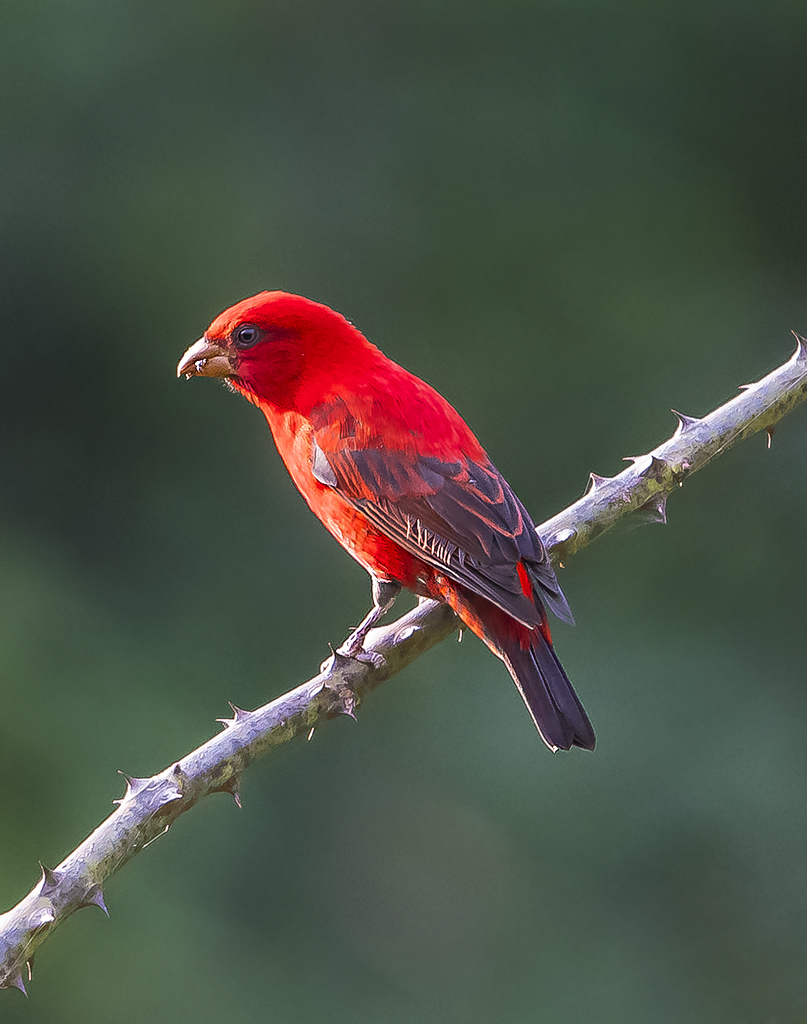
Spectacled Finch
Callacanthis burtoni
Order: Passeriformes / Family: Fringillidae

Wikimedia Commons
About the Spectacled Finch
The Spectacled Finch, scientifically known as Callacanthis burtoni, is a striking member of the finch family Fringillidae, widely recognized for its vibrant red plumage and bold white eye ring that lends it the name 'Spectacled.' Native to the mountainous regions of Asia, this bird is predominantly found in the Himalayas, spanning countries like India, Nepal, and Bhutan. The species prefers the subalpine and temperate forests, often inhabiting areas with an abundance of coniferous trees. These finches play a crucial role in their ecosystems, particularly through seed dispersal. During the breeding season, which typically occurs from April to July, Spectacled Finches are more conspicuous as they actively engage in courtship displays and nest-building activities. The elevation range for this species generally falls between 2,500 to 4,000 meters, where they find ample food and nesting materials. Ecologically, the Spectacled Finch contributes significantly to the health of its habitat by aiding in the propagation of plant species through its feeding activities. Throughout the year, the Spectacled Finch exhibits some altitudinal migration, descending to lower elevations during harsher winter months. This seasonal movement reflects their adaptation to varying food availability and climatic conditions. The presence of the Spectacled Finch often indicates a healthy forest ecosystem, as they thrive in regions with minimal habitat disturbance. Conservationists view these birds as an indicator species, meaning changes in their population could signal alterations in the environment. Despite not being globally threatened, certain localized populations face challenges due to habitat fragmentation and deforestation. The continued study of the Spectacled Finch provides valuable insights into the effects of environmental changes on high-altitude avian species.
The Spectacled Finch belongs to the family Fringillidae, within the order Passeriformes. These birds typically live average 5-7 years with a maximum recorded of 12 years..
How to Identify a Spectacled Finch
The adult Spectacled Finch exhibits a striking appearance with its vivid red plumage contrasted by a distinctive white eye ring, a key feature for identification. Males are particularly vibrant, with a deeper red hue, while females and juveniles tend to have a more subdued coloration, often appearing more olive or brownish with hints of red. The bill is robust and conical, typical of finches, designed for seed consumption. In terms of size, the Spectacled Finch is medium-sized, measuring approximately 17-19 cm in length with a wingspan of around 25-30 cm. When perched, the Spectacled Finch maintains a relatively upright posture, often showing off its bold coloration. In flight, observers may note its strong, bounding flight pattern, characterized by rapid wingbeats interspersed with short glides. This flight silhouette can sometimes lead to confusion with other sympatric finch species, such as the Crimson-winged Finch, though the latter lacks the distinctive eye ring. Juveniles, while still resembling the adults, often require careful observation to distinguish due to their more muted coloration and incomplete eye rings. During the breeding season, sexual dimorphism becomes more pronounced, aiding in gender determination from a distance.
Having trouble telling birds apart? Upload a photo to our bird identification tool for an instant species match.
Spectacled Finch Habitat and Range
Preferred Habitat
The Spectacled Finch predominantly inhabits subalpine forests, favoring areas rich in coniferous trees such as fir and pine. These habitats provide essential resources like food and nesting materials. The bird's elevation range is typically between 2,500 and 4,000 meters, where the climate remains temperate. Seasonal habitat shifts occur, with some populations moving to lower elevations during winter to escape harsh weather and find more accessible food sources. In rural settings, Spectacled Finches may venture into nearby deciduous forests and shrublands, particularly when food is scarce in their preferred habitats. Unlike some finch species, they are less commonly found in urban environments, although they may occasionally visit gardens or orchards near mountainous regions.
Geographic Range
The Spectacled Finch's range primarily covers the mountainous regions of Asia, with a stronghold in the Himalayas. It breeds across northern India, Bhutan, and Nepal, where suitable high-altitude forests are prevalent. During winter, some populations exhibit altitudinal migration, moving to lower elevations within these countries. Though not considered migratory in the traditional sense, these finches adapt to seasonal changes by relocating within their range to ensure survival. Population density hotspots include the foothills of the eastern Himalayas, where dense coniferous forests provide an ideal habitat. The Spectacled Finch is relatively uncommon in areas outside its primary range, contributing to its specialized status as a high-altitude resident.
Want to know which birds visit your area? Browse our backyard birds by location guides for region-specific species lists.
What Does the Spectacled Finch Eat?
The Spectacled Finch primarily feeds on seeds, which form the bulk of its diet throughout the year. During the breeding season, when energy demands are high, they may supplement their diet with small insects and larvae to provide necessary protein. Their foraging technique involves deftly picking seeds from the ground or directly from conifer cones, utilizing their strong, conical bills. In the winter months, seeds from deciduous trees and shrubs become more prominent in their diet as they descend to lower elevations. The Spectacled Finch typically feeds in the morning and late afternoon, taking advantage of cooler temperatures to conserve energy. They are often observed foraging in small groups, which provides some protection from predators while enabling efficient food location.
Spectacled Finch Behavior and Social Structure
Spectacled Finches exhibit a primarily social structure, often forming small flocks outside the breeding season. This flocking behavior aids in predator detection and enhances foraging efficiency. Territorial behavior is more pronounced during the breeding season, when males actively defend their chosen nesting sites through song and display. Courtship displays include flutter flights and song bouts designed to attract females. In response to predators, Spectacled Finches often rely on their agility, quickly taking cover in dense foliage. Daily activity patterns include active foraging sessions in the early morning and late afternoon, with midday often spent resting or preening. These finches communicate through a series of soft calls and songs, maintaining contact within their groups. Their social nature and adaptability to changing conditions play a crucial role in their survival in the challenging high-altitude environments they inhabit.
Spectacled Finch Nesting and Reproduction
Spectacled Finches build cup-shaped nests, typically situated in the forks of coniferous trees. They utilize a variety of materials, including twigs, grasses, and moss, to construct a secure and insulated structure. The preferred nesting sites are often located at moderate heights, providing protection from ground-based predators. A typical clutch comprises 3-4 eggs, which are incubated primarily by the female for about 12-14 days. During this period, the male plays a supportive role by providing food. Once hatched, the chicks fledge after approximately 14-18 days, although they remain dependent on parental care for some time. Spectacled Finches usually raise one brood per year, although conditions may allow for a second in particularly favorable years. Parental roles are well-defined, with both parents contributing to feeding and protecting the young.
Spectacled Finch Sounds and Vocalizations
The primary song of the Spectacled Finch is a melodious series of whistles, trills, and warbles that vary in pitch and rhythm. This song serves to establish territory and attract mates during the breeding season. Call notes are softer, often described as a gentle 'tchip' or 'chew,' used to maintain contact within flocks. Alarm calls are sharper and more insistent, designed to alert fellow finches to potential threats. During the dawn chorus, the Spectacled Finch's song blends with those of other high-altitude birds, creating a vibrant symphony that resonates through the forest. The song is reminiscent of other finches but can be distinguished by its unique tempo and clarity.
Interesting Facts About the Spectacled Finch
- 1The Spectacled Finch's striking eye ring is not just for show; it may play a role in mate selection.
- 2Despite its vivid coloration, the Spectacled Finch remains elusive in its dense forest habitat.
- 3Spectacled Finches can consume up to 40% of their body weight in seeds daily during peak foraging periods.
- 4The species is named after Francis Burton, a British naturalist who first described the bird in the 19th century.
- 5Spectacled Finches are known to hybridize with closely related finch species in some parts of their range.
- 6Their nests are often built with insulating moss, providing warmth for the eggs in colder climates.
- 7The vibrant red plumage of males is partially attributed to their diet rich in carotenoid pigments.
Spectacled Finch Conservation Status
The Spectacled Finch is currently listed as Least Concern by the IUCN, with stable population trends across its range. However, localized threats such as habitat fragmentation and deforestation pose potential risks to certain populations. Conservation efforts focus on preserving the high-altitude forests they rely on, with particular emphasis on minimizing human impact through sustainable practices. Historical population changes have been minor, though ongoing monitoring remains essential to ensure their continued stability. Efforts to protect key habitats within the Himalayas contribute significantly to the conservation of the Spectacled Finch and other species sharing the same environment.
Other Fringillidae Species


Birds Similar to the Spectacled Finch
These species are often confused with the Spectacled Finch due to similar appearance or overlapping range.