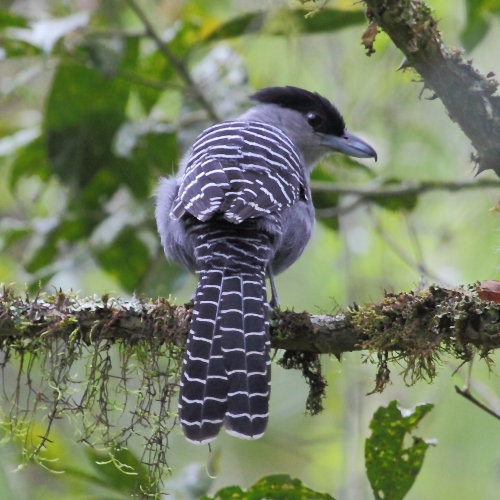
Spiny-faced Antshrike
Xenornis setifrons
Order: Passeriformes / Family: Thamnophilidae

Wikimedia Commons
About the Spiny-faced Antshrike
The Spiny-faced Antshrike, scientifically named Xenornis setifrons, is a unique member of the Thamnophilidae family. This bird finds its home in the humid and dense lowland forests of Central and South America, primarily within Panama and the northwestern parts of Colombia. Its role in the ecosystem is significant, as it helps control insect populations, maintaining a balance within its habitat. This species thrives in the understory of tropical forests, where it is often seen foraging for insects and other small invertebrates. The Spiny-faced Antshrike is an insectivorous bird that plays an essential role in its ecosystem by consuming various larvae and adult insects, thus controlling pest populations and contributing to the health of the forest.
Conservationists pay close attention to this species due to its limited range and specialized habitat requirements. The Spiny-faced Antshrike exhibits a fascinating array of behaviors throughout the year, such as forming mixed-species foraging flocks during non-breeding seasons. This seasonal behavior enhances its feeding efficiency and protection against predators. During the breeding season, it becomes more territorial and can be heard delivering its characteristic vocalizations in a display of dominance and courtship.
The Spiny-faced Antshrike's presence in the forest understory is not only a testament to its adaptability but also highlights the intricate relationships and dependencies between species in tropical ecosystems. As a sentinel species, the health of the Spiny-faced Antshrike population can often reflect the overall state of its habitat, making it a crucial subject of study for ornithologists and conservationists alike. Its existence underscores the importance of preserving these tropical forest environments, which are rich in biodiversity but increasingly threatened by deforestation and habitat degradation.
The Spiny-faced Antshrike belongs to the family Thamnophilidae, within the order Passeriformes. These birds typically live average 5-6 years, with a maximum recorded of 8 years..
How to Identify a Spiny-faced Antshrike
The adult Spiny-faced Antshrike is easily recognizable by its spiky, forward-facing facial feathers that give it a distinct appearance. This feature, coupled with its predominantly brown and black body, makes it stand out among other forest-dwelling birds. The plumage is a blend of rich browns with darker streaks, particularly on the wings and tail, providing effective camouflage in the forest understory. Males and females are similar in appearance, but subtle differences can be noted: males tend to have slightly more pronounced facial spines and a richer contrast in plumage coloration.
Juvenile Spiny-faced Antshrikes resemble adults but with less defined facial spines and a generally duller plumage, making them slightly less conspicuous. When perched, they exhibit a characteristic posture with an upright stance, often flicking their tails as they survey their surroundings for prey. In flight, their silhouette is compact and direct, lacking the undulating pattern seen in many other forest birds.
In terms of potential confusion with similar species, the Spiny-faced Antshrike's unique facial feathers and overall darker plumage pattern effectively distinguish it from other antshrikes and forest birds. Observers should note the bird's preference for remaining within the dense foliage of the lower canopy, which is a key behavioral trait when identifying this species in its natural habitat.
Having trouble telling birds apart? Upload a photo to our bird identification tool for an instant species match.
Spiny-faced Antshrike Habitat and Range
Preferred Habitat
The Spiny-faced Antshrike thrives in the humid, lowland tropical forests of Panama and northwestern Colombia. These dense forests provide ample cover and an abundance of insect prey, which is crucial for the antshrike's survival. Typically found at elevations ranging from sea level to about 1,200 meters, this bird prefers the thick understory and mid-level canopy of primary and secondary forests.
While the Spiny-faced Antshrike is primarily a forest dweller, it can occasionally be found in semi-open areas adjacent to forests, especially during the non-breeding season when it may join mixed-species flocks. Urban presence is minimal as this species relies heavily on the rich complexity of its natural forest habitat.
Seasonal shifts in habitat usage are minor, but during the wetter months, the bird may move slightly higher in elevation to avoid flooding in lowland areas. Conservation of these specific forest environments is critical to the species' survival, as it does not readily adapt to highly altered landscapes or urban settings.
Geographic Range
The Spiny-faced Antshrike has a relatively limited geographic range, confined primarily to Panama and the Chocó region of Colombia. Within Panama, it is most commonly found in the eastern part of the country, particularly in the Darien region, where expansive lowland forests provide suitable habitat.
Migration is not a significant aspect of the Spiny-faced Antshrike's life history, as it tends to be a resident species within its range. However, slight altitudinal movements may occur in response to seasonal changes in food availability or climatic conditions. The bird's population density tends to be higher in regions where primary forests remain intact, as these areas offer the dense understory and rich insect diversity the bird requires.
The absence of this species from other Central and South American countries highlights its specific habitat needs and the importance of preserving the forested regions of its home range. Efforts to protect these areas are vital for the continued existence of the Spiny-faced Antshrike and the multitude of other species that share its habitat.
Want to know which birds visit your area? Browse our backyard birds by location guides for region-specific species lists.
What Does the Spiny-faced Antshrike Eat?
The diet of the Spiny-faced Antshrike primarily consists of insects and other small invertebrates. It employs a methodical foraging technique, moving through the dense undergrowth and lower canopy with deliberate, quiet movements as it searches for prey. The bird's diet includes a variety of insects such as beetles, ants, and caterpillars, as well as spiders and other arthropods.
During the wet season, when insect populations typically increase, the Spiny-faced Antshrike may broaden its diet slightly to include a greater variety of insect species and their larvae. This seasonal abundance allows the bird to maintain its energy levels and support breeding activities. In contrast, during the drier months, the antshrike may concentrate its efforts on specific insect groups that remain available.
The Spiny-faced Antshrike forages primarily during the early morning and late afternoon, taking advantage of the cooler temperatures and peak insect activity. Its feeding strategy involves gleaning insects from leaves, branches, and the forest floor, often employing its sharp bill to extract prey from crevices and hidden spots. This efficient foraging behavior ensures that the Spiny-faced Antshrike can sustain itself even in the dense and competitive environment of the tropical forest.
Spiny-faced Antshrike Behavior and Social Structure
The Spiny-faced Antshrike exhibits a variety of intriguing behaviors that are well-adapted to its forest environment. It is generally a solitary bird, although it may form pairs during the breeding season. Outside of this period, it often joins mixed-species foraging flocks, which enhance its ability to locate food and provide collective vigilance against predators.
Territorial behavior is pronounced during the breeding season, with individuals or pairs defending their chosen area from intruders. Courtship displays involve vocalizations and subtle physical postures, where the male may showcase its distinctive facial feathers to attract a mate.
Daily activity patterns include foraging primarily during cooler parts of the day, such as early morning and late afternoon. The Spiny-faced Antshrike is known for its methodical movement through the forest understory, where it investigates potential feeding sites with precision.
In response to potential threats, the Spiny-faced Antshrike relies on its excellent camouflage and remains still, blending into the surrounding foliage. If directly threatened, it may emit alarm calls and employ evasive maneuvers to escape predators. Despite its generally solitary nature, its participation in mixed-species flocks is a testament to its adaptability and the evolutionary advantages of cooperative foraging.
Spiny-faced Antshrike Nesting and Reproduction
The Spiny-faced Antshrike constructs its nest with great care, typically placing it in the dense understory of the forest. The nest itself is cup-shaped, crafted from materials like twigs, leaves, and fine fibers, which are woven together to provide stability and concealment.
Preferred nesting locations are often low in the understory, sometimes only a meter or two above the ground, ensuring that the nest is hidden among the thick foliage. The typical clutch size for this species ranges from two to three eggs, which are incubated primarily by the female.
The incubation period lasts approximately two weeks, during which the male may assist by bringing food to the nesting female. After hatching, both parents participate in feeding and caring for the chicks, which fledge within another two to three weeks. The Spiny-faced Antshrike usually raises one brood per year, although in particularly favorable conditions, a second brood might be attempted.
The involvement of both parents in nurturing the young highlights the cooperative nature of these birds during the breeding season. The careful selection of nest sites and the use of camouflaging materials are critical to the survival of the chicks in the predator-rich environment of the tropical forest.
Spiny-faced Antshrike Sounds and Vocalizations
The primary song of the Spiny-faced Antshrike is a series of sharp, metallic notes that serve as a territorial and courtship signal. These notes are often delivered in a rapid, staccato rhythm, creating a soundscape that is both distinctive and penetrating.
In addition to its primary song, the Spiny-faced Antshrike produces a variety of call notes, including soft churring and sharper, alarm-like calls used to communicate with mates or alert to danger. These calls are often interspersed with the songs of other forest birds, creating a complex auditory environment within its habitat.
During the early morning, the Spiny-faced Antshrike participates in the dawn chorus, contributing its unique voice to the symphony of sounds that fill the forest. Its vocalizations are crucial for maintaining territory boundaries and facilitating communication between mates.
The alarm calls, in particular, are a critical component of its vocal repertoire, allowing it to warn others of potential threats while simultaneously signaling its presence in the dense forest understory.
Interesting Facts About the Spiny-faced Antshrike
- 1The Spiny-faced Antshrike is the sole member of its genus, Xenornis, making it a unique representative of its lineage.
- 2Despite its name, the Spiny-faced Antshrike does not specialize in feeding on ants, unlike some other members of its family.
- 3The facial spines of the Spiny-faced Antshrike are not only for display but may also aid in tactile foraging in dense foliage.
- 4The species was first described in 1924, and since then, it has remained a subject of interest for birdwatchers and ornithologists.
- 5The Spiny-faced Antshrike's habitat in the Chocó region is one of the most biodiverse areas on the planet, hosting numerous endemic species.
- 6This bird's presence in mixed-species flocks suggests it has evolved cooperative behaviors to enhance its survival in the competitive forest environment.
- 7The Spiny-faced Antshrike's limited range makes it a priority for conservationists working to preserve Central and South America's tropical forests.
Spiny-faced Antshrike Conservation Status
The Spiny-faced Antshrike is currently classified as Near Threatened by the IUCN due to its limited range and habitat specialization. The primary threat to this species is habitat loss, driven by deforestation and land conversion for agriculture and development. Population trends for the Spiny-faced Antshrike are concerning, with a gradual decline noted over the past several decades. Conservation efforts focus on preserving the remaining tracts of tropical forest in its range, particularly in regions like the Darien of Panama, which is a stronghold for the species. Historical population changes have been linked directly to the extent of forest cover in its range, with declines correlating with increased deforestation. Efforts by local and international conservation organizations aim to protect critical habitats, promote sustainable land-use practices, and raise awareness about the importance of conserving this and other forest-dependent species. The future of the Spiny-faced Antshrike depends on effective conservation strategies that address both the immediate threats of habitat destruction and the long-term need for sustainable management of its forest environments.