Spix's Warbling-Antbird
Hypocnemis striata
Order: Passeriformes / Family: Thamnophilidae

Wikimedia Commons
About the Spix's Warbling-Antbird
The Spix's Warbling-Antbird, scientifically known as Hypocnemis striata, is a captivating species found predominantly in the lush rainforests of the Amazon Basin. This bird is a member of the Thamnophilidae family, a group well known for their specialized ant-following behavior. The Spix's Warbling-Antbird plays a significant role in the ecosystem, particularly in its interaction with army ants. These antbirds often follow swarms of army ants, taking advantage of the insects and small vertebrates that flee from the advancing swarm. This mutualistic behavior not only aids in controlling insect populations but also demonstrates the intricate food web relationships within tropical ecosystems.
The Amazon Basin, particularly in countries like Brazil and Peru, hosts the highest concentrations of this species. Here, the Spix's Warbling-Antbird thrives in lowland tropical forests, favoring dense understory vegetation where it can forage efficiently. These birds are non-migratory, remaining in their preferred habitats year-round. During the wet season, their activity increases due to the abundance of food resources, and they become more vocal, which is primarily a breeding behavior.
Ecologically, the Spix's Warbling-Antbird serves as both predator and prey. Its diet of insects contributes to pest control, while its position as prey for larger birds and mammals exemplifies its role in maintaining the balance within the food chain. As an indicator species, this antbird's presence reflects the health of its forest habitat. Any disruptions, such as deforestation or habitat fragmentation, can significantly impact its populations, highlighting the need for conservation efforts to preserve these biodiverse regions.
The Spix's Warbling-Antbird belongs to the family Thamnophilidae, within the order Passeriformes. These birds typically live average 4-5 years with a max recorded of 8 years..
How to Identify a Spix's Warbling-Antbird
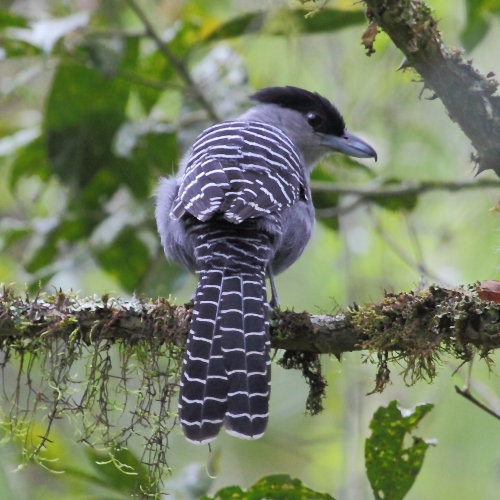
The Spix's Warbling-Antbird is easily identified by its stark black-and-white coloration. Males exhibit a black face, throat, and chest, contrasted by white eyebrows and underparts, which create a striking visual pattern. The females, while similar in size, have a more subdued color palette, with brownish tones replacing the males' black feathers, making them less conspicuous in the dense forest undergrowth. Juveniles resemble females but are generally duller, with more brownish hues throughout their plumage.
Field identification of this species requires attention to its distinctive vocalizations, often a series of melodious whistles that set it apart from similar species. The Spix's Warbling-Antbird's song is more fluid and musical compared to the harsher calls of other antbirds. When perched, these birds maintain an upright posture, often flicking their tails and wings, which can aid in their identification.
In flight, the Spix's Warbling-Antbird exhibits a characteristic short burst of rapid wingbeats followed by a glide, a flight pattern typical of many understory bird species. This style of flight, combined with their vocal activity, can assist birders in locating and confirming sightings in the dense, often visually challenging rainforest environment.
Having trouble telling birds apart? Upload a photo to our bird identification tool for an instant species match.
Spix's Warbling-Antbird Habitat and Range
Preferred Habitat
The Spix's Warbling-Antbird predominantly inhabits lowland tropical rainforests, particularly those within the Amazon Basin. These forests offer the dense, tangled understory vegetation that the species prefers for foraging and nesting. Typically found at elevations below 1000 meters, these birds are adapted to the humid, complex layers of the rainforest ecosystem.
Within these habitats, the Spix's Warbling-Antbird shows a preference for areas near watercourses and swampy regions, where insect prey is abundant. Although primarily a forest dweller, this species can sometimes be found in secondary growth areas, especially where primary forests have been disturbed. However, it tends to avoid open areas or highly urbanized regions, as it relies heavily on the forest's cover for foraging and protection. Seasonal shifts in habitat are minimal, as these birds are non-migratory and locate sufficient resources within their established territories year-round.
Geographic Range
The Spix's Warbling-Antbird is endemic to the Amazon Basin, with a range encompassing parts of Brazil, Peru, and possibly Bolivia and Colombia. This range is primarily limited to lowland rainforests within these countries, where the species finds suitable habitat conditions.
The bird does not engage in long-distance migrations, remaining within its established range throughout the year. While widespread within its range, its population density can vary significantly, often correlated with the availability of dense undergrowth and suitable foraging conditions.
Hotspots for observing the Spix's Warbling-Antbird include the Amazonian rainforests of northeastern Peru and the Brazilian states of Amazonas and Pará. These locations offer some of the most intact forest habitats, supporting robust populations of this and many other rainforest species.
Want to know which birds visit your area? Browse our backyard birds by location guides for region-specific species lists.
What Does the Spix's Warbling-Antbird Eat?
The Spix's Warbling-Antbird primarily consumes insects and arthropods, with a diet heavily influenced by its ant-following behavior. These birds capitalize on the movements of army ant swarms, capturing insects and small invertebrates that are flushed from the leaf litter as the ants advance. This foraging strategy is both efficient and opportunistic, allowing the antbird to exploit a steady food source.
Seasonal variations in diet are relatively minor, with some increase in feeding activity during the wet season when insect populations peak. The Spix's Warbling-Antbird supplements its diet with small vertebrates, such as lizards or frogs, if available. Typically, foraging occurs during daylight hours, with peak activity in the early morning and late afternoon when ambient temperatures are moderate.
The bird employs a systematic approach to foraging, often moving methodically through its territory, scanning the forest floor and undergrowth for movement. This behavior underscores its role as an active and integral predator within its ecosystem.
Spix's Warbling-Antbird Behavior and Social Structure
The social structure of the Spix's Warbling-Antbird is primarily monogamous, with pairs often remaining together throughout the year. These pairs maintain territories that they actively defend against intruders, using both vocalizations and physical displays to assert dominance. Courtship behaviors are subtle, usually involving synchronized movements and duet singing that strengthens pair bonds.
During the breeding season, the Spix's Warbling-Antbird becomes particularly vocal, with both males and females engaging in complex songs that serve to communicate territorial boundaries and attract mates. Outside of the breeding season, these birds may join mixed-species flocks, although they tend to remain on the periphery, capitalizing on feeding opportunities without engaging heavily in social interactions.
When faced with potential threats, the Spix's Warbling-Antbird relies on its cryptic coloration and dense habitat to evade predators. If alarmed, it may use a series of rapid, high-pitched calls to alert its mate or other nearby birds. This antbird is predominantly diurnal, with peak activity occurring during cooler parts of the day.
Spix's Warbling-Antbird Nesting and Reproduction
The nesting habits of the Spix's Warbling-Antbird are closely aligned with the dense forest environments they inhabit. These birds typically build their nests low in the understory, often utilizing forked branches or dense tangles of vegetation. The nest itself is a small, well-camouflaged cup constructed from twigs, leaves, and fibers, providing a secure environment for eggs and chicks.
Clutch size ranges from two to three eggs, with both parents sharing incubation duties, which last approximately 14 days. After hatching, the chicks remain in the nest for another 10 to 14 days before fledging. Parental care continues post-fledging, with both adults involved in feeding and protecting the young until they are independent.
The Spix's Warbling-Antbird typically produces one brood per year, though in optimal conditions, a second brood may be attempted. This reproductive strategy reflects the need to balance energy expenditure with the demands of raising offspring in a challenging environment.
Spix's Warbling-Antbird Sounds and Vocalizations
The Spix's Warbling-Antbird is renowned for its melodious song, a series of clear, whistled notes that rise and fall in a fluid, rhythmic pattern. This primary song serves both territorial and courtship functions and can be heard throughout the year, though it is most prominent during the breeding season.
In addition to its song, the bird produces a variety of call notes, including short, sharp chips and a distinctive alarm call that resembles a rapid, high-pitched trill. These vocalizations are integral to communication between mates and in maintaining social bonds within their territory.
During the dawn chorus, the Spix's Warbling-Antbird's song often stands out as one of the most melodious sounds in the forest, its clarity and musical quality distinguishing it from the harsher calls of other antbird species.
Interesting Facts About the Spix's Warbling-Antbird
- 1The Spix's Warbling-Antbird was named after German naturalist Johann Baptist von Spix, who explored Brazil in the early 19th century.
- 2Unlike some other antbird species, the Spix's Warbling-Antbird does not solely rely on ant swarms, showcasing a more versatile foraging strategy.
- 3Its song is considered one of the most musical among antbirds, distinguishing it in the diverse soundscape of the Amazonian rainforest.
- 4The Spix's Warbling-Antbird often joins mixed-species flocks, gaining protection and foraging benefits without direct competition.
- 5The dense understory favored by the Spix's Warbling-Antbird also provides shelter from predators, a crucial survival adaptation.
- 6This antbird species is non-migratory, emphasizing the importance of year-round habitat conservation in its native range.
- 7Despite its striking appearance, the Spix's Warbling-Antbird relies heavily on vocalizations for communication and territory defense.
Spix's Warbling-Antbird Conservation Status
The Spix's Warbling-Antbird is currently classified as Least Concern by the IUCN, with populations considered stable across its range. However, ongoing threats from deforestation and habitat fragmentation pose significant risks to its long-term survival. These activities result in the loss of critical habitat and disrupt the ecological balance necessary for the species' thriving. Conservation efforts focus on preserving large tracts of continuous rainforest and implementing sustainable land-use practices. Protected areas within the Amazon Basin play a crucial role in safeguarding the habitats of the Spix's Warbling-Antbird and other endemic species. Historical population trends have shown resilience, yet continued vigilance is essential to ensure that these birds retain their ecological niche.