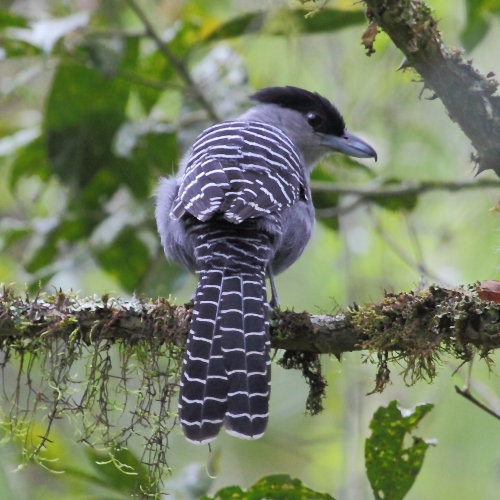
Spot-backed Antbird
Hylophylax naevius
Order: Passeriformes / Family: Thamnophilidae

Wikimedia Commons
About the Spot-backed Antbird
The Spot-backed Antbird, scientifically known as Hylophylax naevius, is a striking member of the Thamnophilidae family. This bird is predominantly found in the dense understory of lowland tropical forests across South America. With a distribution range extending from eastern Colombia and southern Venezuela through the Amazon basin of Brazil, the Spot-backed Antbird thrives in regions characterized by a lush, humid environment. This species plays a crucial role in the ecosystem as both a predator of insects and a prey item for larger avian species, contributing to the complex food web of the rainforest.
The Spot-backed Antbird is particularly significant due to its relationship with army ants. It is an opportunistic follower of these ants, capturing insects and other small creatures that flee from the advancing ant swarms. This behavior not only highlights the bird's adaptability but also its importance in maintaining insect population levels. The antbird's presence is often an indicator of healthy forest ecosystems, as it relies on dense, undisturbed habitats to thrive.
Seasonally, the Spot-backed Antbird exhibits some changes in behavior but remains largely sedentary within its range. Breeding typically occurs during the rainy season, when food resources are abundant. During this time, the bird becomes more vocal and territorial, with pairs often engaging in elaborate courtship displays. Although the species does not migrate, it may exhibit minor altitudinal movements in response to seasonal variations in food availability. The Spot-backed Antbird's preference for dense, primary forest environments underscores its vulnerability to habitat destruction, making conservation efforts critical for its continued survival.
The Spot-backed Antbird belongs to the family Thamnophilidae, within the order Passeriformes. These birds typically live estimated average 4-6 years, with limited data on maximum lifespan..
How to Identify a Spot-backed Antbird
The Spot-backed Antbird is a small, strikingly patterned bird characterized by its distinctive black and white spotted plumage. Adult birds exhibit a predominantly black body with bold white spots across the back and wings, giving the species its common name. The underparts are generally a lighter gray, and the bird possesses a slender, slightly curved bill adapted for insect foraging. Males and females display similar plumage, though females may have slightly less pronounced spotting, making sex differentiation subtle without close observation.
Juvenile Spot-backed Antbirds resemble adults but with less defined spotting and a more muted coloration overall, which helps them blend into the forest understory during their vulnerable early months. The bird's flight silhouette is compact, with rounded wings and a short tail, typical of many understory-dwelling species that require maneuverability in dense vegetation.
Potential confusion may arise with similar species such as the Scale-backed Antbird, but the Spot-backed's more pronounced white spotting and lack of scaling on the back provide a clear distinguishing feature. When perched, the Spot-backed Antbird often adopts a horizontal posture, which is typical for birds of its family, aiding in its concealment among the foliage.
Having trouble telling birds apart? Upload a photo to our bird identification tool for an instant species match.
Spot-backed Antbird Habitat and Range
Preferred Habitat
The Spot-backed Antbird predominantly inhabits the humid, lowland tropical forests of the Amazon basin. It favors primary forests with dense understory vegetation that provides ample cover and feeding opportunities. These forests are typically found at elevations ranging from sea level up to about 1,000 meters, though the bird is most common at lower elevations where the forest canopy is intact.
The bird's affinity for densely vegetated areas means it is rarely found in secondary growth or heavily disturbed habitats. Seasonal shifts in habitat use are minimal, as the Spot-backed Antbird remains largely within the same forested areas throughout the year, taking advantage of the consistent climate and food availability typical of equatorial regions.
While urban presence is virtually nonexistent, the Spot-backed Antbird may occasionally be found on the periphery of rural areas where forest edges remain intact. Its reliance on undisturbed forest makes it a poor candidate for adaptation to fragmented landscapes, highlighting the importance of preserving large tracts of contiguous habitat for its survival.
Geographic Range
The Spot-backed Antbird's range is confined to the tropical forests of South America, with a particular concentration in the Amazon basin. It is found in eastern Colombia, southern Venezuela, and through a broad swath of northern and central Brazil. Additionally, its range extends into Ecuador, Peru, and northern Bolivia, aligning with the distribution of lowland, evergreen forests.
Breeding occurs throughout its range, as the bird is non-migratory, maintaining year-round residency in suitable habitats. The Spot-backed Antbird does not engage in long-distance migration, though local movements within its range may occur in response to variations in microhabitat conditions or resource availability.
Population densities are highest in the undisturbed core areas of its range, particularly within protected reserves where habitat integrity is preserved. Areas such as the Amazonian regions of Brazil and Peru serve as population hotspots, supporting robust communities of Spot-backed Antbirds due to their extensive, contiguous forest habitats.
Want to know which birds visit your area? Browse our backyard birds by location guides for region-specific species lists.
What Does the Spot-backed Antbird Eat?
The Spot-backed Antbird primarily feeds on insects and other arthropods, which it captures through a combination of active foraging and opportunistic following of army ant swarms. Its diet consists largely of ants, beetles, spiders, and small invertebrates, which it snatches from the forest floor or low vegetation. The bird employs a technique known as 'sallying,' where it makes short, agile flights from a perch to catch prey disturbed by the ants' movement.
Seasonal changes in diet are minimal, as the Spot-backed Antbird inhabits regions with relatively stable climates and food availability. However, during the breeding season, it may increase its intake to meet the higher energy demands of raising young.
Prey size is typically small, ranging from a few millimeters to about a centimeter in length. The Spot-backed Antbird is diurnal, conducting most of its foraging during daylight hours, with peak activity in the early morning and late afternoon when insect activity is highest in the humid forest undergrowth.
Spot-backed Antbird Behavior and Social Structure
The Spot-backed Antbird is known for its solitary and secretive nature, often found alone or in pairs rather than in large flocks. Territorial behavior is pronounced, with males vigorously defending their space through song and visual displays. During the breeding season, courtship involves complex vocalizations and displays, with both members of the pair participating in duet singing to strengthen pair bonds.
This species is a follower of army ant swarms, a behavior that defines much of its foraging activity. By staying close to the moving swarms, the Spot-backed Antbird captures prey items flushed out by the ants, showcasing its adaptability and reliance on this ecological niche.
In response to predators, the Spot-backed Antbird relies on its cryptic plumage to remain undetected in the dense forest understory. It typically freezes at the approach of danger, minimizing movement to avoid detection. Daily activity patterns are predominantly diurnal, with heightened activity during cooler parts of the day.
Spot-backed Antbird Nesting and Reproduction
The Spot-backed Antbird constructs a cup-shaped nest, typically located low in the understory of dense tropical forests. Nest materials consist of leaves, twigs, and other plant fibers, intricately woven to provide stability and camouflage. Nests are often placed in forked branches or on a stable support that offers concealment from predators.
Clutch size generally consists of two eggs, which are incubated primarily by the female, though the male may assist occasionally. The incubation period lasts around 14 to 16 days, followed by a fledging period of approximately 10 to 12 days during which both parents participate in feeding and caring for the young.
The Spot-backed Antbird typically raises one brood per year, though in favorable conditions, a second brood may be attempted. Parental roles are shared, with both parents involved in feeding and protecting the chicks until they are self-sufficient.
Spot-backed Antbird Sounds and Vocalizations
The primary song of the Spot-backed Antbird is a series of short, sharp notes delivered in rapid succession, often described as a 'chick-chick-chick' sound. This rhythmic vocalization serves both to establish territory and communicate with mates.
In addition to its primary song, the Spot-backed Antbird produces a variety of call notes, including soft whistles and harsh, chattering sounds used in close contact communication. Alarm calls are sharp and piercing, alerting others to potential threats in the vicinity.
During the early morning hours, the Spot-backed Antbird participates in the dawn chorus, contributing its distinct vocalizations to the ambient soundscape of the forest. The bird's calls are often compared to a woodpecker's drumming in their rapid repetition and tonal quality.
Interesting Facts About the Spot-backed Antbird
- 1The Spot-backed Antbird's scientific name, Hylophylax naevius, reflects its forest habitat and distinctive spotted appearance.
- 2This species is one of the many 'ant-followers,' relying on army ants to flush out prey, a fascinating ecological partnership.
- 3Spot-backed Antbirds can be remarkably elusive, often heard more frequently than seen, due to their secretive nature.
- 4Their distinctive spotted plumage provides effective camouflage amidst the dappled light of the forest understory.
- 5Unlike many birds, Spot-backed Antbirds do not undergo seasonal migrations, remaining in their tropical habitats year-round.
- 6The Spot-backed Antbird is a keystone species, indicating healthy forest ecosystems where it thrives.
- 7These birds are primarily found in the Amazon basin, one of the world's most biodiverse regions.
Spot-backed Antbird Conservation Status
The Spot-backed Antbird is currently listed as Least Concern by the IUCN, with populations considered stable across much of its range. However, its reliance on primary forest habitats makes it vulnerable to deforestation and habitat fragmentation, which pose significant threats. Conservation efforts focus on protecting large tracts of rainforest and establishing protected areas that ensure the preservation of habitat integrity. Initiatives to curb illegal logging and land conversion for agriculture are critical to maintaining viable populations of this species. Historically, the Spot-backed Antbird has maintained a relatively stable population, though local declines may occur in areas experiencing severe habitat degradation. Continuous monitoring and habitat conservation remain vital to safeguard its future.