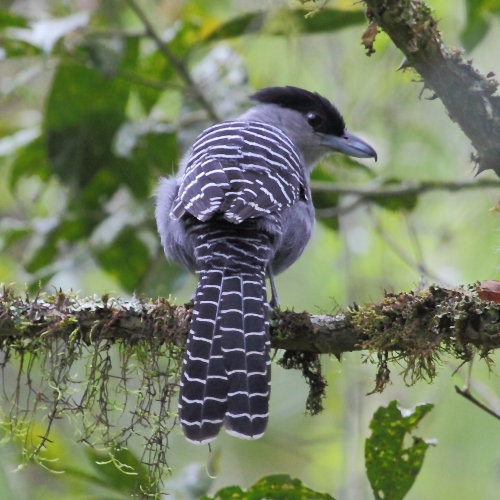
Spot-crowned Antvireo
Dysithamnus puncticeps
Order: Passeriformes / Family: Thamnophilidae

Wikimedia Commons
About the Spot-crowned Antvireo
The Spot-crowned Antvireo, scientifically known as Dysithamnus puncticeps, is a small passerine bird belonging to the family Thamnophilidae. Renowned for its distinctive spotted crown, this bird inhabits the subtropical and tropical moist lowland forests of Central and South America. The bird's range extends from Honduras through Nicaragua, Costa Rica, and Panama to the northern parts of Colombia and Ecuador. Its role in the ecosystem is vital as it helps in controlling insect populations, thus maintaining ecological balance. The Spot-crowned Antvireo prefers dense understory vegetation where it can forage undisturbed. During the breeding season, which varies across its range but generally occurs in the wetter months, the bird becomes more vocal and active in defending its territory. Its presence is an important indicator of forest health, as it thrives in undisturbed habitats. The bird's ecological significance extends beyond its immediate environment as it participates in mixed-species feeding flocks, providing a link between various avian species within its habitat. As a resident species, the Spot-crowned Antvireo does not migrate, making its study crucial for understanding the impacts of habitat fragmentation and climate change on resident tropical birds. Despite its small size, it plays a significant role in seed dispersal and pest control, thereby contributing to the forest's regeneration processes. Its preference for uninterrupted forest tracts makes it susceptible to habitat destruction, highlighting the need for conservation efforts in its native range.
The Spot-crowned Antvireo belongs to the family Thamnophilidae, within the order Passeriformes. These birds typically live average 4-6 years, with a max recorded of 8 years..
How to Identify a Spot-crowned Antvireo
The Spot-crowned Antvireo is a small bird, measuring about 11 cm in length, with a weight of approximately 13 grams. Its plumage features a grayish hue with subtle differences between males and females. Males display a more pronounced gray with a distinctive white-spotted crown, which gives the species its name. Females, on the other hand, show a slightly browner tone with similar crown markings, but less conspicuous. Juvenile birds resemble females but with a more muted overall coloration. In flight, the Spot-crowned Antvireo exhibits a moderately rounded wing shape and a short tail, contributing to its agile maneuvers through dense foliage. When perched, its posture is upright, often seen clinging to vertical branches or vines. This posture allows for quick movements, essential for its insectivorous diet. Differentiating it from similar species, such as the Checker-throated Antwren, involves careful observation of its crown and size, as the antwren lacks the distinctive spotting. The Spot-crowned Antvireo's call and habitat preference also aid identification, as it is more commonly found in the understory compared to some sympatric species.
Having trouble telling birds apart? Upload a photo to our bird identification tool for an instant species match.
Spot-crowned Antvireo Habitat and Range
Preferred Habitat
The Spot-crowned Antvireo thrives in subtropical and tropical moist lowland forests. It prefers the dense understory and edge habitats where it can forage efficiently. This species is typically found at elevations ranging from sea level to 1,500 meters, with occasional reports as high as 2,000 meters. Seasonal shifts in habitat use are minimal, as this bird is non-migratory and remains within its range year-round. Urban presence is rare, primarily due to its reliance on intact forest ecosystems. In regions like Costa Rica and Panama, the Spot-crowned Antvireo often inhabits protected areas such as national parks and reserves, benefiting from conservation efforts that preserve its natural habitat. The bird's dependence on dense, mature forest understory makes it vulnerable to habitat fragmentation, emphasizing the importance of maintaining continuous forest corridors for its survival.
Geographic Range
The Spot-crowned Antvireo's range is largely confined to Central and parts of northern South America. It is found from Honduras in the north, continuing through Nicaragua, Costa Rica, and Panama, and extending into the northern reaches of Colombia and Ecuador. The bird's distribution is relatively stable, as it is a resident species that does not partake in long-distance migrations. However, within its range, it may exhibit altitudinal movements in response to seasonal variations in food availability. Population densities are highest in undisturbed forested areas, with notable hotspots in Costa Rica's Osa Peninsula and Panama's Darién region. Conservation areas within these countries often serve as crucial refuges, providing the necessary habitat conditions for sustaining viable populations. Despite being non-migratory, the Spot-crowned Antvireo's presence in these regions underscores the importance of international conservation efforts, as its range traverses several national boundaries.
Want to know which birds visit your area? Browse our backyard birds by location guides for region-specific species lists.
What Does the Spot-crowned Antvireo Eat?
The Spot-crowned Antvireo primarily feeds on insects and other arthropods. Its diet consists of ants, beetles, spiders, and caterpillars, which it actively gleans from leaves and twigs in the dense understory. Foraging involves a combination of short flights and agile hops as the bird navigates through foliage to catch prey. Seasonal variations in diet are minimal, although during the wetter months, the abundance of insects may lead to increased feeding activity. The bird's foraging technique is precise and methodical, often involving close inspection of leaves and branches. It typically feeds alone or in pairs, although it frequently joins mixed-species flocks to exploit feeding opportunities. Prey size is usually small, as the bird's diminutive stature limits its ability to handle larger insects. The Spot-crowned Antvireo is diurnal, with feeding activity peaking during the early morning and late afternoon when insect activity is highest.
Spot-crowned Antvireo Behavior and Social Structure
The Spot-crowned Antvireo exhibits a complex social structure. While often seen alone or in pairs, it frequently participates in mixed-species flocks, enhancing its foraging efficiency and predator avoidance. Territorial behavior is pronounced during breeding, with both sexes actively defending their chosen area. Courtship displays involve vocalizations and subtle posturing by the male to attract a mate. The bird's response to predators includes remaining motionless and silent, relying on its cryptic plumage to avoid detection. Daily activity patterns show peaks in the early morning and late afternoon, coinciding with the highest availability of insects. During non-breeding periods, the Spot-crowned Antvireo maintains a more relaxed territorial approach, occasionally overlapping with other individuals in foraging areas. Flocking patterns provide insights into its adaptability and social interactions, as it blends seamlessly into groups of other insectivorous birds, benefiting from the communal vigilance against predators.
Spot-crowned Antvireo Nesting and Reproduction
The Spot-crowned Antvireo constructs a delicate cup-shaped nest, typically placed in the fork of a small tree or shrub within the dense understory. Nest materials include fine twigs, leaves, spider webs, and moss, providing camouflage and structural integrity. The female lays a clutch of two eggs, which she incubates for approximately 14 days. During this period, the male assists by providing food and defending the nest site. Upon hatching, both parents participate in feeding and caring for the chicks, which fledge after about 12 to 14 days. The Spot-crowned Antvireo usually raises one brood per year, although in areas with extended favorable conditions, a second brood is possible. Parental roles are well-defined, with the female primarily responsible for incubation and brooding, while the male focuses on provisioning and protection. The dependence of fledglings on parental care extends for several weeks post-fledging, ensuring their survival in the challenging forest environment.
Spot-crowned Antvireo Sounds and Vocalizations
The Spot-crowned Antvireo's primary song consists of a series of sharp, metallic notes, often described as 'tik' or 'tsip,' delivered in quick succession. This song serves both territorial and mate attraction purposes. Its call notes are softer, often given during foraging or when joining mixed-species flocks. Alarm calls are more abrupt and higher-pitched, indicating the presence of predators. The bird participates in the dawn chorus, contributing to the symphony of sounds that characterize its forest habitat. The vocalizations of the Spot-crowned Antvireo, while not as melodious as some other songbirds, are distinctive and serve as a reliable identification tool in the dense undergrowth where it resides.
Interesting Facts About the Spot-crowned Antvireo
- 1Despite its small size, the Spot-crowned Antvireo plays a critical role in its ecosystem by controlling insect populations.
- 2The bird's distinctive spotted crown is not only for show; it serves as a key identifier among closely related species.
- 3The Spot-crowned Antvireo is often found in mixed-species flocks, demonstrating its adaptability and social nature.
- 4Its non-migratory nature makes the Spot-crowned Antvireo an excellent indicator species for forest health.
- 5The bird uses spider webs in its nest construction, showcasing its resourcefulness and adaptability in material selection.
- 6The Spot-crowned Antvireo's call is less melodious than some, yet it remains a critical tool for communication and territory defense.
- 7With a territory often shared with other species, this bird exemplifies the intricate balance of tropical forest ecosystems.
Spot-crowned Antvireo Conservation Status
The Spot-crowned Antvireo is currently listed as Least Concern by the IUCN, indicating a stable population trend. However, its habitat is increasingly threatened by deforestation and land conversion for agriculture. Conservation efforts focus on protecting large tracts of forest within its range, particularly in Costa Rica and Panama. Historical population data suggests stability, but ongoing habitat destruction could alter this trend. Initiatives aimed at preserving primary forests and creating connected habitat corridors are crucial for ensuring the long-term survival of this species. Research into its ecological role further highlights the importance of maintaining diverse and intact ecosystems for the benefit of this and other forest-dependent species.