Spot-tailed Antwren
Herpsilochmus sticturus
Order: Passeriformes / Family: Thamnophilidae

Wikimedia Commons
About the Spot-tailed Antwren
The Spot-tailed Antwren (Herpsilochmus sticturus) is a diminutive bird of the Thamnophilidae family, inhabiting the dense tropical forests of the Amazon basin. It is widely distributed across regions of northern Brazil, southern Venezuela, and parts of Colombia and Peru. This bird plays a crucial role in the ecosystem as part of the complex avian community that inhabits the understory and mid-levels of these biodiverse habitats. It primarily consumes insects, thus contributing to insect population control within its range.
The ecological significance of the Spot-tailed Antwren extends beyond its trophic interactions. As an insectivore, it participates in the intricate web of predator-prey relationships that maintain the equilibrium of its environment. This bird often forages in mixed-species flocks, a behavior that enhances foraging efficiency and provides protection against predators. These flocks are a testament to the complex social structures present in these ecosystems, illustrating the interconnectedness of Amazonian wildlife.
Despite its small size, the Spot-tailed Antwren is a resilient species adapted to the dynamic conditions of tropical forests. Seasonal changes affect its behavior, particularly during the wet season when insect abundance increases, leading to heightened foraging activity. Nesting typically occurs during the drier months, allowing for optimal conditions for raising young. The Spot-tailed Antwren is also noted for its role as an indicator species, reflecting the health of its forest habitat. Its presence and population trends can provide insights into the broader environmental changes occurring within the Amazon basin.
The Spot-tailed Antwren belongs to the family Thamnophilidae, within the order Passeriformes. These birds typically live average 3-5 years with a maximum recorded of 7 years..
How to Identify a Spot-tailed Antwren
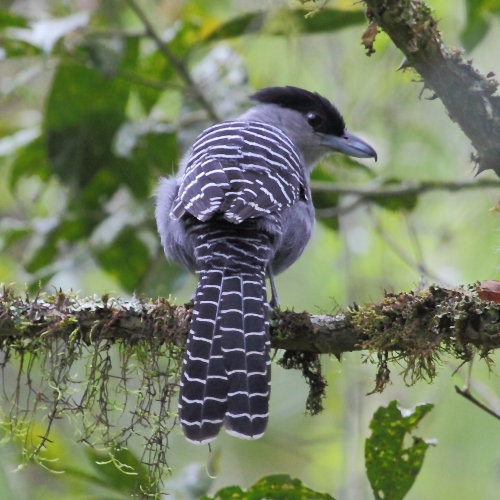
The Spot-tailed Antwren is easily identified by its small size, approximately 11 cm in length, and its distinctive tail pattern. Adults boast a grayish plumage with a white throat and a blackish crown. The most striking feature is the tail, which exhibits white spots against a dark background, visible even when the bird is perched. This tail pattern sets it apart from similar species within its range.
Males and females display subtle differences; males have more pronounced black markings on their faces and crowns, while females exhibit a slightly browner hue on their upperparts. Juveniles resemble adults but often have less distinct tail spots and a browner overall appearance.
In flight, the Spot-tailed Antwren appears agile and quick, with a tendency to flit between branches rather than engage in sustained flight. When perched, it maintains an upright posture, often flicking its tail to reveal the characteristic spotting. This behavior, combined with its vocalizations, makes it identifiable even in the dense forest understory.
Having trouble telling birds apart? Upload a photo to our bird identification tool for an instant species match.
Spot-tailed Antwren Habitat and Range
Preferred Habitat
The Spot-tailed Antwren thrives in tropical lowland forests, particularly within the Amazon basin. It favors dense understory and mid-story vegetation, where it can forage and nest with relative safety from predators. These birds are typically found at elevations below 500 meters, where the forest canopy provides optimal conditions for their lifestyle.
Seasonally, the Spot-tailed Antwren may adjust its habitat preferences slightly, moving to areas with denser foliage during wetter months to exploit the increased insect populations. Although primarily a forest bird, it is occasionally observed in secondary growth areas and forest edges, indicating some degree of habitat flexibility. Unlike some avian species, the Spot-tailed Antwren is rarely encountered in urban environments, preferring the seclusion of undisturbed forest habitats.
Geographic Range
The Spot-tailed Antwren's range is largely confined to the Amazon basin, covering parts of northern Brazil, southern Venezuela, eastern Colombia, and northern Peru. This distribution aligns with the vast expanses of tropical rainforest that dominate these regions. The bird's range is primarily non-migratory, as the stable climate and abundant resources of the Amazon provide year-round sustenance.
Within its range, population densities vary, with higher concentrations observed in regions where the forest remains largely intact and undisturbed by human activity. Despite its extensive range, the Spot-tailed Antwren is less commonly found in heavily deforested areas or regions subjected to severe habitat fragmentation. Conservation of its habitat is crucial to maintaining the species' current distribution and population stability.
Want to know which birds visit your area? Browse our backyard birds by location guides for region-specific species lists.
What Does the Spot-tailed Antwren Eat?
The Spot-tailed Antwren primarily feeds on a variety of insects and other arthropods, playing a critical role in controlling insect populations within its habitat. Its diet includes ants, beetles, spiders, and caterpillars, which it gleans from foliage and branches in the forest understory.
Foraging behavior consists of agile movements through dense vegetation, where the bird uses its sharp eyesight to locate prey. The Spot-tailed Antwren often participates in mixed-species foraging flocks, which increases its foraging efficiency by reducing competition and enhancing predator vigilance.
Seasonal changes influence its diet, with a noticeable increase in foraging activity during the wet season when insect abundance peaks. This increased activity ensures adequate nutrition for breeding and feeding young, aligning with the ecological rhythms of its tropical environment.
Spot-tailed Antwren Behavior and Social Structure
The Spot-tailed Antwren exhibits a range of behaviors that reflect its adaptation to a forested lifestyle. It often joins mixed-species flocks, which provide safety in numbers and increase foraging success. This social structure is vital for avoiding predators and efficiently exploiting food resources.
Territorial behavior is less pronounced in this species, as the dense forest understory offers ample resources and space. However, during the breeding season, pairs may become more territorial, defending their nesting area from intruders. Courtship displays are subtle, involving vocalizations and mutual preening, which strengthen pair bonds.
Daily activity patterns include periods of intense foraging interspersed with rest and preening. The Spot-tailed Antwren is diurnal, with peak activity occurring in the early morning and late afternoon. When faced with potential threats, it relies on its small size and agility to escape, often retreating into thicker foliage.
Spot-tailed Antwren Nesting and Reproduction
The Spot-tailed Antwren constructs a delicate cup-shaped nest, typically placed in the fork of a tree or shrub within the dense understory. Nest materials include fine twigs, leaves, and spider silk, which provide both structure and camouflage.
Clutch size generally ranges from two to three eggs, which are incubated by both parents for approximately 14 days. The cooperative approach to incubation and chick rearing ensures higher survival rates for offspring in the challenging forest environment.
Fledging occurs around 12-14 days post-hatching, with both parents active in feeding and protecting the young. While the species may attempt multiple broods per year, this largely depends on food availability and environmental conditions, with most successful nesting occurring during the drier season.
Spot-tailed Antwren Sounds and Vocalizations
The Spot-tailed Antwren's primary song is a series of high-pitched, rapid notes that crescendo into a trill, lasting several seconds. This song serves to maintain contact with flock members and assert presence within its territory.
Call notes are typically sharp and metallic, often described as 'tik' or 'tseet' sounds, used in communication between mates and during foraging. Alarm calls are more abrupt and harsh, signaling potential threats to nearby birds.
During the dawn chorus, the Spot-tailed Antwren joins in with other forest species, contributing to the symphony of sounds that characterize the Amazonian morning. Its vocalizations, while not as varied as some songbirds, play a crucial role in its social interactions and survival.
Interesting Facts About the Spot-tailed Antwren
- 1The Spot-tailed Antwren is named for its distinctive tail pattern, which helps differentiate it from other antwrens.
- 2Despite its small size, the Spot-tailed Antwren is an integral part of mixed-species foraging flocks in the Amazon.
- 3Spot-tailed Antwrens exhibit sexual dimorphism, with males displaying more pronounced facial markings.
- 4These birds use spider silk in nest construction, providing both strength and camouflage to their nests.
- 5The Spot-tailed Antwren's song, a rapid series of high-pitched notes, is a distinctive sound in its dense forest habitat.
- 6The species is non-migratory, relying on the rich, stable environment of the Amazon basin for year-round sustenance.
- 7Spot-tailed Antwrens play a crucial role in insect population control, consuming a range of arthropods.
Spot-tailed Antwren Conservation Status
Currently, the Spot-tailed Antwren is classified as Least Concern by the IUCN, with a stable population trend. However, ongoing threats such as deforestation and habitat degradation pose significant risks to its long-term survival. Conservation efforts within the Amazon basin focus on habitat preservation and sustainable land-use practices to mitigate these threats. Protected areas and reserves provide crucial refuges for the Spot-tailed Antwren and other forest-dependent species. While historical population changes are not well-documented, continued monitoring is essential to detect potential declines. Conservation strategies prioritize maintaining large, contiguous tracts of forest and promoting biodiversity to ensure the resilience of avian communities.