Spot-winged Antbird
Schistocichla leucostigma
Order: Passeriformes / Family: Thamnophilidae

Wikimedia Commons
About the Spot-winged Antbird
The Spot-winged Antbird, scientifically known as Schistocichla leucostigma, is a small, elusive bird that plays a significant role in the ecosystem of the Amazon Basin. Found primarily in dense tropical forests of South America, this bird is an integral part of the Thamnophilidae family. Its presence is noteworthy across regions such as Brazil, Peru, Ecuador, and Colombia. The Spot-winged Antbird thrives in lowland rainforests, particularly in areas with dense understory vegetation. This habitat preference supports its primary feeding method as it follows swarms of army ants to catch insects and other small invertebrates disturbed by the ants. The bird's ecological role is critical as it helps control insect populations and contributes to the forest's biodiversity.
The significance of the Spot-winged Antbird extends beyond its ecological contributions. As a forest indicator species, its presence or absence can provide important information about forest health and biodiversity. The Spot-winged Antbird is a non-migratory species, maintaining territories throughout the year. This territorial behavior ensures that the bird has consistent access to food resources.
Spot-winged Antbirds are social creatures that often form small, loose groups, especially during feeding. However, they can also be seen foraging alone or in pairs during the breeding season. The bird's interactions with its environment and other species highlight its importance within the complex web of tropical forest ecosystems. While the Spot-winged Antbird does not undertake long migrations, it may exhibit local movements in response to food availability or habitat changes. Understanding these patterns can offer insights into broader ecological dynamics within its habitat.
In terms of conservation, the Spot-winged Antbird benefits from the protection of its natural habitats, as large swathes of the Amazon are designated as protected areas. However, deforestation and habitat fragmentation pose significant threats to its population. Efforts to conserve tropical forests directly impact the survival of this species, underscoring the interconnectedness of conservation initiatives and wildlife protection.
The Spot-winged Antbird belongs to the family Thamnophilidae, within the order Passeriformes. These birds typically live average 4-6 years with a maximum recorded of 8 years..
How to Identify a Spot-winged Antbird
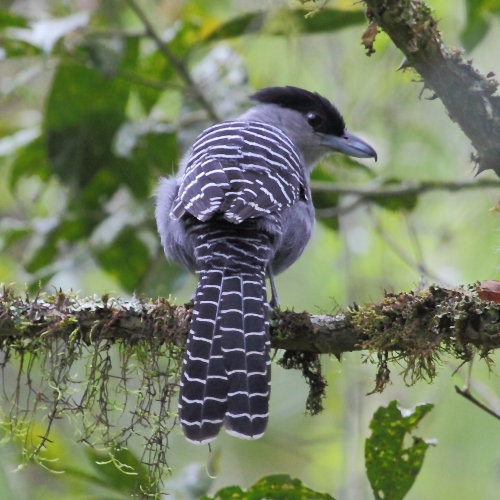
The Spot-winged Antbird is a medium-sized bird, measuring approximately 13 to 14 cm in length. Adult males exhibit a striking plumage with black feathers and prominent white spots on their wings, from which the bird derives its common name. Their underparts are primarily gray, adding to their subtle yet distinctive appearance. Females, on the other hand, have similar wing spotting, but their plumage tends to be more brownish in tone, providing a slight sexual dimorphism in color that helps in identification.
Juvenile Spot-winged Antbirds resemble the adult females but often have less defined wing spots and a generally duller plumage. This subtlety in markings can sometimes make it challenging to differentiate them from other antbird species in the field. The bird's flight is typically low and fast, skimming just above the forest floor, which is characteristic of antbirds adapted to dense forest environments. When perched, the Spot-winged Antbird often adopts a horizontal posture, keeping its body parallel to branches, which helps it remain inconspicuous.
Spot-winged Antbirds can be confused with similar species like the White-lined Antbird. However, close attention to the wing spotting and the bird's vocalizations can aid in accurate identification. The Spot-winged Antbird's distinct calls and songs are unique identifiers among the diverse avian community in its habitat.
Having trouble telling birds apart? Upload a photo to our bird identification tool for an instant species match.
Spot-winged Antbird Habitat and Range
Preferred Habitat
The Spot-winged Antbird resides predominantly in the humid lowland forests of the Amazon Basin. It favors areas with dense understory vegetation, which provides ample cover and foraging opportunities. These birds are typically found at elevations below 1,000 meters, where the forest canopy remains relatively intact. While primarily associated with mature forests, the Spot-winged Antbird can also adapt to secondary growth forests, provided there is sufficient underbrush.
During different seasons, the Spot-winged Antbird does not exhibit significant habitat shifts, maintaining a strong preference for dense, tropical forest environments year-round. Unlike some forest birds, it is rarely found in urban settings or open landscapes, emphasizing its reliance on continuous forest cover.
The bird's habitat preferences highlight the importance of intact forest ecosystems for its survival. Conservation of these habitats is critical, as deforestation and habitat fragmentation pose substantial threats to its population.
Geographic Range
The Spot-winged Antbird's range spans a significant portion of the northern and central Amazon Basin. It is primarily found in Brazil, with populations extending into Peru, Ecuador, Colombia, and occasionally in Bolivia. This species favors lowland tropical rainforests, where it occupies territories that provide abundant food resources and suitable nesting sites.
Unlike many migratory birds, the Spot-winged Antbird is largely sedentary, residing in its chosen habitats throughout the year. This lack of migration is typical for many Amazonian birds, which find stable resources within the consistent climate of their forests. However, local movements in response to food availability or environmental changes can occur within its range.
The highest population densities of the Spot-winged Antbird are typically found in areas with minimal human disturbance, where the forest remains largely intact. This distribution pattern underscores the importance of preserving large tracts of continuous forest to maintain healthy populations of this and similar species.
Want to know which birds visit your area? Browse our backyard birds by location guides for region-specific species lists.
What Does the Spot-winged Antbird Eat?
The Spot-winged Antbird primarily feeds on insects and other small invertebrates, utilizing a specialized foraging technique known as 'ant-following.' This involves trailing swarms of army ants and capturing prey items that flee from the advancing ants. This opportunistic feeding strategy allows the Spot-winged Antbird to access a rich and varied food supply.
The bird's diet shifts slightly with seasonal changes in prey availability, but it consistently relies on ants, beetles, spiders, and other arthropods. During periods of scarcity, it may also consume small fruits or seeds, although these make up a minor portion of its diet.
The Spot-winged Antbird is typically active during the day, with peak foraging activity occurring in the early morning and late afternoon. This schedule coincides with the movements of army ants, which are most active during these times. The bird's keen sense of sight and hearing aids in detecting and capturing prey efficiently in the dim understory light.
Spot-winged Antbird Behavior and Social Structure
The Spot-winged Antbird exhibits a range of behaviors that reflect its adaptation to life in dense tropical forests. It is generally a solitary or pair-living bird, particularly during the breeding season, when pairs establish and defend territories. These territories are marked by vocal displays and occasional physical confrontations with intruders.
During the non-breeding season, Spot-winged Antbirds may join mixed-species flocks, although they retain a degree of independence in their foraging activities. This behavior allows them to exploit available resources while reducing the risk of predation.
Courtship is marked by vocalizations and subtle displays, with males performing quiet songs to attract females. The Spot-winged Antbird is known for its alertness and quick response to potential threats, often retreating into the dense underbrush at the first hint of danger. Their daily activity patterns are closely tied to the availability of food sources, with most activity occurring during daylight hours.
Spot-winged Antbird Nesting and Reproduction
Spot-winged Antbirds construct their nests in hidden locations close to the ground within dense foliage. The nest is typically a cup-shaped structure made from leaves, grasses, and twigs, carefully woven together to provide camouflage and protection from predators. Preferred nest sites are often situated in shrubs or thickets, offering additional concealment.
The breeding season for Spot-winged Antbirds varies slightly depending on the region but generally aligns with the rainy season, when food resources are abundant. Clutch size is usually two to three eggs, which are incubated by both parents over a period of 14 to 16 days. The involvement of both parents in incubation and feeding ensures a higher chance of fledgling success.
After hatching, the chicks remain in the nest for another 10 to 12 days before fledging. The parents continue to care for the young birds for several weeks post-fledging, teaching them essential foraging and survival skills. Spot-winged Antbirds typically raise one to two broods per year, depending on environmental conditions and food availability.
Spot-winged Antbird Sounds and Vocalizations
The primary song of the Spot-winged Antbird is a melodious series of whistles and chirps, characterized by a rising and falling rhythm. These vocalizations play crucial roles in communication, particularly in territorial defense and courtship. The song's pitch is moderate, with a clear and somewhat plaintive quality that can carry through the dense forest.
In addition to its primary song, the Spot-winged Antbird produces a variety of call notes, including short chips and trills, used for maintaining contact with mates or signaling alarm. Alarm calls are sharper and more rapid, often eliciting a response from nearby conspecifics. During the dawn chorus, the Spot-winged Antbird's song is more frequent, contributing to the overall soundscape of the tropical forest.
Interesting Facts About the Spot-winged Antbird
- 1Spot-winged Antbirds are one of the few bird species that specialize in following army ant swarms to capture prey.
- 2The bird's distinctive white wing spots are not just for show-they play a role in species recognition among antbirds.
- 3Spot-winged Antbirds are known to occasionally forage with mixed-species flocks, enhancing their access to diverse food sources.
- 4Despite their small size, Spot-winged Antbirds are highly territorial and will defend their space aggressively against intruders.
- 5The species' preference for dense understories makes it a challenging subject for birdwatchers aiming to spot one in its natural habitat.
Spot-winged Antbird Conservation Status
The Spot-winged Antbird is currently classified as Least Concern by the IUCN, owing to its relatively stable population across a broad range. However, it faces mounting threats from habitat loss due to deforestation and land conversion for agriculture and mining. These activities lead to habitat fragmentation, which can adversely affect local populations by isolating groups and reducing genetic diversity. Conservation efforts for the Spot-winged Antbird are closely tied to broader initiatives aimed at preserving the Amazon rainforest. Protected areas and national parks play a vital role in safeguarding the bird's habitat. Continued monitoring of population trends and habitat health is essential to anticipate potential declines. Historically, the Spot-winged Antbird's population has remained stable, largely due to the expansive and relatively undisturbed nature of its habitat. However, ongoing environmental pressures necessitate proactive conservation strategies to ensure the species' long-term survival.