
Stripe-backed Antbird
Myrmorchilus strigilatus
Order: Passeriformes / Family: Thamnophilidae

Wikimedia Commons
About the Stripe-backed Antbird
The Stripe-backed Antbird, scientifically known as Myrmorchilus strigilatus, is a captivating bird native to the lush tropical forests of South America. This species belongs to the family Thamnophilidae, a group renowned for their specialized ant-following behaviors. The Stripe-backed Antbird holds a significant place in the ecosystem, playing a crucial role in controlling insect populations. Found primarily in countries like Brazil, Colombia, and Venezuela, this bird is often seen in the underbrush of lowland forests and dense shrubbery, particularly in areas rich with leaf litter and decaying wood. Its presence is most notable in the Amazon Basin, where it contributes to the biodiversity and the intricate food web of the region. Unlike many other antbirds, Myrmorchilus strigilatus is a year-round resident, showing little to no migratory behavior. The bird's life cycle revolves around the availability of its primary food source: ants and other small invertebrates. During the wet season, its activity levels peak as insect populations surge, providing ample feeding opportunities. In contrast, the dry season sees a slight shift in behavior, with the Stripe-backed Antbird foraging more extensively to locate adequate food. The Stripe-backed Antbird's ecological role extends beyond its diet. By preying on insects, it indirectly aids in the decomposition process, accelerating nutrient cycling within its habitat. This interaction underscores the bird's importance in maintaining the health and stability of the forest ecosystem. Its presence often indicates a robust, functioning forest environment, as it relies on the dense, undisturbed undergrowth typical of mature tropical forests.
The Stripe-backed Antbird belongs to the family Thamnophilidae, within the order Passeriformes. These birds typically live average 4-6 years with a maximum recorded of 9 years..
How to Identify a Stripe-backed Antbird
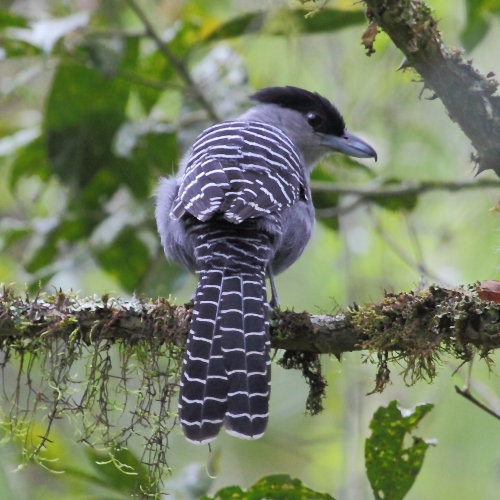
The Stripe-backed Antbird is a medium-sized bird, measuring approximately 16 cm in length. Its most distinguishing feature is the bold black and white striping on its back, which provides excellent camouflage among the dappled light and shadow of the forest floor. The plumage of the male and female are similar, though the male typically exhibits slightly more pronounced striping. Both sexes have a white throat and breast, contrasting with their darker wings and tail, which feature subtle white barring. Juvenile Stripe-backed Antbirds differ from adults in their less distinct striping and overall duller coloration, an adaptation that likely aids in avoiding predators. When in flight, their silhouette is compact, with short, rounded wings and a slightly rounded tail. This configuration enables agile maneuvering through thick vegetation. Perched, they maintain an upright posture, often seen clinging to vertical branches or stems as they survey their surroundings. While confusion with other antbird species is possible, the Stripe-backed Antbird's unique back pattern and vocalizations usually help distinguish it in the field.
Having trouble telling birds apart? Upload a photo to our bird identification tool for an instant species match.
Stripe-backed Antbird Habitat and Range
Preferred Habitat
The Stripe-backed Antbird thrives in the dense undergrowth of tropical lowland forests, favoring areas with thick leaf litter and abundant woody debris. It is predominantly found in the Amazon Basin, where vast expanses of uninterrupted forest provide ideal conditions. The bird prefers elevations up to 800 meters, although it is most commonly observed at lower elevations. Unlike some forest-dwelling birds, the Stripe-backed Antbird shows little inclination to enter urban or heavily disturbed areas, emphasizing its reliance on pristine forest habitats. Seasonal habitat shifts are minimal due to its resident nature, though it may adjust its microhabitat preference slightly in response to seasonal changes in food availability. The bird is absent from open areas such as savannas and grasslands, underscoring its dependence on dense, continuous canopy cover.
Geographic Range
The Stripe-backed Antbird's range is primarily within the tropical forests of northern South America. It is prominently found in Brazil, particularly within the expansive Amazon rainforest, as well as in Colombia and Venezuela. The bird's distribution is largely associated with the Amazon Basin, where the vast stretches of undisturbed rainforest provide ideal conditions for its lifestyle. This species does not engage in long-distance migration, maintaining a stable presence across its range throughout the year. Population density hotspots include areas of rich, undisturbed primary forest, where the bird's specialized feeding habits can be fully supported. Its presence in regions with significant deforestation is limited, highlighting the impact of habitat destruction on its distribution.
Want to know which birds visit your area? Browse our backyard birds by location guides for region-specific species lists.
What Does the Stripe-backed Antbird Eat?
The Stripe-backed Antbird's diet primarily consists of ants and small invertebrates, which it skillfully extracts from leaf litter and decaying wood. This bird is a master of the understory, utilizing a methodical foraging technique known as 'ant-following.' By shadowing ant swarms, it captures prey items disturbed by the ants' movement. This behavior is most prominent during mornings and late afternoons, coinciding with peak insect activity. In addition to ants, it consumes beetles, spiders, and occasionally small snails, adapting its diet to seasonal availability. During the wet season, when insect populations flourish, the Stripe-backed Antbird takes advantage of this abundance, whereas in the dry season, it may expand its foraging range slightly to maintain its energy requirements. The bird's foraging strategy demands keen eyesight and quick reflexes, allowing it to capture swiftly moving prey with precision.
Stripe-backed Antbird Behavior and Social Structure
The Stripe-backed Antbird exhibits a solitary or paired lifestyle, rarely forming large groups. Pairs maintain defined territories within their forested habitats, using vocalizations to communicate and defend their space. Territorial calls are frequent, serving as both a deterrent to intruders and a means of communication between mates. Courtship displays involve subtle visual cues, such as wing flicking and tail fanning, accompanied by soft vocalizations. These interactions strengthen pair bonds and ensure successful reproduction. In response to predators, the antbird relies on its cryptic plumage for concealment, often freezing in place to avoid detection. It shows a preference for low-light activity, with peak foraging occurring during dawn and dusk. The Stripe-backed Antbird's daily routine revolves around foraging and maintaining its territory, with brief periods of rest during the hottest parts of the day.
Stripe-backed Antbird Nesting and Reproduction
The Stripe-backed Antbird constructs its nest in the dense understory, often close to the ground in a sheltered location. The nest is a cup-shaped structure made from twigs, leaves, and grasses, intricately woven to provide stability and camouflage. Preferred nesting sites include thickets and areas with dense vegetation, which offer protection from predators. The typical clutch size consists of two eggs, which both parents incubate over a period of approximately 14 days. After hatching, the chicks remain in the nest for about 12-14 days before fledging. Parental roles are shared, with both the male and female participating in feeding and protecting the young. The Stripe-backed Antbird typically raises one brood per year, although favorable conditions may occasionally lead to a second brood.
Stripe-backed Antbird Sounds and Vocalizations
The primary song of the Stripe-backed Antbird is a series of rapid, melodious whistles that rise and fall in pitch. This song serves as both a territorial marker and a means of communication between mates. Call notes are short, sharp chips, often delivered in quick succession when the bird is agitated or alert to potential danger. Alarm calls, harsher in tone, signal immediate threats and prompt a swift response from nearby conspecifics. During the dawn chorus, the Stripe-backed Antbird contributes its voice to the symphony of the forest, its song intertwining with those of other avian residents. The clarity and rhythm of its vocalizations make it a familiar sound to those who frequent its habitat.
Interesting Facts About the Stripe-backed Antbird
- 1The Stripe-backed Antbird's unique striping provides excellent camouflage in dappled forest light, making it a master of disguise.
- 2Unlike many antbirds, Myrmorchilus strigilatus is a year-round resident, showing no migratory behavior.
- 3This species is known for its specialized ant-following behavior, a trait that aids in controlling insect populations.
- 4Stripe-backed Antbirds are primarily active during dawn and dusk, taking advantage of peak insect activity.
- 5Both sexes of the Stripe-backed Antbird participate equally in parenting, sharing incubation and feeding duties.
Stripe-backed Antbird Conservation Status
The Stripe-backed Antbird currently holds a status of Least Concern on the IUCN Red List, reflecting its relatively stable population. However, ongoing deforestation and habitat fragmentation pose significant threats to its future. The destruction of tropical forests, particularly in the Amazon Basin, reduces available habitat and food sources, threatening the bird's long-term survival. Conservation efforts focus on preserving large tracts of contiguous forest and implementing sustainable land management practices. Historically, the Stripe-backed Antbird has maintained stable numbers, but continued vigilance is necessary to ensure its persistence in the face of anthropogenic pressures.
Other Thamnophilidae Species



Birds Similar to the Stripe-backed Antbird
These species are often confused with the Stripe-backed Antbird due to similar appearance or overlapping range.
