
Stub-tailed Antbird
Sipia berlepschi
Order: Passeriformes / Family: Thamnophilidae

Wikimedia Commons
About the Stub-tailed Antbird
The Stub-tailed Antbird (Sipia berlepschi) is a small, elusive bird native to the humid forests of northwestern South America. This antbird is particularly known for its notably short tail, which sets it apart from other members of the Thamnophilidae family. Found primarily in the Chocó region of Colombia and Ecuador, the Stub-tailed Antbird thrives in the dense, humid undergrowth of lowland and montane forests, typically at elevations ranging from 400 to 1,500 meters. These birds are adapted to life in the forest understory, where they forage methodically for insects and other invertebrates. Their role in the ecosystem is significant as they help control insect populations and participate in the complex food web of their habitat. The Stub-tailed Antbird's presence within these ecosystems is an indicator of forest health, and its sensitivity to habitat changes makes it a species of interest for conservationists.
The ecological role of the Stub-tailed Antbird extends beyond its diet. As a territorial species, it influences the distribution and behavior of other understory birds. During the breeding season, it becomes particularly vocal and active, establishing and defending its territory through a series of calls and displays. The antbird's response to seasonal changes is subtle; it remains largely sedentary, with little to no migratory movement. However, it may exhibit slight altitudinal shifts within its range in response to food availability or environmental conditions. Despite its relatively small range, the Stub-tailed Antbird plays a critical role in the biodiversity of the Chocó bioregion, an area renowned for its exceptional levels of endemism and species richness.
The scientific community and bird enthusiasts alike regard the Stub-tailed Antbird as a species that embodies the unique natural heritage of the region. Its presence is a testament to the intricate ecological tapestry of South American forests. Conservation efforts aimed at preserving the Chocó forests are vital not only for the Stub-tailed Antbird but also for the myriad other species that share its habitat. This bird's subtle yet significant presence underscores the importance of protecting tropical forest ecosystems, which face pressures from deforestation and habitat degradation.
The Stub-tailed Antbird belongs to the family Thamnophilidae, within the order Passeriformes. These birds typically live average 4 years with a maximum recorded of 6 years..
How to Identify a Stub-tailed Antbird
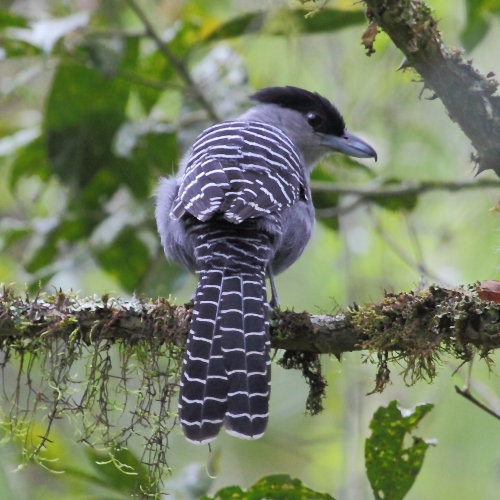
Identifying the Stub-tailed Antbird requires attention to several key features. Adult Stub-tailed Antbirds typically exhibit a muted brown and gray plumage, blending seamlessly with the forest understory. Their most distinguishing characteristic, as their name suggests, is the notably short tail. The tail, often described as stubby, is a key field mark, helping to differentiate it from other antbird species which usually have longer and more prominent tails.
Males and females display similar plumage colors, though males may exhibit slightly more pronounced darker markings on their heads. Juvenile Stub-tailed Antbirds resemble adults but often have duller plumage and less distinct markings. This lack of sexual dimorphism and age-based variation can make field identification challenging, particularly in dense forest environments where visibility is limited.
The Stub-tailed Antbird's posture while perching is another useful identification cue. It often adopts a horizontal stance, with its tail held low, providing a silhouette that is distinctive from other similarly sized forest birds. When compared to similar species like the Ruddy Antbird, the Stub-tailed Antbird's smaller size and shorter tail are reliable identification markers. Its flight is typically direct and low to the ground, suitable for navigating the dense forest understory.
Having trouble telling birds apart? Upload a photo to our bird identification tool for an instant species match.
Stub-tailed Antbird Habitat and Range
Preferred Habitat
The Stub-tailed Antbird thrives in the humid, dense forests of northwestern South America. It primarily inhabits the Chocó bioregion, which stretches from central Panama through western Colombia and into northwestern Ecuador. This region is characterized by high levels of rainfall and diverse, lush vegetation, providing ideal conditions for the antbird's survival.
Within this habitat, the Stub-tailed Antbird prefers lowland and montane forests, occupying elevations ranging from 400 to 1,500 meters. It favors the dense understory of primary and well-preserved secondary forests. The bird's reliance on thick vegetation makes it particularly vulnerable to deforestation and habitat fragmentation. Unlike some other bird species, the Stub-tailed Antbird does not adapt well to urban environments and is seldom found in open or heavily disturbed areas.
Seasonal habitat shifts are minimal for this species, as it remains largely sedentary throughout the year. However, slight altitudinal movements may occur in response to changes in food availability or environmental conditions. As a species dependent on intact forest ecosystems, the Stub-tailed Antbird's presence is indicative of healthy, biodiverse environments.
Geographic Range
The Stub-tailed Antbird's range is relatively restricted compared to other antbird species. It is primarily found in the Chocó bioregion of northwestern South America, specifically within Colombia and Ecuador. This region is recognized for its remarkable biodiversity and high levels of endemism, which include the unique Stub-tailed Antbird.
Within its range, the Stub-tailed Antbird occupies lowland and montane forests at elevations from 400 to 1,500 meters. It is considered a resident species, showing little to no migratory behavior. The bird's presence is concentrated in areas where dense forest understories provide ample cover and foraging opportunities. Population density is highest in well-preserved forest patches where human impact is minimal.
Although the Stub-tailed Antbird does not migrate, it may exhibit small-scale altitudinal movements in response to environmental changes or fluctuations in prey availability. Its restricted range and specific habitat preferences make it particularly susceptible to threats from deforestation and habitat fragmentation. Conservation efforts in the Chocó region are crucial to ensure the survival of this and other specialized forest species.
Want to know which birds visit your area? Browse our backyard birds by location guides for region-specific species lists.
What Does the Stub-tailed Antbird Eat?
The diet of the Stub-tailed Antbird primarily consists of insects and other small invertebrates, which it forages for amid the dense understory of tropical forests. This bird employs a methodical foraging technique, moving slowly through foliage and leaf litter to uncover hidden prey. Its diet includes ants, spiders, beetles, and caterpillars, making it a critical player in controlling insect populations within its habitat.
Seasonal variations in diet are minimal, as the Stub-tailed Antbird remains in the same habitat year-round. However, prey availability may fluctuate with changes in environmental conditions, prompting slight adjustments in foraging behavior. The bird typically forages alone or in pairs, using its sharp bill to glean insects from leaves and branches.
The Stub-tailed Antbird's foraging schedule is primarily diurnal, with peak activity occurring during the early morning and late afternoon. During these times, the cooler temperatures and higher humidity levels may increase insect activity, providing ample feeding opportunities. This bird's role in the ecosystem extends beyond pest control; it is an integral component of the food web, with its feeding habits influencing the distribution and abundance of other forest organisms.
Stub-tailed Antbird Behavior and Social Structure
The Stub-tailed Antbird exhibits a range of behaviors that reflect its adaptation to life in dense, humid forests. As a primarily solitary bird, it often forages alone or in pairs, rarely joining mixed-species flocks. This independence is a hallmark of its behavior, allowing it to focus on its specialized foraging techniques.
Territorial behavior is pronounced in the Stub-tailed Antbird, particularly during the breeding season. Males become more vocal and active, using a series of calls and displays to establish and defend their territories against intruders. These territories provide essential resources, such as nesting sites and food, critical for successful reproduction.
Courtship displays are subtle and involve vocalizations and physical posturing. Once paired, the Stub-tailed Antbird remains monogamous throughout the breeding season. The bird's response to predators includes remaining motionless or retreating into dense vegetation, where its camouflaged plumage provides effective concealment. Daily activity patterns align with its diurnal nature, with peak foraging and territorial activities occurring during the morning and late afternoon. The Stub-tailed Antbird's behavior is a testament to its adaptation to the complex forest environments of the Chocó region.
Stub-tailed Antbird Nesting and Reproduction
The Stub-tailed Antbird constructs its nest low in the understory, often concealed within dense vegetation. The nest is typically a cup-shaped structure made from twigs, leaves, and other forest debris, providing camouflage and protection from predators. These nests are strategically placed, ensuring they blend seamlessly with the surrounding environment.
Clutch size generally consists of two to three eggs, which both parents incubate. The incubation period lasts approximately 14 to 16 days, during which time the parents take turns maintaining warmth and protection for the developing embryos. Once hatched, the chicks are altricial, requiring significant parental care.
Fledging occurs about 14 to 18 days after hatching, but the young remain dependent on their parents for food and protection for several weeks thereafter. Both parents share feeding duties, providing a steady supply of insects and invertebrates. The Stub-tailed Antbird typically raises one or two broods per year, depending on environmental conditions and food availability. Parental roles are well-defined, with both male and female contributing to the success of their offspring.
Stub-tailed Antbird Sounds and Vocalizations
The Stub-tailed Antbird's primary song is a series of sharp, musical notes delivered in quick succession. The rhythm is consistent and the pitch remains steady, producing a sound that resonates through the dense forest understory. This song serves as both a territorial display and a means of attracting a mate.
Call notes are typically short and sharp, often used to communicate with a mate or signal distress. The alarm call is a rapid series of notes, designed to alert nearby individuals to potential threats. During the dawn chorus, the Stub-tailed Antbird's song is most prominent, marking its presence in the territory and establishing its boundaries.
The song's quality bears resemblance to other forest songbirds, yet it maintains unique characteristics that allow it to stand out. The sounds of the Stub-tailed Antbird are a vital aspect of its behavioral repertoire, facilitating communication and social interaction within the dense forests of its range.
Interesting Facts About the Stub-tailed Antbird
- 1The Stub-tailed Antbird's short tail is an adaptation that helps it navigate through dense forest undergrowth.
- 2Despite its name, the Stub-tailed Antbird does not primarily follow ant swarms, a behavior common in other antbird species.
- 3The Chocó region, where the Stub-tailed Antbird resides, is one of the most biologically diverse areas in the world.
- 4The Stub-tailed Antbird's call is often one of the first sounds heard in the early morning forest chorus.
- 5This bird's camouflaged plumage is crucial for avoiding predators in its dense forest habitat.
- 6The Stub-tailed Antbird plays a role in controlling insect populations, contributing to forest health.
- 7Conservation of the Stub-tailed Antbird's habitat helps preserve an entire ecosystem rich in endemic species.
Stub-tailed Antbird Conservation Status
The Stub-tailed Antbird is currently listed as Near Threatened on the IUCN Red List, with its population trend showing a gradual decline. The primary threat to this species is habitat loss due to deforestation, driven by agricultural expansion, logging, and infrastructure development in the Chocó region. Conservation efforts focus on preserving and restoring critical forest habitats through the establishment of protected areas and sustainable land management practices. Historical population changes have seen fluctuations, largely influenced by varying degrees of habitat disturbance and degradation. Efforts to raise awareness about the ecological importance of the Chocó bioregion and its endemic species play a crucial role in conservation strategies. Protecting the Stub-tailed Antbird's habitat benefits not only this species but also the entire ecosystem, supporting biodiversity and ecological balance.
Other Thamnophilidae Species



Birds Similar to the Stub-tailed Antbird
These species are often confused with the Stub-tailed Antbird due to similar appearance or overlapping range.

