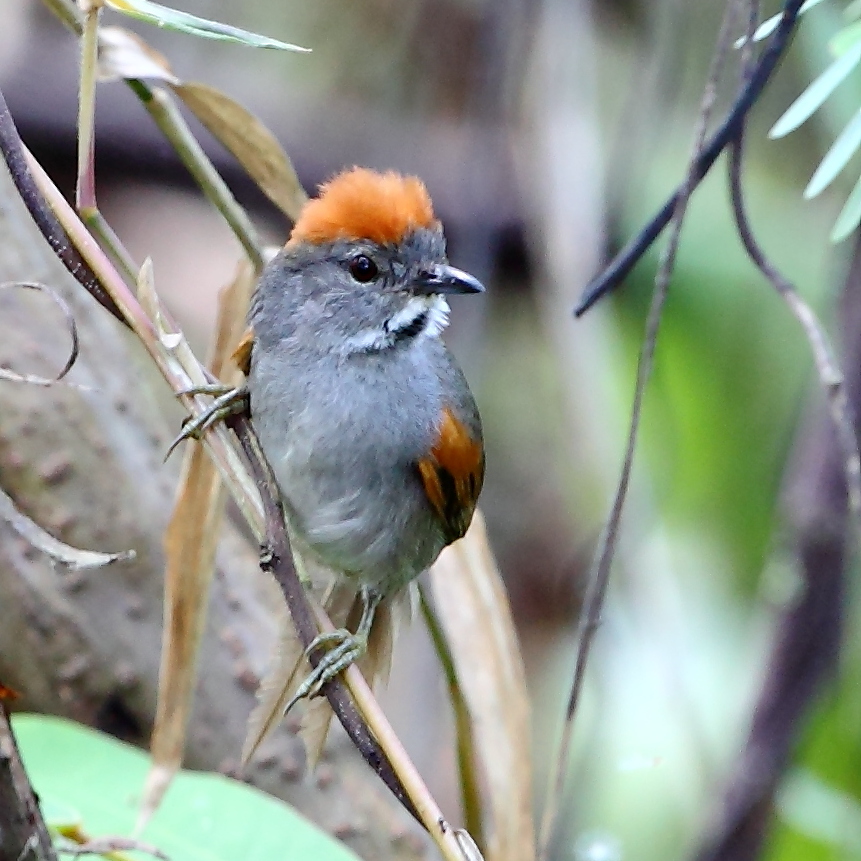
Synallaxis amazonica
Synallaxis amazonica
Order: Passeriformes / Family: Furnariidae
About the Synallaxis amazonica
The Synallaxis amazonica, commonly referred to as the Amazonian Spinetail, is a fascinating member of the Furnariidae family. This bird thrives in the dense undergrowth of tropical rainforests, predominantly within the Amazon Basin, spanning countries like Brazil, Peru, and Bolivia. It plays a crucial role in these ecosystems by aiding in insect control and contributing to seed dispersal. The Amazonian Spinetail is of significant ecological importance due to its habitat specificity and its ability to adapt to the highly competitive environment of the rainforest understory. Unlike many birds in these regions, it is not migratory and does not exhibit significant seasonal behavior changes. However, its breeding season aligns with the rainy seasons in its range, which occurs roughly from November to February in the Southern Hemisphere. During this period, the abundance of food resources in the rainforest supports the rearing of its young. The bird's presence in the Amazon is indicative of the health of the forest, as it prefers undisturbed habitats. The Amazonian Spinetail is a key bioindicator, signaling changes in forest dynamics, largely due to its sensitivity to habitat destruction. As forests face increasing threats from deforestation and climate change, the distribution and population trends of the Amazonian Spinetail can offer insights into the broader impacts on tropical ecosystems. Its adaptability to slight habitat changes also underscores the interconnectedness of rainforest species and their reliance on the intricate balance of these complex ecosystems. The bird contributes to the ecological web by preying on insects, which helps control pest populations. Its role in seed dispersal, albeit limited compared to frugivorous species, is also crucial in maintaining plant diversity in the forest.
The Synallaxis amazonica belongs to the family Furnariidae, within the order Passeriformes. These birds typically live average 3-5 years with a max recorded of 6 years..
How to Identify a Synallaxis amazonica
The Amazonian Spinetail displays a set of field marks that make it identifiable to seasoned birders. Adults showcase a rufous crown and tail, which contrast with their olive-brown upperparts and paler, buffy underparts. Their eyes are dark, set against a subtle grayish-white face. Juveniles resemble adults but have slightly duller plumage and less pronounced rufous coloring. Sexual dimorphism is minimal, with males and females appearing similar, though males may have marginally brighter plumage. In flight, the Amazonian Spinetail's silhouette is characterized by its long, rounded tail and short, rounded wings. Its flight is generally short and low, as it prefers to move through the dense vegetation of the forest understory. Perched, it maintains an upright posture, frequently flicking its tail. Among similar species, the Synallaxis ruficapilla, or Rufous-capped Spinetail, might cause confusion. However, S. amazonica's habitat preferences and overall darker plumage help distinguish it. Unlike some sympatric species, the Amazonian Spinetail is rarely seen above the undergrowth, which offers another clue for identification.
Having trouble telling birds apart? Upload a photo to our bird identification tool for an instant species match.
Synallaxis amazonica Habitat and Range
Preferred Habitat
The Amazonian Spinetail inhabits the dense understory of tropical rainforests, specifically within the Amazon Basin. It thrives in areas with thick vegetation, where it can forage for insects and other small prey. Unlike some other members of the Furnariidae family, it shows a strong preference for primary forest environments and is less frequently found in secondary forests or disturbed areas. It is typically found at elevations up to 600 meters, avoiding higher altitudes where other spinetail species may be present. Seasonal habitat shifts are minimal, as the Amazonian Spinetail is a year-round resident of its preferred rainforest environment. Its presence in urban or suburban areas is rare, as it requires the dense cover and resources provided by undisturbed forest ecosystems.
Geographic Range
The breeding range of the Amazonian Spinetail is concentrated within the Amazon Basin, spanning Brazil, Peru, Ecuador, and Bolivia. It is a non-migratory species, remaining within its established range throughout the year. Population density hotspots occur in regions where forest cover is dense and relatively undisturbed, such as the central Amazonian rainforests in Brazil and the Manu National Park in Peru. These areas offer the ideal habitat for sustaining its populations. The Amazonian Spinetail does not undertake significant migrations, which distinguishes it from other Neotropical bird species that exhibit seasonal movements. Its range is primarily dictated by the availability of suitable forest habitats, and it is generally absent from areas that have been heavily deforested or developed.
Want to know which birds visit your area? Browse our backyard birds by location guides for region-specific species lists.
What Does the Synallaxis amazonica Eat?
The Amazonian Spinetail primarily feeds on insects and other small invertebrates, which it skillfully extracts from the dense foliage of the rainforest. Its foraging technique involves gleaning prey from leaves and branches, often hanging upside down to reach hidden food sources. The bird's diet remains largely consistent throughout the year, although it may consume a higher proportion of soft-bodied insects during the breeding season, when energy demands are greater. Secondary food sources include occasional small fruits and seeds, which may be ingested when insect availability is low. The Amazonian Spinetail generally forages alone or in pairs, maintaining a low profile as it moves methodically through the undergrowth. Its feeding schedule is diurnal, with peak activity occurring during the early morning and late afternoon when insects are most active.
Synallaxis amazonica Behavior and Social Structure
The Amazonian Spinetail exhibits intriguing social and territorial behaviors. It is typically seen alone or in monogamous pairs, rarely forming larger flocks. This solitary behavior aligns with its territorial nature, as pairs defend their chosen areas vigorously against intruders. During the breeding season, courtship displays include mutual preening and synchronized movements, reinforcing pair bonds. The bird's response to predators is cautious; it often relies on its cryptic plumage to remain hidden within the dense foliage. Vocalizations serve as both territorial markers and alarms, with specific calls signaling the presence of potential threats. Daily activity patterns are closely tied to the availability of light in the dense rainforest understory, with peak activity occurring during the cooler, less humid hours of the day. Unlike some rainforest birds, the Amazonian Spinetail does not participate in mixed-species flocks, preferring to maintain its own space within the complex forest ecosystem.
Synallaxis amazonica Nesting and Reproduction
The nesting habits of the Amazonian Spinetail are particularly interesting. It constructs a domed nest using a combination of plant fibers, leaves, and twigs, often located low in the dense undergrowth. The nest's entrance is typically oriented to provide protection from the elements and predators. Clutch size usually consists of 2 to 3 eggs, which the pair incubates for approximately 17 to 19 days. Both parents contribute to the incubation and care of the young, with the roles being shared equally. Nestlings fledge after about 18 to 20 days, at which point they begin to accompany their parents on foraging trips. The number of broods per year is generally limited to one, due to the extended parental care required in the challenging rainforest environment.
Synallaxis amazonica Sounds and Vocalizations
The primary song of the Amazonian Spinetail is a series of sharp, rapid notes delivered in a descending sequence. This song can be described as a repetitive 'chip-chip-chip-chip' that resonates through the dense forest understory. Its call notes are more subdued, often consisting of short, soft 'chit' sounds used for communication between mates. Alarm calls are higher-pitched and more insistent, alerting to the presence of potential predators. During the dawn chorus, the Amazonian Spinetail's song contributes to the vibrant soundscape of the rainforest, although it may be overshadowed by the louder calls of larger bird species.
Interesting Facts About the Synallaxis amazonica
- 1The Amazonian Spinetail's rufous crown and tail feathers are excellent camouflage in the leafy understory.
- 2Unlike many forest birds, the Amazonian Spinetail rarely joins mixed-species flocks, preferring solitude.
- 3The species is a key indicator of rainforest health, thriving only in undisturbed habitats.
- 4Its nests, made primarily of plant fibers, are cleverly concealed in the tangled growth of the forest.
- 5With a preference for primary forests, the Amazonian Spinetail highlights the importance of conservation areas.
- 6Despite its small size, the Amazonian Spinetail plays a critical role in insect population control.
- 7The bird's song, while soft, is a consistent presence in its dense rainforest home, especially during dawn.
Synallaxis amazonica Conservation Status
The IUCN currently lists the Amazonian Spinetail as Least Concern, with population trends considered stable. However, the primary threat to its continued existence is habitat loss due to deforestation and land conversion for agriculture. Conservation efforts focus on preserving large tracts of rainforest and promoting sustainable land-use practices. Historical population changes have been minimal, but ongoing monitoring is essential to ensure that this species does not become threatened. Protected areas within its range, such as national parks and reserves, provide crucial refuges for the Amazonian Spinetail, supporting its habitat needs and allowing for continued research and conservation efforts.
Other Furnariidae Species


Birds Similar to the Synallaxis amazonica
These species are often confused with the Synallaxis amazonica due to similar appearance or overlapping range.