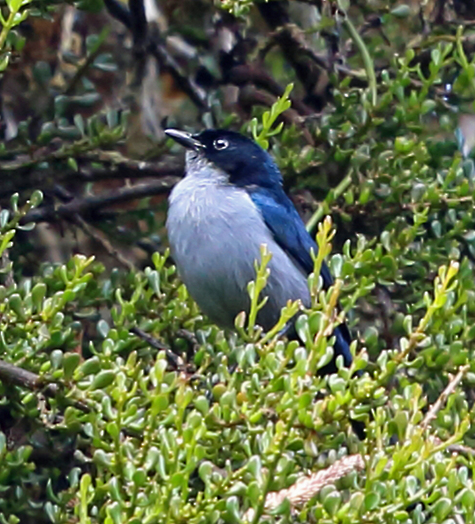
Thick-billed Berrypecker
Rhamphocharis crassirostris
Order: Passeriformes / Family: Melanocharitidae

Wikimedia Commons
About the Thick-billed Berrypecker
The Thick-billed Berrypecker (Rhamphocharis crassirostris) is an intriguing member of the Melanocharitidae family, found exclusively on the island of New Guinea. This small, yet robust bird plays a crucial role in the montane forest ecosystems where it resides, primarily through seed dispersal. With its stout bill, this berrypecker is perfectly adapted to a diet dominated by a variety of berries, a primary food source available in its forested habitat. The Thick-billed Berrypecker is a vital part of the ecological web, assisting in the propagation of numerous plant species through its feeding habits. The bird's presence in the dense and often inaccessible montane forests of New Guinea makes it a less observed species compared to other birds in the region, yet it holds a significant place in the island's rich biodiversity. Typically found at elevations between 1,000 to 2,500 meters, the Thick-billed Berrypecker occupies habitats that are often cooler and more humid than the lowland environments. This altitudinal preference influences its behavior and ecological interactions. Seasonal behaviors of the Thick-billed Berrypecker are not well-documented, largely due to the challenges of studying this bird in its native, often remote habitats. However, like many montane species, it likely exhibits some degree of altitudinal migration, moving to different elevations in response to seasonal changes in food availability. The significance of the Thick-billed Berrypecker extends beyond its ecological role. It is an important species for scientific study, offering insights into the evolution of frugivory among passerines and the adaptation of birds to montane environments. Conservationists and ornithologists alike are keen to learn more about the species to ensure its continued survival amid environmental changes.
The Thick-billed Berrypecker belongs to the family Melanocharitidae, within the order Passeriformes. These birds typically live average 5-7 years, with a maximum recorded of 9 years..
How to Identify a Thick-billed Berrypecker
The Thick-billed Berrypecker is a medium-sized songbird, notable for its distinctive, deep-set bill. Adult plumage is predominantly olive-green with a subtle brownish tinge on the wings and tail. This coloration provides effective camouflage against the mossy and leaf-laden forest understory. Juveniles resemble adults but often display a slightly duller overall coloration, which gradually brightens as they mature. Sexual dimorphism is subtle, with females generally exhibiting a slightly smaller and less robust bill compared to males, though this difference is often hard to discern in the field. The bird's thick bill is its most identifying feature, perfectly adapted for consuming its preferred diet of berries. Similar species include other berrypeckers and some fruit-doves, but the Thick-billed Berrypecker can be distinguished by its unique bill shape and feeding posture. In flight, the bird's silhouette is compact, with rounded wings and a short tail, allowing for agile maneuvering through dense foliage. When perched, it often adopts a horizontal posture, blending seamlessly into the branches.
Having trouble telling birds apart? Upload a photo to our bird identification tool for an instant species match.
Thick-billed Berrypecker Habitat and Range
Preferred Habitat
The Thick-billed Berrypecker thrives in montane forests, preferring elevations ranging from 1,000 to 2,500 meters. These habitats are characterized by dense vegetation, a mix of broadleaf trees, and a rich undergrowth of shrubs and vines. This environment provides ample food resources and cover. The bird is primarily found in the central highlands of New Guinea, where its habitat overlaps with other frugivorous birds. While it does not typically venture into urban areas, it remains a prominent species within its forested range. Seasonal habitat shifts are primarily altitudinal, with some movement to lower elevations during cooler months, although extensive migration is not a characteristic behavior of this species.
Geographic Range
The Thick-billed Berrypecker's range is restricted to the island of New Guinea, predominantly within the central highland regions. It is a resident bird, exhibiting little to no migratory behavior due to the island's tropical climate and stable food supply. Key regions include the Owen Stanley Range and other mountainous areas, where it is locally common. Although the bird's distribution is limited compared to more widespread species, its population is stable within these areas. Population density tends to be higher in undisturbed forest regions, where the availability of berries and suitable nesting sites is optimal.
Want to know which birds visit your area? Browse our backyard birds by location guides for region-specific species lists.
What Does the Thick-billed Berrypecker Eat?
Primarily frugivorous, the Thick-billed Berrypecker relies heavily on a diet of berries. Its stout bill is ideal for crushing and consuming a variety of berry species found in its montane forest habitat. While berries constitute the bulk of its diet, the bird may also consume insects and small invertebrates, particularly during breeding seasons when protein intake is crucial. Foraging is often conducted in the mid to upper canopy, where the bird uses its agility to maneuver through branches in search of ripe fruit. Feeding generally occurs throughout the day, with peaks in activity during the early morning and late afternoon when temperatures are cooler and insect activity increases.
Thick-billed Berrypecker Behavior and Social Structure
The Thick-billed Berrypecker exhibits a largely solitary lifestyle, although it may form loose associations with other frugivorous birds when food resources are abundant. Territorial behavior is minimal, as the abundance of food in its habitat reduces competition. During breeding season, males may engage in subtle courtship displays, including vocalizations and short flights to attract females. The bird's daily activity patterns are diurnal, with peak activity occurring during cooler morning and late afternoon hours. In response to predators, the Thick-billed Berrypecker relies on its camouflaged plumage and rapid, erratic flight patterns to evade capture. Vocalizations serve as both a communication tool and a defense mechanism, alerting others to potential threats.
Thick-billed Berrypecker Nesting and Reproduction
Nesting occurs in dense foliage, often within the higher branches of trees, where it is sheltered from predators and environmental elements. The nest is a small cup structure, meticulously crafted from twigs, leaves, and moss, providing a secure environment for eggs. Clutch size typically ranges from one to three eggs, with an incubation period of approximately two weeks. Both male and female participate in nurturing the young, sharing responsibilities of feeding and protection. Fledging occurs roughly three weeks post-hatching, with juveniles remaining close to the nest until they gain full independence. The Thick-billed Berrypecker generally raises one brood per year, though conditions can influence this.
Thick-billed Berrypecker Sounds and Vocalizations
The primary song of the Thick-billed Berrypecker is a series of melodious whistles, often delivered in a descending sequence. These notes are clear, with a slightly mournful quality that carries through the forest. Call notes include sharp, quick 'chip' sounds utilized during feeding or when alerting to the presence of a predator. Alarm calls are more intense, comprising a rapid series of high-pitched notes that signal immediate danger. During the dawn chorus, the bird's song blends with the symphony of other forest dwellers, creating a rich tapestry of sound that marks the beginning of a new day.
Interesting Facts About the Thick-billed Berrypecker
- 1The Thick-billed Berrypecker is one of the few bird species endemic to New Guinea, highlighting its unique evolutionary path.
- 2Despite its name, the Thick-billed Berrypecker sometimes supplements its diet with insects, showcasing its adaptability.
- 3The species' robust bill is not only for eating berries but also helps in breaking open tougher plant materials.
- 4Thick-billed Berrypeckers are known for their agility, often seen hopping between branches in search of food.
- 5The bird's olive-green plumage serves as excellent camouflage in the dense montane forests of New Guinea.
Thick-billed Berrypecker Conservation Status
Currently, the Thick-billed Berrypecker is listed as a species of Least Concern by the IUCN, with its population considered stable. However, the primary threats to its habitat include deforestation and habitat fragmentation due to logging and agricultural expansion. Conservation efforts focus on preserving large tracts of montane forests, which are crucial for the species' survival. Historically, the bird has maintained a stable population, but ongoing environmental changes necessitate continued monitoring to ensure its continued well-being.
Other Melanocharitidae Species


Birds Similar to the Thick-billed Berrypecker
These species are often confused with the Thick-billed Berrypecker due to similar appearance or overlapping range.