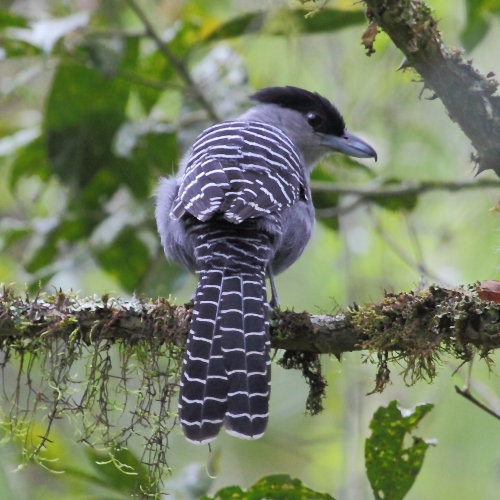
Undulated Antshrike
Frederickena unduliger
Order: Passeriformes / Family: Thamnophilidae

Wikimedia Commons
About the Undulated Antshrike
The Undulated Antshrike, scientifically named Frederickena unduliger, is a distinctive bird found primarily in the dense understory of tropical forests in South America. This species plays a crucial role in the ecosystem by controlling insect populations and serving as both predator and prey in the complex food web. Found predominantly in the Amazon Basin, the Undulated Antshrike inhabits regions of Brazil, Peru, Colombia, and Ecuador. Its presence is a strong indicator of healthy forest ecosystems, as it thrives in lush, undisturbed habitats. These birds are non-migratory, residing year-round in their preferred environments. During the breeding season, which typically coincides with the onset of the rainy season, their activity becomes more pronounced as they engage in nesting and rearing their young. The Undulated Antshrike’s contribution to forest health extends beyond insect control. By participating in mixed-species flocks, these birds help to enhance the foraging success of other species while benefiting from the collective vigilance against predators. Their presence in these flocks underscores their ecological importance and adaptability to the challenges of forest life. Unlike migratory species that rely on multiple habitats throughout the year, the Undulated Antshrike maintains a stable home range, which makes it particularly vulnerable to habitat destruction. This bird's dependence on continuous forest cover highlights the need for conservation efforts focused on preserving primary forests. As a result, the Undulated Antshrike serves as a flagship species for conservation initiatives aimed at protecting tropical forests and maintaining biodiversity.
The Undulated Antshrike belongs to the family Thamnophilidae, within the order Passeriformes. These birds typically live average 6 years, with a maximum recorded of 8 years..
How to Identify a Undulated Antshrike
The Undulated Antshrike is a medium-sized bird, measuring approximately 20 centimeters in length. It is characterized by its unique, undulating black and white plumage, which provides excellent camouflage in the dappled light of the forest understory. Males and females exhibit sexual dimorphism, with males displaying more pronounced barring and a slightly darker overall appearance. Females generally have a browner hue, which aids in nesting camouflage. Juveniles resemble females but are duller with less defined barring. In flight, the Undulated Antshrike presents a compact silhouette with broad wings and a short tail, typical of many thamnophilid birds. When perched, it maintains a horizontal posture, often seen clinging to vertical stems or branches. This posture, combined with its cryptic coloration, makes the bird challenging to spot. The Undulated Antshrike can be confused with other antshrike species, such as the Black-throated Antshrike, but can be distinguished by its unique undulating patterns and habitat preferences. Field observers often rely on the bird's distinctive vocalizations to confirm identification when visual sightings are difficult.
Having trouble telling birds apart? Upload a photo to our bird identification tool for an instant species match.
Undulated Antshrike Habitat and Range
Preferred Habitat
The Undulated Antshrike inhabits the humid, lowland forests of the Amazon Basin, thriving in regions with dense understory and abundant leaf litter. Typical habitat includes terra firme forest, várzea, and transitional zones near water bodies. These birds prefer elevations below 1,000 meters, where the forest canopy provides ample cover and feeding opportunities. During the wet season, they may venture into flooded areas, taking advantage of the increased insect activity. Unlike some thamnophilids, the Undulated Antshrike shows little tolerance for habitat fragmentation and rarely ventures into disturbed or secondary growth areas. Its presence is most commonly noted in large, contiguous tracts of primary forest. Urban encroachment poses a significant threat to its preferred habitats, underscoring the need for careful land management and conservation measures.
Geographic Range
The Undulated Antshrike's range is confined to the Amazon Basin, encompassing parts of northern Brazil, eastern Peru, southern Colombia, and eastern Ecuador. This species does not undertake long migrations, instead remaining within its established home range throughout the year. Within this range, population densities are higher in regions where primary forest remains intact, such as the central Amazon. Hotspots for observation include the Manu National Park in Peru and the Cuyabeno Wildlife Reserve in Ecuador. These areas offer extensive, unbroken forest habitats that support robust populations. The Undulated Antshrike's distribution is patchy, correlating closely with the availability of suitable forest environments. Conservation efforts in these regions are vital to maintaining the bird's habitat and population stability.
Want to know which birds visit your area? Browse our backyard birds by location guides for region-specific species lists.
What Does the Undulated Antshrike Eat?
The Undulated Antshrike primarily feeds on insects, with a particular preference for ants and beetles. Its diet also includes spiders, small arthropods, and occasionally small vertebrates. During the wet season, when insect abundance peaks, the antshrike's diet becomes more varied, incorporating caterpillars and other soft-bodied insects. The bird employs a sit-and-wait foraging strategy, using its sharp eyesight to detect prey from a perch before executing quick, darting flights to capture it. The Undulated Antshrike often joins mixed-species foraging flocks, which increases its success rate by flushing out hidden prey. These flocks also allow the antshrike to capitalize on the vigilance of other species, reducing its own risk of predation while foraging.
Undulated Antshrike Behavior and Social Structure
The Undulated Antshrike exhibits a range of behaviors that reflect its adaptability to the dense forest understory. It is primarily solitary or found in pairs, maintaining territories by vocalizing and engaging in subtle displays rather than overt aggression. During the breeding season, males become more conspicuous, using their distinctive calls to attract mates and deter rivals. Courtship involves mutual preening and soft vocal exchanges between pairs. The antshrike is diurnal, with peak activity occurring during the early morning and late afternoon. It spends much of its time foraging at low to mid-levels of the forest, though it occasionally ventures to the canopy. In response to predators, the antshrike relies on its cryptic plumage to remain undetected. When alarmed, it freezes in place or makes short, rapid flights to denser cover. While generally not gregarious, the Undulated Antshrike does participate in mixed-species flocks, benefiting from the collective vigilance and increased foraging opportunities.
Undulated Antshrike Nesting and Reproduction
The Undulated Antshrike constructs a small, cup-shaped nest using materials such as twigs, leaves, and plant fibers, often incorporating spider silk for binding. Nests are typically situated low in the understory, concealed among foliage to evade predators. A typical clutch consists of two eggs, which are pale with dark speckling. Both parents share incubation duties, which last approximately 14-16 days. After hatching, the nestlings remain in the nest for about two weeks before fledging. Parental care continues post-fledging, with both adults involved in feeding and protecting the young until they become independent. The species generally raises one brood per year, though favorable conditions may allow for a second.
Undulated Antshrike Sounds and Vocalizations
The primary song of the Undulated Antshrike is a series of short, sharp notes that rise and fall in pitch, creating a rolling, wave-like pattern reminiscent of its plumage. These calls serve both as a territorial signal and a means of communication between mates. Alarm calls are sharper and more abrupt, designed to alert others to potential threats. The dawn chorus often features the antshrike's song prominently, as males establish their presence at first light. Compared to other forest birds, its calls are relatively quiet and understated, blending seamlessly with the ambient forest sounds.
Interesting Facts About the Undulated Antshrike
- 1The Undulated Antshrike's name reflects its plumage, which resembles undulating waves in black and white.
- 2Despite its secretive nature, the Undulated Antshrike plays a vital role in mixed-species flocks, enhancing foraging efficiency.
- 3This bird relies heavily on cryptic coloration to avoid predators, often remaining motionless when threatened.
- 4The Undulated Antshrike's diet primarily consists of ants and beetles, with larger prey being taken during the wet season.
- 5Its breeding season aligns with the rainy season, taking advantage of increased food availability for rearing young.
- 6The antshrike's habitat preferences make it a key indicator species for assessing forest ecosystem health.
- 7Unlike many forest birds, the Undulated Antshrike is non-migratory, emphasizing its reliance on stable environments.
Undulated Antshrike Conservation Status
The Undulated Antshrike is currently listed as Least Concern by the IUCN, though its population trend is decreasing due to habitat loss. Deforestation for agriculture and logging poses the most significant threat to its survival, as the species relies on intact primary forests. Conservation efforts focus on preserving large forest tracts and promoting sustainable land-use practices. Historically, the antshrike's range has contracted in areas where forest cover has been significantly reduced. Protecting key habitats and fostering community-based conservation initiatives are vital to ensuring the long-term survival of this species.