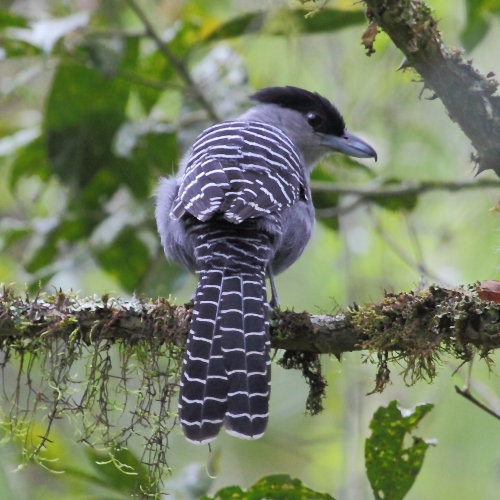
Upland Antshrike
Thamnophilus aroyae
Order: Passeriformes / Family: Thamnophilidae

Wikimedia Commons
About the Upland Antshrike
The Upland Antshrike, scientifically known as Thamnophilus aroyae, is a striking member of the Thamnophilidae family. It resides primarily within the montane forests of the eastern Andes, thriving in the humid and dense understory that characterizes these regions. This bird plays an essential role in the ecosystem as both predator and prey. Feeding predominantly on insects and small arthropods, it helps control pest populations, thus maintaining ecological balance. Furthermore, it provides a food source for larger predators, thereby contributing to the trophic dynamics of its habitat. This antshrike is a resident species, displaying little to no migratory behavior, which emphasizes the importance of its specific habitat for survival. Its presence is most notable in countries like Bolivia and Peru, where it occupies elevations ranging from 1,500 to 3,000 meters. Seasonal behaviors include subtle shifts where individuals may move slightly in elevation or habitat in response to changes in prey availability. The Upland Antshrike is a sentinel of forest health, with its population trends offering insights into the impacts of deforestation and habitat fragmentation. Observations suggest that the bird's numbers are stable, but ongoing habitat destruction poses a potential threat to its long-term survival. Conservation efforts aimed at preserving montane forests are crucial for the continued presence of Thamnophilus aroyae and the myriad of other species that share its environment.
The Upland Antshrike belongs to the family Thamnophilidae, within the order Passeriformes. These birds typically live average 5-6 years, with a maximum recorded of 9 years..
How to Identify a Upland Antshrike
The Upland Antshrike is a medium-sized bird measuring approximately 18 centimeters in length. Its plumage is primarily black and white, with males exhibiting striking black upperparts and contrasting white underparts, which creates a bold patterning effect. Females have a similar pattern but their black feathers are slightly duller, often with a more brownish hue. Juveniles resemble females but may display more rufous tones in their plumage. This species can be confused with other antshrikes, particularly those within the same genus. However, the Upland Antshrike's preference for higher elevations and its distinctive vocalizations aid in differentiation. In flight, it maintains a robust silhouette with strong, rounded wings and a relatively short tail. When perched, it often adopts an upright posture that highlights its compact body and large head, enhancing its alert appearance. Observers should note its behavior of flicking wings and tail, a characteristic movement that can help in its identification.
Having trouble telling birds apart? Upload a photo to our bird identification tool for an instant species match.
Upland Antshrike Habitat and Range
Preferred Habitat
The Upland Antshrike inhabits montane forest environments, preferring the dense understory and edge habitats that provide ample cover and foraging opportunities. Typically found at elevations between 1,500 and 3,000 meters, it thrives in the humid conditions of the eastern Andes. This species shows a strong preference for primary forests but can sometimes be found in secondary growth if sufficient vegetation cover remains. Unlike many birds that adapt to urban settings, the Upland Antshrike avoids heavily disturbed areas, reflecting its reliance on intact forest ecosystems. Seasonal habitat shifts are minimal, though some individuals may move slightly in search of food or during breeding periods.
Geographic Range
The Upland Antshrike is endemic to South America, with its range primarily concentrated in the eastern Andes of Bolivia and Peru. It occupies a relatively narrow altitudinal band, favoring forested habitats within the montane region. There is no evidence of significant migratory behavior, and the bird is considered a resident species throughout its range. The highest population densities occur in areas where the forest remains intact and undisturbed. While its distribution is somewhat limited geographically, it can be locally common within suitable habitats. Conservation of the montane forests is crucial for the continued stability of its population.
Want to know which birds visit your area? Browse our backyard birds by location guides for region-specific species lists.
What Does the Upland Antshrike Eat?
The diet of the Upland Antshrike consists mainly of insects and small arthropods, making it an important insectivorous bird within its ecosystem. It forages primarily in the understory, using a methodical approach to search for prey among leaves and branches. This antshrike employs a sit-and-wait strategy, often perching quietly before darting out to capture passing insects. It is known to consume a variety of prey, including beetles, ants, spiders, and caterpillars, adjusting its diet according to seasonal availability. The bird's feeding schedule is largely diurnal, with peak activity during the cooler morning and late afternoon hours. Its ability to adapt its foraging techniques to different prey types underscores its ecological versatility.
Upland Antshrike Behavior and Social Structure
The Upland Antshrike exhibits a predominantly solitary lifestyle, although it may occasionally join mixed-species foraging flocks. Its territorial nature is evident through its vocal displays, which serve to establish and maintain boundaries. During the breeding season, males engage in courtship displays that involve vocalizations and physical posturing to attract mates. This bird exhibits strong site fidelity, often returning to the same territories year after year. Its response to predators includes a combination of cryptic behavior and alarm calls, which alert conspecifics to potential threats. Daily activity patterns revolve around foraging, with individuals spending much of their time searching for food within their territories.
Upland Antshrike Nesting and Reproduction
The nesting habits of the Upland Antshrike involve constructing cup-shaped nests from leaves, twigs, and other plant materials. These nests are typically placed in dense shrubbery or low trees, providing camouflage and protection from predators. The female lays a clutch of two to three eggs, which she incubates for approximately 14 days. Both parents participate in feeding and caring for the young, which fledge about two weeks after hatching. Parental roles are well-defined, with males often defending the territory while females focus on brooding. The species generally produces one brood per year, though favorable conditions may lead to a second.
Upland Antshrike Sounds and Vocalizations
The primary song of the Upland Antshrike is a series of sharp, evenly spaced notes that rise and fall in pitch, resembling a rapid 'chip-chip-chip' sound. These vocalizations serve both territorial and mating purposes. The bird also produces softer call notes, which are shorter and less structured, used for communication between mates or within family groups. Alarm calls are harsher and more urgent, designed to alert others to danger. During the dawn chorus, the Upland Antshrike's song is particularly prominent, adding to the rich soundscape of the montane forest.
Interesting Facts About the Upland Antshrike
- 1The Upland Antshrike's vocalizations are so distinct that they are key in identifying individuals within dense forests.
- 2Unlike many birds, the Upland Antshrike maintains a relatively small home range, emphasizing its territorial nature.
- 3The species' preference for high-elevation habitats means it often shares its environment with unique flora and fauna.
- 4Upland Antshrikes have been observed using their strong bills to pry insects from bark and leaves.
- 5The bird's name, 'Antshrike,' comes from its similarity to shrikes and its diet that includes ants, though it's not closely related to true shrikes.
Upland Antshrike Conservation Status
The Upland Antshrike is currently classified as Least Concern by the IUCN, with populations considered stable. However, ongoing threats such as deforestation and habitat degradation pose significant risks to its future. Habitat conservation efforts are critical, focusing on preserving the montane forests of the Andes. Historical population changes have been minimal, though increased human activity in its range could alter this trend. Conservation strategies aim to protect critical habitats and mitigate the impacts of development.