
Wahlberg's Honeyguide
Prodotiscus regulus
Order: Piciformes / Family: Indicatoridae

Wikimedia Commons
About the Wahlberg's Honeyguide
Wahlberg's Honeyguide, scientifically classified as Prodotiscus regulus, is a small bird within the Indicatoridae family, primarily found across sub-Saharan Africa. This bird is famous for its brood parasitism, laying eggs in the nests of other bird species, particularly those of warblers and other small insectivorous birds. Its ecological role involves a complex interaction with its host species, often influencing the population dynamics of the regions it inhabits. The Wahlberg's Honeyguide thrives in diverse habitats ranging from savannas to open woodlands, particularly favoring areas with scattered trees and bushes. It is most commonly observed in countries such as South Africa, Botswana, and Zimbabwe, extending its range into parts of East Africa, including Tanzania and Kenya. Seasonally, these birds may demonstrate some movement within their range, often related to the availability of their primary food sources and suitable nesting opportunities. Despite their parasitic nature, they play a crucial role in maintaining ecological balance by controlling insect populations and influencing plant pollination through their diet. The Wahlberg's Honeyguide is intriguing for its adaptability to varied environments and its stealthy, elusive behaviors, often remaining unnoticed due to its cryptic coloration and silent mannerisms.
The Wahlberg's Honeyguide belongs to the family Indicatoridae, within the order Piciformes. These birds typically live lives around 4-6 years, with some individuals reaching up to 9 years..
How to Identify a Wahlberg's Honeyguide
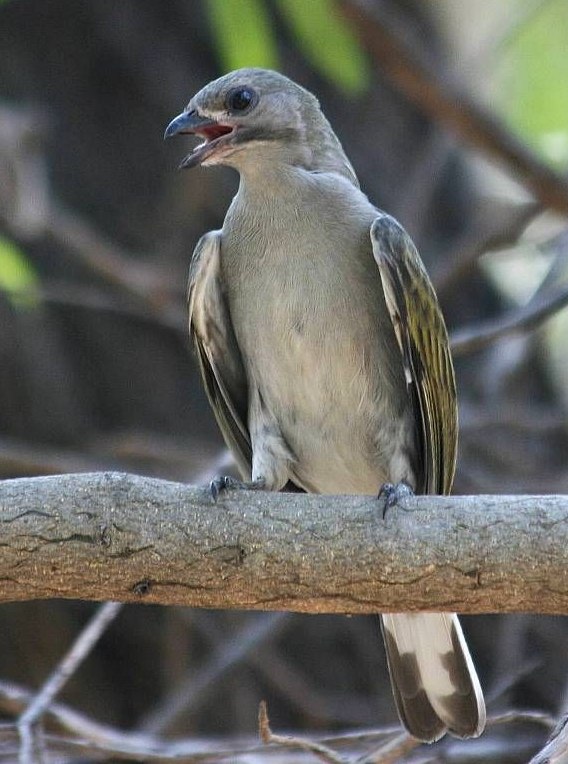
Adult Wahlberg's Honeyguides display a predominantly gray plumage, which serves as excellent camouflage in their natural habitats. The upperparts are a muted gray with slightly darker wings and tail, while the underparts are paler, almost white. Juveniles are similar in appearance but may exhibit slightly more mottling on the underparts. Sexual dimorphism is minimal, with males and females appearing almost identical in the field. This bird's small size, typically around 12-13 cm in length, combined with its subtle coloring, can make it challenging to identify. It might be confused with similar small gray birds like the African Dusky Flycatcher. However, the honeyguide's behavior and preferred habitats help differentiate it. When perched, Wahlberg's Honeyguide adopts an upright posture, often remaining still for extended periods. In flight, its short, rounded wings and rapid, direct flight pattern are distinctive, assisting in identification during brief sightings.
Having trouble telling birds apart? Upload a photo to our bird identification tool for an instant species match.
Wahlberg's Honeyguide Habitat and Range
Preferred Habitat
Wahlberg's Honeyguide inhabits a range of environments, primarily favoring open woodlands and savannas. It is commonly found in areas with scattered trees, such as acacia-dominated landscapes, and frequently visits gardens and farmlands where suitable trees are present. The bird is adaptable to various elevations, often residing between sea level and 2000 meters. While generally absent from dense forests, it may venture into forest edges and clearings. Seasonal shifts in habitat preference are driven more by food availability and breeding opportunities than by climate, as these birds are resident year-round in much of their range. While less common in urban areas, Wahlberg's Honeyguide occasionally appears in suburban settings if suitable habitats are nearby.
Geographic Range
The range of Wahlberg's Honeyguide spans much of sub-Saharan Africa, with a concentration in southern and eastern regions. It is found from South Africa and Namibia in the south, extending through Zimbabwe, Botswana, and Mozambique, and moving northwards into Tanzania, Kenya, and parts of Uganda. In these regions, it occupies a wide array of habitats, showing a preference for areas with abundant insect prey and potential host nests. Population density tends to be higher in regions where suitable habitats are abundant, such as the miombo woodlands of Zimbabwe and mosaics of savanna and woodland in Botswana. While generally non-migratory, some individuals may undertake local movements in response to shifts in food availability or breeding conditions.
Want to know which birds visit your area? Browse our backyard birds by location guides for region-specific species lists.
What Does the Wahlberg's Honeyguide Eat?
Wahlberg's Honeyguide primarily feeds on insects, with a diet heavily dominated by bees and wasps. Its specialized feeding technique involves capturing adult insects in flight and gleaning larvae from nests. This bird also consumes wax, a rare dietary trait among birds, which it obtains by raiding beehives, often following honey badgers or other large mammals to find them. Seasonal variations in diet are minimal, as the bird consistently relies on insects and wax throughout the year. Its foraging schedule is typically diurnal, matching the activity patterns of its prey, but it may also feed opportunistically when conditions allow.
Wahlberg's Honeyguide Behavior and Social Structure
Wahlberg's Honeyguide exhibits solitary or loosely paired behaviors, mainly outside the breeding season. It is territorial during the breeding period, with males often engaging in aggressive displays to deter rivals. Courtship involves subtle displays and calls, with paired individuals showing increased territorial fidelity. Although not highly social, the species may join mixed-species foraging flocks, especially when resources are scarce. Its response to predators is primarily evasive, utilizing its cryptic coloration to remain undetected. Daily activity centers around foraging, with peak activity during early morning and late afternoon, aligning with the activity of its insect prey.
Wahlberg's Honeyguide Nesting and Reproduction
Wahlberg's Honeyguide is a brood parasite, laying its eggs in the nests of other bird species. Preferred hosts include various species of warblers and flycatchers. The female honeyguide discreetly places her eggs in the host's nest, often removing a host egg or two to minimize detection. Clutch size is typically limited to a single egg per host nest, although females may use multiple nests throughout the breeding season. The incubation period aligns with that of the host species, with little parental investment from the honeyguide beyond egg-laying. Once hatched, the young honeyguide often eliminates competition by ejecting host nestlings or eggs. This strategy allows the honeyguide chick to receive undivided care from the unwitting foster parents, leading to higher survival rates.
Wahlberg's Honeyguide Sounds and Vocalizations
The vocalizations of Wahlberg's Honeyguide are subtle and often overlooked. Its primary song consists of a series of soft, whistling notes, typically delivered from a concealed perch. These notes are rhythmically spaced and may be repeated several times in succession. In addition to its song, the bird produces a variety of call notes, used primarily for communication between mates or to alert potential rivals. Alarm calls are sharper and more urgent, serving to warn of nearby threats. Unlike many songbirds, Wahlberg's Honeyguide contributes little to the dawn chorus, often remaining silent during the early hours.
Interesting Facts About the Wahlberg's Honeyguide
- 1Wahlberg's Honeyguide is one of few birds known to consume beeswax, a dietary trait it shares with only a handful of other species.
- 2The species was named after Johan August Wahlberg, a Swedish naturalist who collected specimens in southern Africa during the 19th century.
- 3Honeyguides exhibit a unique brood parasitism strategy, often resulting in the host species raising the honeyguide chick at the expense of their own.
- 4Unlike many brood parasites, Wahlberg's Honeyguide chicks actively eliminate competition by ejecting host eggs or nestlings shortly after hatching.
- 5This bird's cryptic plumage makes it difficult to spot, aiding in its stealthy parasitic lifestyle and helping it avoid detection by potential predators.
- 6Wahlberg's Honeyguide can be seen following larger animals like honey badgers to locate bee hives, benefiting from the mammals' ability to break open the nests.
- 7Despite their parasitic behavior, honeyguides play an essential ecological role in controlling insect populations and aiding in pollination.
Wahlberg's Honeyguide Conservation Status
The Wahlberg's Honeyguide is currently listed as Least Concern by the IUCN, with populations considered stable across its range. Major threats include habitat destruction and alteration due to agricultural expansion and deforestation. Despite these challenges, the species remains adaptable to a variety of habitats, aiding its conservation status. Ongoing conservation efforts focus on habitat preservation and the maintenance of ecological corridors to ensure the continued availability of suitable nesting sites and food sources. Historically, the population has shown resilience to environmental changes, benefiting from its broad range and adaptable nature.
Other Indicatoridae Species



Birds Similar to the Wahlberg's Honeyguide
These species are often confused with the Wahlberg's Honeyguide due to similar appearance or overlapping range.