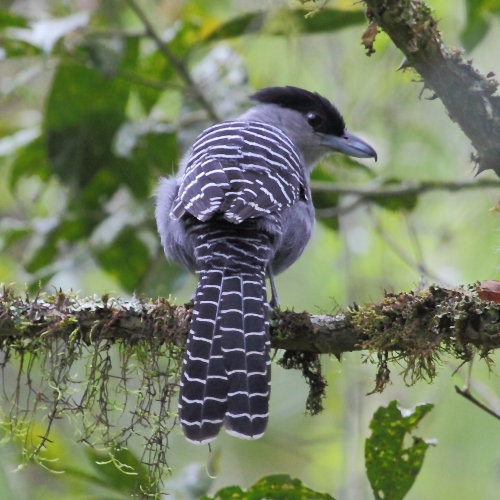
White-backed Fire-eye
Pyriglena leuconota
Order: Passeriformes / Family: Thamnophilidae

Wikimedia Commons
About the White-backed Fire-eye
The White-backed Fire-eye, scientifically known as Pyriglena leuconota, is a captivating member of the Thamnophilidae family. This bird primarily inhabits the dense, humid forests of South America, particularly favoring the tropical rainforests of Brazil. In these lush environments, the White-backed Fire-eye plays a vital role in the ecosystem as an insectivore, helping to control insect populations. Its presence is significant in regions like the Atlantic Forest, where its habitat is increasingly threatened by deforestation. The bird's striking appearance, with its stark white back contrasting sharply against its black body and fiery red eyes, makes it a notable species for birdwatchers and researchers alike. During the breeding season, which typically occurs in the wetter months, the White-backed Fire-eye becomes more vocal, using its distinct calls to establish territory and attract mates. Outside of breeding, these birds are relatively quiet, focusing on foraging and maintaining their territories. They often participate in mixed-species flocks, which helps them efficiently find food while reducing the risk of predation. This bird's ecological role extends beyond insect control; it also contributes to seed dispersal through its consumption of small fruits, further highlighting its importance to forest biodiversity. As a result, the White-backed Fire-eye serves as both a biological control agent and a seed disperser, underpinning the health of its native habitats. Conservation efforts are crucial to ensure the survival of this species, as its population faces pressure from habitat loss and fragmentation.
The White-backed Fire-eye belongs to the family Thamnophilidae, within the order Passeriformes. These birds typically live average 5-8 years, with a maximum recorded of 11 years..
How to Identify a White-backed Fire-eye
The White-backed Fire-eye is easily identifiable by its bold coloration. Adult males have a glossy black plumage with a striking white patch on their upper back, which gives the species its name. Their eyes are a conspicuous bright red, adding to their dramatic appearance. Females, on the other hand, display a more subdued coloration; their plumage tends to be a dark brown rather than black, yet they retain the characteristic white back. Juveniles resemble females but usually have a duller brown tone. In flight, the White-backed Fire-eye presents a compact silhouette with broad, rounded wings and a short tail. This profile is typical of many antbirds, allowing for agile maneuvering through dense foliage. When perched, the bird maintains an upright posture, often flicking its tail as a sign of alertness. Despite their distinctive appearance, the White-backed Fire-eye can be confused with other antbird species, particularly those with similar coloration patterns. However, the unique combination of the white back and red eyes usually aids in accurate identification.
Having trouble telling birds apart? Upload a photo to our bird identification tool for an instant species match.
White-backed Fire-eye Habitat and Range
Preferred Habitat
The White-backed Fire-eye predominantly inhabits lowland tropical forests, thriving in dense, humid environments replete with thick undergrowth and ample cover. It is commonly found in the Atlantic Forest of Brazil, a biodiversity hotspot characterized by high humidity and a rich variety of flora and fauna. These birds prefer areas with dense shrub layers, as this provides both ample foraging opportunities and protection from predators. While they primarily reside in forest interiors, they can occasionally be found at forest edges or in secondary growth forests, particularly where primary forest has been disturbed. The species is generally not found at high elevations, preferring lowland areas where their preferred habitat is most abundant. They do not typically venture into urban environments, as their reliance on dense forest makes such areas unsuitable for their needs.
Geographic Range
The range of the White-backed Fire-eye is primarily restricted to South America, with a notable concentration in Brazil's Atlantic Forest region. This bird does not engage in long-distance migrations, instead remaining in its tropical habitat year-round. Its range extends into parts of northeastern Argentina and eastern Paraguay, although these populations are less dense compared to those in Brazil. Within these regions, the White-backed Fire-eye is more prevalent in areas with extensive forest cover, where it can find the dense undergrowth it requires for foraging and nesting. The species does not exhibit significant seasonal range shifts, largely maintaining its presence within these core areas throughout the year.
Want to know which birds visit your area? Browse our backyard birds by location guides for region-specific species lists.
What Does the White-backed Fire-eye Eat?
The diet of the White-backed Fire-eye primarily consists of insects and other small invertebrates. As an insectivore, it plays a crucial role in controlling insect populations within its habitat. The bird employs a methodical foraging technique, moving through the undergrowth in search of prey, often flipping over leaves and probing crevices to uncover hidden insects. While insects form the bulk of its diet, the White-backed Fire-eye also consumes small fruits, particularly during the dry season when insect availability may decrease. This dietary flexibility allows the bird to adapt to varying food resources throughout the year. The prey size targeted by this bird is typically small to medium, including beetles, caterpillars, and spiders. Feeding activity peaks during the early morning and late afternoon, aligning with times of lower predator activity and cooler temperatures.
White-backed Fire-eye Behavior and Social Structure
The behavior of the White-backed Fire-eye is characterized by its secretive and territorial nature. These birds are often encountered alone or in pairs, defending their territory with persistent vocalizations and displays. They exhibit a strong attachment to their chosen territory, which provides them with the necessary resources for feeding and breeding. Courtship displays involve a combination of vocalizations and physical displays, with males often showcasing their white backs prominently. Territorial disputes with neighboring pairs can become intense, involving chases and aggressive posturing. Despite their territoriality, White-backed Fire-eyes often join mixed-species foraging flocks, which affords them protection from predators and increases foraging efficiency. Their response to predators is typically cautious, relying on their cryptic coloration and dense habitat to avoid detection. The daily activity patterns of the White-backed Fire-eye involve periods of active foraging interspersed with rest during the hottest parts of the day.
White-backed Fire-eye Nesting and Reproduction
The nesting habits of the White-backed Fire-eye are adapted to its dense forest environment. Nests are typically constructed low to the ground, often in dense shrubbery or among vines. The nest itself is a shallow cup made from twigs, leaves, and plant fibers, carefully woven to provide stability and concealment. Clutch size generally consists of two to three eggs, which are incubated predominantly by the female, while the male assists in feeding the incubating female and later, the chicks. The incubation period lasts approximately 14 to 16 days, with both parents participating in feeding the hatchlings. Fledging occurs after about 10 to 12 days, with young birds remaining close to the nest site under parental supervision. The White-backed Fire-eye typically raises one brood per year, although favorable conditions may allow for a second.
White-backed Fire-eye Sounds and Vocalizations
The White-backed Fire-eye's primary song is a series of clear, melodious whistles, often delivered in rapid succession. The rhythm is brisk, with each note descending slightly in pitch, creating a distinctive and easily recognizable sound. In addition to their songs, these birds produce a variety of call notes, including sharp, metallic chips used for communication between mates or to signal alarm. Alarm calls are more emphatic and urgent, serving to alert other birds of potential threats. During the dawn chorus, the White-backed Fire-eye contributes to the symphony of forest sounds, its song cutting through the dense canopy with clarity and resonance.
Interesting Facts About the White-backed Fire-eye
- 1The White-backed Fire-eye's striking red eyes are not just for show; they help in distinguishing it from other similar antbirds.
- 2Despite its vivid appearance, the White-backed Fire-eye relies on dense forest cover to avoid predators, utilizing its sharp eyesight.
- 3During the wet season, the bird is more vocal and active, using its calls to establish territory and attract mates.
- 4The bird's diet shifts slightly to include more fruit during the dry season, showcasing its dietary adaptability.
- 5The White-backed Fire-eye's participation in mixed-species flocks reduces its risk of predation while enhancing foraging success.
- 6Its nest is often well-hidden among vines or shrubs, providing excellent camouflage against predators.
- 7The White-backed Fire-eye is a crucial insectivore in its ecosystem, helping control insect populations naturally.
White-backed Fire-eye Conservation Status
According to the IUCN, the White-backed Fire-eye is currently listed as Least Concern, though its population trend is decreasing due to habitat loss. The primary threat to this species is deforestation, particularly within the Atlantic Forest, where much of its habitat has been lost to agriculture and urbanization. Conservation efforts focus on protecting and restoring forest habitats, with initiatives aimed at reforestation and establishing protected areas. Despite these efforts, historical habitat fragmentation continues to impact population connectivity and genetic diversity. Continued monitoring and conservation action are essential to ensure the long-term survival of this species.