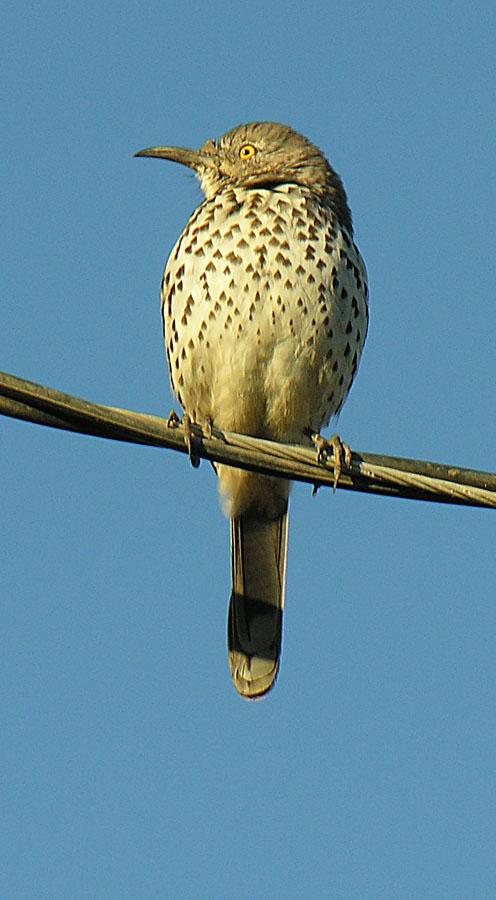
White-breasted Thrasher
Ramphocinclus brachyurus
Order: Passeriformes / Family: Mimidae

Wikimedia Commons
About the White-breasted Thrasher
The White-breasted Thrasher (Ramphocinclus brachyurus) is a captivating bird species endemic to the Lesser Antilles, specifically found in the dry forests of Saint Lucia and Martinique. This medium-sized songbird, part of the Mimidae family, plays a crucial ecological role in its limited range. Thrashers are known for their complex vocalizations and the White-breasted Thrasher is no exception, contributing to the rich soundscape of its native habitats. The bird's presence in these regions highlights the importance of tropical dry forests, a habitat under threat from deforestation and human encroachment. The White-breasted Thrasher's diet consists mainly of insects and small fruits, which helps in seed dispersion and pest control, reflecting its role in maintaining the ecological balance. Seasonal behaviors of the White-breasted Thrasher are influenced by the availability of food and breeding needs. During the breeding season, which aligns with the rainy months, the thrashers become more territorial, and their vocalizations increase as pairs establish and defend territories. Outside of this period, they may be slightly more tolerant of conspecifics though they do not form large flocks. The White-breasted Thrasher's limited distribution and population size make it an important species for conservationists focusing on Caribbean avifauna. The bird's reliance on specific forest types means that habitat protection is vital for its continued survival. Efforts to conserve this species are ongoing but challenged by habitat fragmentation and natural disasters common in the Caribbean.
The White-breasted Thrasher belongs to the family Mimidae, within the order Passeriformes. These birds typically live average 4-6 years in the wild..
How to Identify a White-breasted Thrasher
The White-breasted Thrasher is easily identified by its striking contrast of white underparts against a brownish-gray back and wings. Adult thrashers possess a clean white throat and belly with a subtle transition to brown on the flanks. Their eyes are dark, and their long, slightly curved bill is well-suited for foraging in leaf litter. Males and females appear similar in plumage, making them difficult to distinguish visually. Juveniles, however, can be identified by their slightly duller plumage and less defined white areas. In flight, the White-breasted Thrasher presents a distinctive silhouette with its long tail and rounded wings, which is unlike the more common thrushes found in the same region. When perched, it often adopts an upright posture, frequently flicking its tail and wings, a behavior typical of many Mimidae species. Though similar species exist within the region, such as the Tropical Mockingbird, the White-breasted Thrasher's specific plumage pattern and vocalizations are key differentiators.
Having trouble telling birds apart? Upload a photo to our bird identification tool for an instant species match.
White-breasted Thrasher Habitat and Range
Preferred Habitat
The White-breasted Thrasher primarily inhabits dry forests and scrublands, particularly on the islands of Saint Lucia and Martinique. These forests are characterized by less dense canopies and a prevalence of thorny shrubs and open ground, ideal for the thrashers' ground-foraging behavior. The bird's preferred elevation range is typically lowland, rarely exceeding 300 meters above sea level. Seasonal shifts in habitat use are minimal, largely due to the non-migratory nature of the species. However, some movement within their territory may occur in response to food availability. In urban areas, sightings are scarce as the bird tends to avoid heavily developed regions, favoring undisturbed forest environments.
Geographic Range
The White-breasted Thrasher is one of the few bird species endemic to the Caribbean islands of Saint Lucia and Martinique. Its range is remarkably limited, with specific population concentrations in the dry forests of these islands. On Saint Lucia, the bird is primarily found in the coastal and lowland regions of the northeast and southeast. On Martinique, its presence is restricted to a few isolated patches of suitable habitat. The bird does not migrate, thus its range remains consistent throughout the year. Population density hotspots are small, with fragmented habitats making conservation efforts crucial. This limited geographical range makes the species particularly vulnerable to habitat changes and environmental pressures.
Want to know which birds visit your area? Browse our backyard birds by location guides for region-specific species lists.
What Does the White-breasted Thrasher Eat?
The diet of the White-breasted Thrasher consists mainly of insects and small fruits, reflecting its adaptation to the dry forest ecosystems of its range. The bird actively forages on the ground, using its bill to dig through leaf litter in search of insects such as beetles, ants, and caterpillars. Fruits, such as berries from native shrubs, provide a secondary food source, especially during the breeding season when nutritional demands are higher. Seasonal changes in food availability can influence their diet, with thrashers showing remarkable adaptability in prey size and type. Feeding typically occurs during daylight hours, with peak activity in the cooler mornings and late afternoons.
White-breasted Thrasher Behavior and Social Structure
White-breasted Thrashers exhibit a mix of solitary and pair-based social structures, particularly noticeable during the breeding season when pairs establish and defend territories vigorously. Courtship displays often involve synchronized movements and vocal duets, strengthening pair bonds. Outside the breeding season, these birds remain territorial but may tolerate neighboring pairs within proximity. Aggressive interactions with intruders are common, marked by vocal warnings and physical displays. Thrashers are diurnal, with peak activity in the early morning and late afternoon. In response to predators, these birds rely on dense vegetation for cover, often freezing or fleeing into thickets. Their flight is generally short and direct, with a noticeable flicking of the tail and wings.
White-breasted Thrasher Nesting and Reproduction
Nesting for the White-breasted Thrasher occurs primarily during the rainy season, aligning with optimal food availability. Nests are typically cup-shaped and constructed from twigs, dry grass, and leaves, situated in dense shrubs or low trees. Preferred nest locations are well-concealed within the forest understory to protect against predators. The clutch size ranges from two to three eggs, with both parents sharing duties in incubation and feeding. Incubation lasts approximately 14 days, followed by a fledging period of about 12 to 15 days. The role of each parent is crucial, with both involved in feeding and protecting the young. Generally, the species produces one brood per year, though a second brood may occur if conditions are favorable.
White-breasted Thrasher Sounds and Vocalizations
The song of the White-breasted Thrasher is a complex series of melodious whistles and harsh notes, often delivered in repeated phrases. These vocalizations serve both territorial and mate attraction purposes. Call notes are sharper and more abrupt, used primarily for communication between mates or when alarmed. During the dawn chorus, their songs are particularly prominent, adding to the ambient forest sounds. Compared to other thrashers, their vocalizations are less varied but possess a distinctive rhythm and pitch that make them recognizable to experienced birders.
Interesting Facts About the White-breasted Thrasher
- 1The White-breasted Thrasher is one of the few bird species endemic to the Lesser Antilles, found only on Saint Lucia and Martinique.
- 2Despite its rarity, this bird plays a crucial role in controlling insect populations through its insectivorous diet.
- 3The White-breasted Thrasher constructs its nests low to the ground, often less than 2 meters high, to avoid detection.
- 4Vocal duets are common between male and female White-breasted Thrashers, particularly during courtship.
- 5Their song repertoire is less varied than other Mimidae family members, but they make up for it with their distinctive patterns.
- 6The White-breasted Thrasher's population is estimated to be less than 1,500 individuals, highlighting its endangered status.
- 7Local conservation groups in Saint Lucia and Martinique are actively involved in monitoring and protecting thrasher habitats.
White-breasted Thrasher Conservation Status
The White-breasted Thrasher is currently listed as Endangered by the IUCN, primarily due to its restricted range and declining population. Habitat loss, driven by deforestation for agriculture and development, poses the greatest threat. Conservation efforts focus on habitat preservation and restoration, alongside local education initiatives to raise awareness about the species. Historical data indicates a steady decline, emphasizing the need for continued protection measures. Recent conservation actions have included the establishment of protected areas and partnerships with local communities to promote sustainable land use.
Other Mimidae Species


Birds Similar to the White-breasted Thrasher
These species are often confused with the White-breasted Thrasher due to similar appearance or overlapping range.