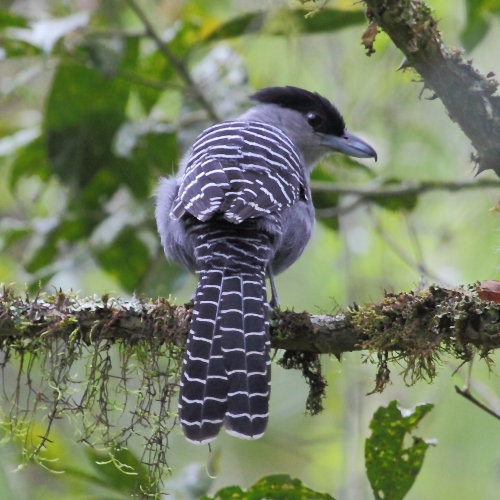
White-browed Antbird
Myrmoborus leucophrys
Order: Passeriformes / Family: Thamnophilidae

Wikimedia Commons
About the White-browed Antbird
The White-browed Antbird (Myrmoborus leucophrys) is a captivating species belonging to the Thamnophilidae family, known for its distinctive plumage and intriguing behaviors. This bird primarily inhabits the dense undergrowth of the Amazon Rainforest, where its presence signifies a well-balanced ecosystem. Found in countries such as Brazil, Peru, and Colombia, the White-browed Antbird thrives in humid, tropical climates. Its ecological role is significant as it helps control insect populations, being an active predator of ants and other small invertebrates. Through its participation in mixed-species flocks, this antbird contributes to the rich biodiversity of the Amazon Basin. Seasonal behaviors of the White-browed Antbird include subtle shifts in foraging territories, which correspond to changes in food availability in the dense jungle. During the wet season, when insect populations surge, the antbird becomes more active, taking advantage of the abundant resources. Conversely, in drier periods, it may adjust its foraging range slightly, but it remains within the forest's protective cover. The White-browed Antbird's adaptability to these seasonal changes highlights its resilience and its integral role in its habitat. Furthermore, its reliance on pristine forest environments underscores the importance of habitat conservation efforts in regions like the Amazon. This bird's presence is often a positive indicator of forest health, illustrating its value beyond mere aesthetics. The White-browed Antbird serves as a barometer for environmental changes, making it a species of interest not only to ornithologists but also to conservationists working to preserve the delicate balance of tropical ecosystems.
The White-browed Antbird belongs to the family Thamnophilidae, within the order Passeriformes. These birds typically live average 4-5 years, with a maximum recorded of 7 years..
How to Identify a White-browed Antbird
The White-browed Antbird is easily identifiable by its prominent white supercilium, or eyebrow stripe, which contrasts starkly with its otherwise dark plumage. Males exhibit a striking black face and throat, while females and juveniles show a more subdued brownish hue in these areas. The rest of the plumage is predominantly gray, with subtle variations depending on age and sex. Juveniles, in particular, possess a more mottled appearance, lacking the crispness of adult plumage. In flight, the White-browed Antbird displays a short, rounded wing structure typical of forest understory species, designed for maneuverability among dense vegetation. Its perching posture is often upright, with a slight forward lean, as it scans the leaf litter for prey. This posture, combined with its distinct coloration, aids in its identification even when partially obscured by foliage. While the White-browed Antbird may superficially resemble other antbird species, particularly those within the Myrmoborus genus, its distinctive white eyebrow and vocalizations help distinguish it from similar species.
Having trouble telling birds apart? Upload a photo to our bird identification tool for an instant species match.
White-browed Antbird Habitat and Range
Preferred Habitat
The White-browed Antbird predominantly inhabits tropical lowland forests within the Amazon Basin, favoring areas with dense undergrowth. This bird thrives at elevations ranging from sea level up to about 800 meters, where it finds ample cover and food resources. The species shows a strong preference for primary forest habitats, where the complex structure provides numerous niches. It is commonly found in countries such as Brazil, Peru, Ecuador, and Colombia. While primarily a forest dweller, the White-browed Antbird can occasionally be found in secondary growth areas that retain a dense understory, although it is less common in these habitats compared to primary forests. Unlike more adaptable species, it seldom ventures into urban or heavily altered landscapes, indicating its reliance on undisturbed forest environments.
Geographic Range
The range of the White-browed Antbird encompasses much of the Amazon Basin, with populations distributed across Brazil, Peru, Ecuador, and Colombia. It is a year-round resident of these regions, showing little to no migratory behavior. The bird's presence is most notable in the western Amazon, where dense forest tracts remain relatively intact. While not a migratory species, local movements within its range are influenced by factors such as food availability and habitat conditions. In areas where the forest remains undisturbed, the White-browed Antbird is a common sight, often detected by its vocalizations before it is seen. However, its population density can vary significantly, with higher concentrations often found in regions with minimal human disturbance.
Want to know which birds visit your area? Browse our backyard birds by location guides for region-specific species lists.
What Does the White-browed Antbird Eat?
The diet of the White-browed Antbird primarily consists of insects, with ants being a particularly favored prey. This bird employs a methodical foraging technique, often seen hopping along the forest floor as it searches through leaf litter for hidden insects. Its sharp eyesight and quick reflexes allow it to catch a variety of small invertebrates, including beetles, spiders, and caterpillars. Seasonal changes in diet correlate with the availability of prey, with a noticeable increase in feeding activity during the rainy season when insect populations peak. The White-browed Antbird also takes advantage of army ant swarms, following these swarms to catch insects flushed out by the advancing ants. This opportunistic feeding behavior highlights its adaptability and underscores its role in the forest ecosystem as a controller of insect populations.
White-browed Antbird Behavior and Social Structure
The White-browed Antbird exhibits a predominantly solitary or pair-based social structure, with individuals or pairs defending territories within the dense forest undergrowth. Territorial disputes are common, involving vocal displays and occasional physical confrontations, particularly during the breeding season. This antbird species engages in a variety of vocalizations, ranging from melodious songs to sharp alarm calls, to communicate with mates and deter intruders. Courtship involves displays of plumage and vocal duets between male and female. The White-browed Antbird's daily activity pattern is diurnal, with peak activity occurring during the cooler morning hours. It spends much of the day foraging on or near the ground, retreating to roost sites as evening approaches. The species exhibits a moderate level of curiosity towards human observers, often approaching cautiously but remaining within cover. In the presence of predators, it uses alarm calls to alert fellow antbirds and nearby species, demonstrating a keen awareness of its environment.
White-browed Antbird Nesting and Reproduction
The nesting habits of the White-browed Antbird involve constructing cup-shaped nests from leaves, twigs, and other plant materials, typically situated low in the undergrowth or occasionally on the ground. Preferred nesting sites include dense thickets with ample cover to shield the nest from predators. The typical clutch size ranges from two to three eggs, which are incubated primarily by the female for about 14 days. Both parents participate in feeding the nestlings, which fledge approximately two weeks after hatching. The White-browed Antbird may raise one or two broods per year, depending on environmental conditions and food availability. Parental roles are well-defined, with the male often taking a more active role in territory defense while the female focuses on incubation and initial feeding.
White-browed Antbird Sounds and Vocalizations
The White-browed Antbird's primary song consists of a series of clear, melodious notes that rise and fall in a rhythmic pattern, often described as a 'whip-crack' series. These songs serve to establish territory and communicate with mates. In addition to its song, the bird emits short, sharp call notes, often used to signal alarm or communicate with nearby individuals. During the dawn chorus, the White-browed Antbird's song is particularly prominent, contributing to the rich acoustic tapestry of the Amazon forest. Its calls can be compared to the sounds produced by a small whistle, clear and piercing, which carry well through the dense foliage.
Interesting Facts About the White-browed Antbird
- 1The White-browed Antbird often follows army ant swarms to catch insects flushed by the ants.
- 2Myrmoborus leucophrys exhibits sexual dimorphism, with males possessing a striking black face.
- 3This antbird's song is a key tool for territory defense and mate attraction in the dense forest.
- 4White-browed Antbirds are primarily found in the Amazon Basin, one of the world's most biodiverse areas.
- 5Their reliance on dense undergrowth makes them key indicators of forest health and habitat quality.
White-browed Antbird Conservation Status
The White-browed Antbird currently holds a status of Least Concern on the IUCN Red List, with a stable population trend. However, habitat destruction due to deforestation poses a significant threat to its long-term survival. Primary threats include logging and agricultural expansion, which fragment the bird's habitat. Conservation efforts focus on preserving large tracts of primary forest and mitigating the impacts of human encroachment. Historically, the bird's population has remained stable in well-preserved areas, but ongoing habitat degradation necessitates continued conservation attention to ensure its future.