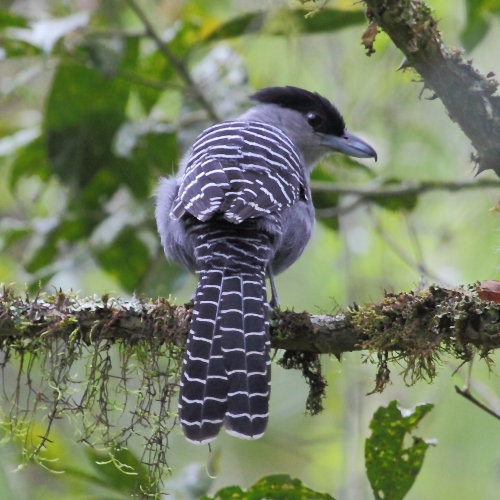
White-plumed Antbird
Pithys albifrons
Order: Passeriformes / Family: Thamnophilidae

Wikimedia Commons
About the White-plumed Antbird
The White-plumed Antbird (Pithys albifrons) is an extraordinary member of the Thamnophilidae family, known for its striking appearance and intricate behaviors. This species inhabits the dense and humid undergrowth of the Amazon rainforest, spanning regions in South America such as Brazil, Peru, and Colombia. The bird's distinctive white facial plumes set it apart from other antbirds, serving as a key identification feature. These plumes contrast sharply with its otherwise dark plumage, which helps it blend into the shady forest floor. The White-plumed Antbird plays a critical ecological role by following army ant swarms, a behavior that has been meticulously studied by ornithologists. As the ants move through the forest, they flush out insects and other prey, which the antbird deftly captures. Its dependence on these ant swarms makes it an important link in the food web of the rainforest. During the wet season, these birds engage in elaborate courtship rituals that include vocal displays and synchronized movements. As a resident species, the White-plumed Antbird does not migrate but adjusts its range slightly in response to seasonal variations in ant activity. The White-plumed Antbird's presence is a strong indicator of healthy forest ecosystems, and its absence may signal ecological degradation. Conservationists monitor this species closely due to its reliance on mature tropical forests, which continue to face threats from deforestation and habitat fragmentation. Despite these challenges, the White-plumed Antbird remains a common and widespread species within its native range. Understanding the habits and habitats of this bird provides valuable insights into the health of the Amazon rainforest and highlights the interconnectedness of its diverse ecosystems.
The White-plumed Antbird belongs to the family Thamnophilidae, within the order Passeriformes. These birds typically live average 5-7 years, with a maximum recorded of 10 years..
How to Identify a White-plumed Antbird
The White-plumed Antbird is unmistakable due to its striking white facial plumes, which are set against a backdrop of dark, primarily black plumage. Adult males and females have similar appearances, both exhibiting these prominent white plumes that resemble a beard. This feature is most noticeable when the bird is viewed head-on. Juvenile birds, however, can be confused with other antbird species as they lack fully developed plumes and possess more muted coloration. In flight, the White-plumed Antbird presents a compact silhouette with rounded wings and a short tail, typical of many understory-dwelling birds. When perched, it often adopts a slightly hunched posture, which aids in its stealthy approach to foraging. This bird's short, robust bill is another distinguishing feature, adapted for snapping up insects. Although there are several antbirds within its range, none possess the distinctive white facial plumes that characterize Pithys albifrons, making it relatively easy to identify once spotted. Observers should note its preference for remaining close to the ground, often in dense vegetation, which can make visual identification challenging despite its distinctive markings.
Having trouble telling birds apart? Upload a photo to our bird identification tool for an instant species match.
White-plumed Antbird Habitat and Range
Preferred Habitat
The White-plumed Antbird inhabits the dense undergrowth of tropical rainforests, particularly favoring the Amazon basin. It thrives in lowland forests, often below elevations of 500 meters, where dense vegetation provides ample cover and abundant food sources. This bird is closely associated with mature, undisturbed forests, although it can occasionally be found in secondary forests if they are sufficiently dense and rich in undergrowth. Seasonal shifts in habitat use are minimal, as the bird is non-migratory, but it may adjust its foraging locations in response to the movements of army ant swarms, which it relies on for food. Unlike some other bird species, the White-plumed Antbird is not typically found in urban or suburban areas, preferring remote and pristine forest habitats. Its presence is often an indicator of forest health, and it is rarely seen outside of these environments.
Geographic Range
The White-plumed Antbird is a resident species of the Amazon basin, with its range extending across several South American countries, including Brazil, Peru, Colombia, Ecuador, and Venezuela. Within these regions, it inhabits lowland rainforests, particularly thriving in areas where army ant swarms are prevalent. This range does not significantly change seasonally, as the bird is non-migratory. However, localized movements can occur as it follows the unpredictable paths of army ant swarms. Population densities of the White-plumed Antbird are highest in regions with extensive undisturbed forest cover, such as the Amazon rainforest in Brazil and the contiguous rainforests of southern Colombia and eastern Peru. While it is not considered a rare species within its range, its presence is heavily dependent on the availability of mature forest habitats.
Want to know which birds visit your area? Browse our backyard birds by location guides for region-specific species lists.
What Does the White-plumed Antbird Eat?
The diet of the White-plumed Antbird primarily consists of insects and other small arthropods, which it captures in association with army ant swarms. As the ants move through the forest, they disturb numerous insects from the leaf litter, providing the antbird with ample hunting opportunities. This bird employs a sit-and-wait foraging strategy, perching quietly until prey is flushed into view. It then swiftly darts out to capture its meal mid-air or from the ground. During the wet season, when insect abundance is higher, the White-plumed Antbird may show a slight increase in feeding activity, although it remains consistent in its reliance on army ants. Occasionally, the bird supplements its diet with small vertebrates, such as lizards or frogs, but these constitute a minor part of its overall food intake. Its feeding schedule is largely dictated by the activity of army ant swarms, and the bird is most active during daylight hours when these swarms are on the move.
White-plumed Antbird Behavior and Social Structure
The White-plumed Antbird exhibits complex social behaviors closely tied to its foraging strategy. It often participates in mixed-species flocks, particularly when following army ant swarms. These flocks provide safety in numbers and increase foraging efficiency. While generally non-aggressive, the White-plumed Antbird may exhibit territorial behavior when defending a prime feeding location from conspecifics or other ant-following species. Courtship behavior includes vocalizations and displays of its distinctive white plumes. The species tends to be monogamous, with pairs often observed together throughout the year. During the breeding season, males engage in vocal displays to attract females and warn rival males. The White-plumed Antbird is diurnal, with peak activity in the morning and late afternoon, coinciding with the movement of army ant swarms. Despite its reliance on these swarms, the bird remains vigilant against predators, using its sharp eyesight and quick reflexes to avoid threats.
White-plumed Antbird Nesting and Reproduction
White-plumed Antbirds construct their nests low to the ground, often within dense foliage or among root tangles. The nests are cup-shaped and built from leaves, twigs, and other plant materials, providing camouflage and protection. The female typically lays two eggs per clutch, with both parents sharing incubation duties. Incubation lasts approximately 14-16 days, during which the parents are highly attentive. Once hatched, the chicks remain in the nest for another 10-12 days before fledging. Parental care continues after fledging, with adults feeding the juveniles until they are fully independent. The species typically raises one brood per year, although in favorable conditions, a second brood may be attempted. The nesting period coincides with the wet season, when food resources are most abundant, supporting the high nutritional demands of raising young.
White-plumed Antbird Sounds and Vocalizations
The vocalizations of the White-plumed Antbird are complex and varied, serving multiple communication purposes. Its primary song consists of a series of rapid, high-pitched notes delivered in a rhythmic pattern. These calls are often described as sounding like a series of quick, metallic chirps. In addition to its song, the antbird emits softer contact calls to maintain communication with its mate or flock members. Alarm calls are sharp and more abrupt, serving to alert others to potential threats. During the dawn chorus, the White-plumed Antbird's song can be heard resonating through the forest, a testament to its territorial presence and readiness to start the day's foraging activities. The richness of its vocal repertoire reflects its intricate social structure and the complexities of life in the lush, bustling rainforest.
Interesting Facts About the White-plumed Antbird
- 1The White-plumed Antbird is one of the most specialized ant-followers, relying heavily on army ants to flush prey from the forest floor.
- 2Unlike many birds, the White-plumed Antbird has no seasonal migration, instead adjusting its range in response to ant swarm movements.
- 3This antbird's striking white plumes are not just ornamental; they serve as a visual signal in social interactions and courtship.
- 4The White-plumed Antbird's reliance on army ants makes it an indicator species for rainforest health and biodiversity.
- 5Despite their small size, White-plumed Antbirds are skilled hunters, capturing prey in mid-air with impressive accuracy.
- 6The species' preference for dense forest undergrowth makes it elusive to birdwatchers, requiring patience and keen observation skills to spot.
- 7White-plumed Antbirds are often found in mixed-species flocks, a strategy that enhances foraging success and predator vigilance.
White-plumed Antbird Conservation Status
The White-plumed Antbird is currently classified as Least Concern by the IUCN, with populations considered stable across its range. However, the species faces ongoing threats from habitat destruction due to logging, agriculture, and human encroachment. Conservation efforts focus on preserving large tracts of primary rainforest, which are crucial for the survival of this and many other species. While the White-plumed Antbird itself is not currently endangered, the destruction of its habitat could lead to population declines. Organizations dedicated to rainforest conservation work to establish protected areas and promote sustainable land use practices. Long-term monitoring of population trends is essential to ensure this species remains a vibrant part of the Amazon's biodiversity.