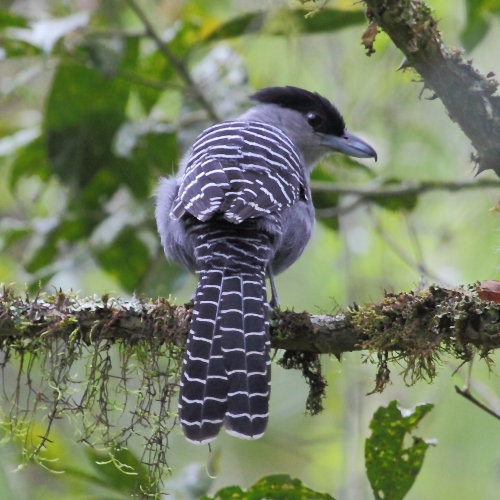
White-shouldered Antshrike
Thamnophilus aethiops
Order: Passeriformes / Family: Thamnophilidae

Wikimedia Commons
About the White-shouldered Antshrike
The White-shouldered Antshrike, scientifically known as Thamnophilus aethiops, is a captivating bird species belonging to the Thamnophilidae family. This bird is a resident of the dense tropical forests of South America, inhabiting regions from the eastern foothills of the Andes to the Amazon Basin. In countries like Brazil, Colombia, and Peru, it plays a vital ecological role as an insectivore, helping to manage insect populations. Its presence indicates a healthy, biodiverse forest ecosystem.
The White-shouldered Antshrike is part of a larger group of antbirds that primarily feed on insects. These birds contribute significantly to the forest's health by controlling insect populations. They are often found in the lower strata of the forest, where they forage methodically through the understory. This behavior not only helps maintain the ecological balance but also supports other species that rely on these insects as a food source.
This antshrike exhibits seasonally varied behaviors, often dictated by the availability of prey. During the rainy season, when insect abundance is at its peak, the White-shouldered Antshrike is most active, engaging in intensive foraging to meet its dietary needs. Conversely, in drier periods, its activity might decrease slightly, reflecting changes in prey availability. The antshrike's adaptability to these seasonal changes exemplifies its resilience and crucial role within its habitat.
The White-shouldered Antshrike belongs to the family Thamnophilidae, within the order Passeriformes. These birds typically live average 4-5 years, with a maximum recorded of 7 years..
How to Identify a White-shouldered Antshrike
The White-shouldered Antshrike can be identified by its distinctive plumage and structural features. Adult males are predominantly black with striking white patches on their shoulders, which are most visible during flight. These patches give the species its common name. Females, on the other hand, are more subdued in color, displaying a mixture of brown and gray tones with smaller, less conspicuous shoulder patches. This sexual dimorphism aids in field identification. Juveniles resemble females but may have a more mottled appearance as they transition to adult plumage.
In terms of behavior, the White-shouldered Antshrike often perches in a horizontal posture, which is typical for antbirds. Its flight is short and direct, usually between dense foliage, making it more often heard than seen. The bird's silhouette is somewhat compact, with a stout bill adapted for its insectivorous diet.
When observing this species, one might confuse it with other antshrikes or antbirds that share overlapping habitats. However, the white shoulder patches of Thamnophilus aethiops are a reliable distinguishing feature. Additionally, this antshrike's vocalizations can help differentiate it from similar species, as its calls are distinct in rhythm and pitch.
Having trouble telling birds apart? Upload a photo to our bird identification tool for an instant species match.
White-shouldered Antshrike Habitat and Range
Preferred Habitat
The White-shouldered Antshrike inhabits lowland tropical forests, particularly favoring dense understory and secondary growth. It thrives in humid environments, often found in primary and secondary forests up to 1300 meters in elevation. This species shows a preference for intact forest environments but can sometimes be found in degraded habitats where sufficient cover remains.
Unlike some other bird species, the White-shouldered Antshrike does not typically venture into urban areas. Its presence is primarily tied to dense, forested regions where it can find ample food and shelter. Throughout the year, the antshrike remains in these forested environments, showcasing limited habitat shifts. This stability in habitat preference underscores the importance of forest conservation for the survival of this species.
Geographic Range
The White-shouldered Antshrike is a resident species in the northern and central regions of South America. Its range extends across countries such as Brazil, Colombia, Peru, Ecuador, and Venezuela. Within these countries, it inhabits forested areas along the Amazon Basin and eastern Andes foothills.
This bird does not partake in long-distance migrations, instead maintaining a relatively stable range year-round. Its presence is most dense in areas with extensive forest cover, where it finds both food and nesting opportunities. Due to its preference for dense forest habitats, the antshrike's populations are concentrated in undisturbed areas, although it can sometimes be spotted in fragmented forests with sufficient understory.
The White-shouldered Antshrike's stable residency in these regions makes it an indicator species for the health of tropical forest ecosystems. Its presence signifies a thriving environment with a balanced food web.
Want to know which birds visit your area? Browse our backyard birds by location guides for region-specific species lists.
What Does the White-shouldered Antshrike Eat?
The diet of the White-shouldered Antshrike is primarily insectivorous, consisting mainly of ants, beetles, and other small arthropods. During the wet season, when insect populations burgeon, the antshrike actively forages throughout the day, capitalizing on the abundance of prey. It employs a methodical foraging technique, moving slowly through the underbrush, carefully inspecting leaves and twigs for hidden insects.
In addition to ants and beetles, the antshrike's diet may include small spiders and occasionally other invertebrates. The size of prey is typically small to medium, aligning with the bird's bill size and foraging strategy. The White-shouldered Antshrike displays a preference for foraging in mixed-species flocks, which can increase foraging success by flushing out insects that it might not access alone.
During dry periods, the bird may adjust its diet slightly, incorporating more varied prey to compensate for reduced insect availability. This dietary adaptability ensures that the White-shouldered Antshrike remains a resilient and effective insect predator throughout the year.
White-shouldered Antshrike Behavior and Social Structure
The White-shouldered Antshrike exhibits a range of behaviors that reflect its ecological niche as an insectivore in tropical forests. It is primarily solitary or found in pairs, occasionally joining mixed-species flocks that traverse the forest understory. This social behavior enhances its foraging efficiency, as the movement of the flock can disturb insects that would otherwise remain hidden.
Territorial behavior is evident in this species, with pairs maintaining and defending specific areas within the forest. Vocalizations play a crucial role in territorial defense and communication between mates. The White-shouldered Antshrike's calls are sharp and penetrating, often echoing through its habitat as a deterrent to intruders.
Courtship displays are subtle, involving vocal exchanges and displays of the white shoulder patches, particularly by males. During the breeding season, which coincides with the wettest months, these displays become more frequent, strengthening pair bonds. The antshrike's daily activity patterns involve intensive foraging during the early morning and late afternoon, with periods of rest during the hottest parts of the day. When faced with predators, the antshrike relies on its cryptic coloration and dense habitat to avoid detection rather than active confrontation.
White-shouldered Antshrike Nesting and Reproduction
Nesting for the White-shouldered Antshrike involves the construction of a cup-shaped nest, typically situated low in the forest understory. The nest is built from twigs, leaves, and other plant materials, providing camouflage in the dense foliage. These nests are often placed in shrubs or small trees, offering protection from predators and environmental elements.
The female typically lays a clutch of two eggs, which both parents incubate for a period of about 14 to 16 days. During incubation, the male and female share duties, with one adult always present at the nest to guard against potential threats.
After hatching, the chicks remain in the nest for approximately two weeks before fledging. Both parents participate in feeding the young, bringing insects and small arthropods to the nest. The fledging period is a critical time for the chicks, as they must learn to forage independently while still receiving parental support. The White-shouldered Antshrike commonly raises one brood per year, aligning its reproductive cycle with periods of high insect availability.
White-shouldered Antshrike Sounds and Vocalizations
The primary song of the White-shouldered Antshrike is a series of sharp, repetitive notes that carry well through the dense forest. This vocalization serves both territorial and mating purposes, often delivered from a concealed perch. The rhythm is consistent, with a slightly ascending pitch towards the end.
In addition to its primary song, the antshrike uses a variety of call notes, ranging from soft chirps to more aggressive, warning calls when predators approach. Alarm calls are abrupt and louder, designed to alert both its mate and other species in the vicinity of potential danger.
The dawn chorus sees a peak in vocal activity, as the White-shouldered Antshrike establishes its presence in the territory. Compared to other antbirds, its song is less melodic but equally effective in communication.
Interesting Facts About the White-shouldered Antshrike
- 1The White-shouldered Antshrike is often heard before it is seen, thanks to its distinctive vocalizations that echo through the forest.
- 2Despite its name, the White-shouldered Antshrike feeds on a variety of insects, not just ants, showcasing its dietary flexibility.
- 3This species is part of a diverse family of antbirds, with over 200 species sharing similar insectivorous habits.
- 4The White-shouldered Antshrike exhibits sexual dimorphism, with males displaying more vivid shoulder patches than females.
- 5These birds often participate in mixed-species flocks, enhancing their foraging success by disturbing insects hidden in foliage.
- 6The antshrike's presence in a forest indicates a healthy ecosystem, as it thrives in areas with abundant insect life.
- 7Breeding coincides with the wet season, ensuring ample food supply for their young during the critical fledging period.
White-shouldered Antshrike Conservation Status
The International Union for Conservation of Nature (IUCN) currently lists the White-shouldered Antshrike as a species of Least Concern. Its population trend remains stable, primarily due to its adaptability to various forested environments. However, habitat loss due to deforestation and land conversion poses a significant threat. Conservation efforts focus on preserving large tracts of tropical forests, crucial for maintaining viable populations. Protected areas in countries like Brazil and Peru offer some refuge from habitat destruction. Historically, the species has maintained stable numbers, but ongoing deforestation could alter this trend. Continued monitoring and habitat protection are essential to ensure the White-shouldered Antshrike's survival. Organizations are working to implement sustainable land management practices that benefit both local communities and wildlife.