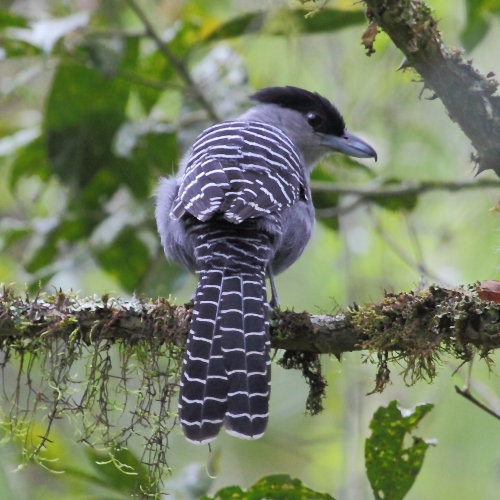
White-shouldered Fire-eye
Pyriglena leucoptera
Order: Passeriformes / Family: Thamnophilidae

Wikimedia Commons
About the White-shouldered Fire-eye
The White-shouldered Fire-eye, Pyriglena leucoptera, is a captivating member of the Thamnophilidae family, primarily found in the humid, dense forests of southeastern Brazil, eastern Paraguay, and northeastern Argentina. This bird exhibits a unique combination of black and white plumage, with its most distinguishing feature being the conspicuous white shoulder patches that contrast sharply against its otherwise dark body. The species thrives in the understory of both primary and secondary forests, often favoring areas with dense vegetation. These fire-eyes play a significant ecological role as insectivores, which helps control insect populations, thereby maintaining the health of their forested habitats. They are also known to be quite vocal, contributing to the rich soundscape of their environment. Seasonally, the White-shouldered Fire-eye remains largely resident, with no significant migratory movements recorded. However, some local movements might occur in response to food availability or habitat changes. This species is particularly significant for birdwatchers and researchers interested in the biodiversity of the Atlantic Forest biome, a biodiversity hotspot that harbors many endemic and threatened species. As these birds are sensitive to environmental changes, they serve as indicators of forest health and can highlight the impact of habitat fragmentation. Understanding the life and habits of the White-shouldered Fire-eye can offer insights into the broader dynamics of forest ecosystems in South America, emphasizing the importance of conservation efforts in these regions.
The White-shouldered Fire-eye belongs to the family Thamnophilidae, within the order Passeriformes. These birds typically live 5-8 years, with a maximum recorded of 10 years..
How to Identify a White-shouldered Fire-eye
The White-shouldered Fire-eye, an unmistakable bird of the forest understory, is characterized by its striking white shoulder patches which appear more pronounced in males. Males boast a stark black plumage, providing a vivid contrast to the eye-catching white patches on their wings. In contrast, females have a more subdued, dark brown plumage, though they share the distinctive white shoulder markings. Juveniles resemble females but often display a more mottled appearance. Differentiating this species from similar birds such as the White-backed Fire-eye can be challenging; however, the lack of extensive white on the back in the White-shouldered Fire-eye serves as a key distinguishing feature. In flight, their broad wings and slightly rounded tail create a unique silhouette. When perched, they adopt a slightly hunched posture, often flicking their wings and tail, which can aid in field identification. Despite their vibrant plumage, these birds can be elusive, often blending into the shadows of the forest undergrowth. Observers must be vigilant and patient to catch sight of these forest dwellers.
Having trouble telling birds apart? Upload a photo to our bird identification tool for an instant species match.
White-shouldered Fire-eye Habitat and Range
Preferred Habitat
The White-shouldered Fire-eye predominantly occupies the Atlantic Forest of South America, a region known for its high humidity and biodiversity. This bird favors the understory of dense, humid forests, thriving in both primary and secondary growth areas. Its habitat includes lowland tropical forests up to 1,200 meters in elevation, where it finds ample cover and food resources. While it is primarily a forest bird, the White-shouldered Fire-eye can occasionally be found in shrubby areas and forest edges, particularly where human encroachment has fragmented their natural habitat. Unlike some forest species, it does not typically venture into urban environments. Seasonal habitat shifts are minimal, as the bird remains resident year-round, relying heavily on the forest's resources. Its presence in the understory plays a crucial role in maintaining the ecological balance, as it preys on insects that inhabit the leaf litter and lower vegetation.
Geographic Range
The White-shouldered Fire-eye's range is concentrated in southeastern Brazil, extending into eastern Paraguay and northeastern Argentina. Within Brazil, it is commonly found in the states of Minas Gerais, Espírito Santo, Rio de Janeiro, São Paulo, and Paraná, where the Atlantic Forest provides a suitable habitat. The species does not undertake long-distance migrations, maintaining a resident status throughout its range. However, it may exhibit minor local movements in response to ecological pressures such as food availability or habitat disturbance. Population densities are highest in well-preserved forest tracts, with protected areas serving as critical refuges. Despite its relatively stable population in these regions, ongoing deforestation and habitat fragmentation pose significant threats, potentially altering its distribution over time. Conservation efforts in these regions focus on preserving the remaining tracts of the Atlantic Forest to ensure the survival of this and other endemic species.
Want to know which birds visit your area? Browse our backyard birds by location guides for region-specific species lists.
What Does the White-shouldered Fire-eye Eat?
The diet of the White-shouldered Fire-eye primarily consists of insects and other small arthropods, making it a key player in controlling invertebrate populations within its habitat. It forages actively in the forest understory, hopping along the ground and through low vegetation in search of prey. Its feeding technique involves picking insects from leaves, bark, and the forest floor. Seasonally, its diet may vary slightly depending on the availability of prey, but it remains predominantly insectivorous throughout the year. The bird's keen eyesight and quick reflexes aid in capturing a variety of insects, including beetles, ants, and spiders. Prey size is generally small, reflecting the limited gape of this medium-sized bird. Feeding occurs throughout the day, with peak activity during the cooler morning and late afternoon hours when insect activity is also heightened. This dietary strategy not only fulfills the bird's nutritional needs but also benefits the broader ecosystem by mitigating potential pest outbreaks.
White-shouldered Fire-eye Behavior and Social Structure
White-shouldered Fire-eyes exhibit a somewhat secretive yet active behavior, often seen foraging alone or in pairs within the dense understory of their forest homes. These birds are known for their territorial nature, defending their chosen area vigorously against intruders. During the breeding season, males engage in elaborate displays to attract females, including vocalizations and wing-flicking, which highlight their striking white shoulder patches. While they can be elusive, these fire-eyes are quite vocal, using a series of calls to communicate with mates and establish territory. Their social structure is primarily pair-based, with little evidence of flocking behavior outside the family unit. When threatened by predators, the White-shouldered Fire-eye employs evasive tactics, using the dense vegetation to its advantage. Daily activity patterns include periods of intense foraging, interspersed with rest and preening sessions. The bird's adaptability and resourcefulness are key to its survival in the competitive forest ecosystem.
White-shouldered Fire-eye Nesting and Reproduction
The nesting habits of the White-shouldered Fire-eye are characterized by a preference for well-concealed sites within dense vegetation. The nest itself is an open cup made from twigs, leaves, and other plant materials, carefully woven to provide stability. These nests are typically placed low to the ground, often in shrubs or small trees. The female lays 2 to 3 eggs per clutch, with an incubation period of approximately 14 to 16 days. Both parents share responsibilities, with duties including incubation and feeding of the chicks after hatching. The fledging period lasts about 12 to 14 days, during which the chicks develop rapidly, supported by the diligent care of both parents. Generally, the White-shouldered Fire-eye raises one brood per year, though conditions such as food availability and environmental stability can influence breeding success and frequency.
White-shouldered Fire-eye Sounds and Vocalizations
The White-shouldered Fire-eye's song is a distinctive, rhythmic series of whistles and trills, often described as a repetitive 'whee-whee-whee' that can vary in pitch and intensity. This vocalization serves as both a territorial signal and a means of communication between mates. Call notes include sharp 'chit' and 'chip' sounds, used in close-range interactions. Alarm calls are more urgent, designed to alert conspecifics of potential threats. During the dawn chorus, the White-shouldered Fire-eye contributes its unique song to the symphony of the forest, establishing its presence within its territory. This vocal repertoire, while not as elaborate as some songbirds, plays a crucial role in the bird's social and ecological interactions.
Interesting Facts About the White-shouldered Fire-eye
- 1The White-shouldered Fire-eye's territorial calls can carry over long distances, up to 100 meters, through dense forest foliage.
- 2Despite their vibrant coloration, White-shouldered Fire-eyes often go unnoticed due to their secretive nature and skulking behavior.
- 3The White-shouldered Fire-eye is closely related to other antbirds, sharing common ancestors in the diverse Thamnophilidae family.
- 4These birds are known for their strong pair bonds, with mates often remaining together throughout the year.
- 5White-shouldered Fire-eyes are adept at navigating dense underbrush, using their short wings and strong legs to maneuver skillfully.
- 6They contribute to the ecological health of forests by preying on insects that can otherwise become pests.
- 7The White-shouldered Fire-eye's presence is a key indicator of a healthy forest ecosystem, due to its reliance on intact habitats.
White-shouldered Fire-eye Conservation Status
Currently classified as Least Concern by the IUCN, the White-shouldered Fire-eye faces challenges due to habitat loss and fragmentation, particularly in the biodiverse but threatened Atlantic Forest. While the overall population trend appears stable, localized declines have been observed in areas with significant deforestation. Primary threats include agricultural expansion, logging, and urban development, which reduce available habitat and resources. Conservation efforts focus on protecting existing forest tracts and restoring degraded areas. Historical accounts suggest that the species was once more widespread, but human activity has reduced its range. Continued monitoring and habitat preservation are essential to ensure its survival amidst ongoing environmental pressures.