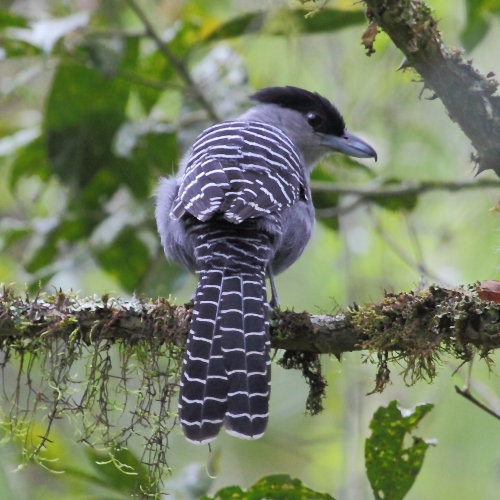
White-streaked Antvireo
Dysithamnus leucostictus
Order: Passeriformes / Family: Thamnophilidae

Wikimedia Commons
About the White-streaked Antvireo
The White-streaked Antvireo (Dysithamnus leucostictus) is a compelling example of the biodiversity found in the dense forests of South America. This species, part of the Thamnophilidae family, plays a crucial role in the ecosystems where it resides, primarily in the cloud forests of Colombia and Venezuela. As a resident bird, it has adapted to life within the understory of these rich tropical forests, where moisture and dense vegetation provide a haven for its foraging activities. Ecologically, the antvireo contributes to insect population control, consuming various arthropods and thus maintaining the balance within its habitat. Moreover, its presence indicates the health of the forest ecosystems, as it thrives in undisturbed habitats with rich plant and animal life. The White-streaked Antvireo is particularly significant for birdwatchers and conservationists due to its sensitivity to habitat changes. Seasonal behaviors of this bird are relatively stable, given its non-migratory nature. However, it may display slight altitudinal movements within its range in response to climatic variations or food availability. Understanding its role in the dense forests can offer insights into the broader ecological dynamics at play in these regions.
The White-streaked Antvireo belongs to the family Thamnophilidae, within the order Passeriformes. These birds typically live average 4-5 years, with a max recorded of 6 years..
How to Identify a White-streaked Antvireo
The adult White-streaked Antvireo features a distinctive plumage with prominent white streaks against a gray body, making it relatively easy to identify in its understorey habitat. Males typically show more vivid streaking compared to females, who display slightly duller coloration. Juveniles often exhibit a brownish tint and less defined streaks, which gradually become more pronounced as they mature. The bird's small size and robust body, typical of the antbird family, set it apart from other species. Its flight silhouette is compact with short, rounded wings suited for maneuvering through thick vegetation. In terms of perching, the antvireo often adopts a horizontal posture, moving stealthily along branches as it searches for prey. While it could be confused with other antbirds, the specific pattern and coloration of its plumage help distinguish it.
Having trouble telling birds apart? Upload a photo to our bird identification tool for an instant species match.
White-streaked Antvireo Habitat and Range
Preferred Habitat
The White-streaked Antvireo is predominantly found in the humid cloud forests of northern South America, preferring altitudes ranging from 900 to 2500 meters. These forests offer a rich tapestry of vegetation that supports its insectivorous diet. Although primarily a forest dweller, the bird may inhabit secondary growth and forest edges, particularly in areas undergoing slight ecological changes. Unlike some species, the antvireo does not commonly venture into urbanized zones, maintaining a preference for undisturbed natural settings. Seasonal habitat shifts are minimal, although slight altitude adjustments may occur in response to climatic changes or food availability.
Geographic Range
The breeding and resident range of the White-streaked Antvireo is localized to the cloud forests of Colombia and Venezuela. Within these countries, it is more common in regions such as the Sierra Nevada de Santa Marta and the Andes, where the environment supports its lifestyle. There is no significant migration pattern, as this species is primarily sedentary, though some populations might exhibit minor altitudinal movements. Population densities are highest in well-preserved forest areas, emphasizing the importance of habitat conservation in these regions.
Want to know which birds visit your area? Browse our backyard birds by location guides for region-specific species lists.
What Does the White-streaked Antvireo Eat?
Primarily insectivorous, the White-streaked Antvireo's diet consists of a variety of arthropods, including ants, beetles, and spiders. It utilizes a gleaning foraging technique, meticulously searching leaves and branches for prey, often hanging upside down to reach hidden insects. The bird's diet may experience slight seasonal variations, with an increased intake of certain prey types during periods of abundance. Prey size generally ranges from small to medium-sized insects, aligning with the bird's foraging capabilities. The antvireo typically forages during daylight hours, with peak activity coinciding with the cooler times of the day.
White-streaked Antvireo Behavior and Social Structure
The social behavior of the White-streaked Antvireo is characterized by its territorial nature and preference for forming monogamous pairs. These birds maintain defined territories within their forest habitats, using song to communicate boundaries and deter rivals. Courtship displays are subtle, often involving mutual preening and vocalizations. Unlike some other antbird species, the White-streaked Antvireo tends not to form large flocks, instead associating with mixed-species foraging groups for increased foraging efficiency. Its response to predators includes staying concealed within dense foliage and sometimes emitting alarm calls. Daily activity patterns consist of active foraging during the morning and late afternoon, resting during the hottest midday hours.
White-streaked Antvireo Nesting and Reproduction
Nesting for the White-streaked Antvireo involves building a small, cup-shaped nest placed low in a shrub or small tree, often hidden among thick vegetation. The nest is constructed from plant fibers, leaves, and spider silk, providing both camouflage and structural integrity. Typically, the female lays two eggs per clutch, with both parents sharing incubation duties over a period of 15-17 days. After hatching, the fledging period lasts approximately 10-12 days, during which both parents actively feed the young. The species generally produces one brood per year, though optimal conditions might allow for a second.
White-streaked Antvireo Sounds and Vocalizations
The White-streaked Antvireo's primary song consists of a series of clear, melodious notes delivered at a steady rhythm. This song serves both territorial and mating purposes. Call notes are short and sharp, often used for communication between pair members or as alarm signals. In the presence of danger, the antvireo may emit a series of harsh, repetitive calls as a warning to other birds. During the dawn chorus, these birds contribute a softer version of their song, blending seamlessly with the soundscape of the forest.
Interesting Facts About the White-streaked Antvireo
- 1The White-streaked Antvireo's foraging technique of hanging upside down is similar to that of a nuthatch.
- 2Despite its small size, the White-streaked Antvireo can be highly territorial, aggressively defending its area from intruders.
- 3This bird is often heard before it is seen, as its song carries well through the dense forest understory.
- 4The White-streaked Antvireo's reliance on pristine forest habitats makes it an excellent indicator species for ecosystem health.
- 5Both male and female White-streaked Antvireos participate equally in nesting duties, showcasing strong parental cooperation.
- 6In mixed-species flocks, the White-streaked Antvireo often takes up a position that allows it to spot and capture insects dislodged by other birds.
- 7The species' name, Dysithamnus leucostictus, reflects its distinct white streaks ('leucostictus' means 'white-spotted' in Greek).
White-streaked Antvireo Conservation Status
Currently classified as Least Concern by the IUCN, the White-streaked Antvireo faces threats primarily from habitat destruction due to deforestation and land conversion for agriculture. Despite a stable population trend, localized declines have occurred in areas of significant habitat degradation. Conservation efforts focus on habitat protection and creating reserves to safeguard their forest environment. Historically, the bird's population has remained relatively stable, but ongoing environmental pressures require continuous monitoring and conservation action.