White-throated Antbird
Gymnopithys salvini
Order: Passeriformes / Family: Thamnophilidae

Wikimedia Commons
About the White-throated Antbird
The White-throated Antbird (Gymnopithys salvini) is a captivating species native to the tropical forests of Central and South America. Renowned for its striking white throat, this bird is a member of the Thamnophilidae family, a group well-known for their ant-following behavior. These antbirds play a crucial ecological role by participating in mixed-species flocks that follow army ants. As the ants forage, they disturb insects and other small creatures, which the antbirds promptly catch. This mutualistic relationship allows the White-throated Antbird to exploit food resources that would otherwise remain hidden.
In terms of geographical distribution, the White-throated Antbird is predominantly found in countries such as Costa Rica, Panama, Colombia, and Ecuador. These regions offer the dense, humid forest environments that the birds prefer. The antbird's habitat choice is a testament to its adaptability within the neotropical ecosystems, as it occupies both primary and secondary forests.
Seasonally, the White-throated Antbird does not migrate extensively, instead remaining within its established territory year-round. This resident behavior underscores the bird's reliance on stable forest ecosystems that provide consistent access to food and nesting sites. Its presence in these forests highlights the importance of conservation efforts aimed at preserving tropical habitats, which are under constant threat from deforestation.
The White-throated Antbird serves as an indicator species for the health of the forest ecosystems it inhabits. Changes in its population can reflect broader ecological shifts, making it a valuable subject for ornithologists and conservationists alike. The species' interdependence with both ants and forest habitats underscores the complex web of interactions that sustain tropical biodiversity.
The White-throated Antbird belongs to the family Thamnophilidae, within the order Passeriformes. These birds typically live average 5 years, with a maximum recorded of 8 years..
How to Identify a White-throated Antbird
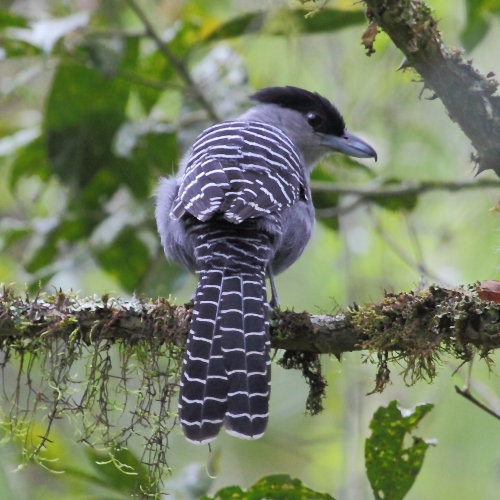
The White-throated Antbird is a small, stocky bird, easily recognized by its namesake white throat patch, which contrasts sharply with its otherwise dark plumage. Adults exhibit a primarily black and brown coloration, with males generally darker than females. The bird's back and wings are a rich chocolate brown, while the head and underparts are black. In both sexes, the white throat is a standout feature, often the first thing noticed by birders in the field.
Juvenile White-throated Antbirds display slightly duller plumage compared to adults, with a more muted brown and gray coloration. The white throat patch is less pronounced in young birds, developing more distinctly as they mature. This age-related variation can sometimes cause confusion in the field, especially when distinguishing juveniles from adults.
In flight, the White-throated Antbird exhibits rapid wingbeats and a somewhat jerky flight pattern typical of many forest-dwelling passerines. When perched, the bird often holds a low, horizontal posture, blending seamlessly into the shadowy understory. Despite its striking throat patch, the bird remains surprisingly elusive, making patience and keen observation essential for identification.
Having trouble telling birds apart? Upload a photo to our bird identification tool for an instant species match.
White-throated Antbird Habitat and Range
Preferred Habitat
The White-throated Antbird inhabits the dense, humid lowland forests of Central and South America. These birds are typically found in primary and secondary forests, where the thick understory provides ample cover and food resources. Elevation ranges from sea level to about 1,200 meters, although they are most commonly observed in lowland regions.
The bird's preference for moist, tropical environments means it shies away from urban areas, instead favoring the undisturbed habitats of national parks and protected reserves. Unlike some other bird species, the White-throated Antbird does not exhibit significant seasonal habitat shifts, remaining within its forested territories throughout the year.
Within these forests, the antbird occupies a niche that involves following swarms of army ants. This behavior necessitates a habitat rich in insect life, where the bird can capitalize on the insects and small vertebrates flushed out by the ants. The preservation of such habitats is crucial for the continued survival of the White-throated Antbird.
Geographic Range
The White-throated Antbird's range extends throughout the humid lowland forests of Central and South America. It has a stable presence in countries such as Costa Rica, Panama, Colombia, and Ecuador. Within these regions, the bird occupies forested areas that are increasingly fragmented by human activity, which poses a threat to its habitat.
The species does not engage in extensive seasonal migrations, remaining within its breeding range year-round. This sedentary lifestyle is typical of many tropical birds, which rely on the consistent availability of food and nesting sites. Despite this, the White-throated Antbird may exhibit local movements in response to environmental pressures or changes in prey availability.
Population densities are highest in areas where army ant swarms are frequent, as these provide rich feeding grounds. Conservation areas in the Amazon Basin and other protected reserves serve as key strongholds for the species, offering refuge from the encroachment of agricultural and urban development.
Want to know which birds visit your area? Browse our backyard birds by location guides for region-specific species lists.
What Does the White-throated Antbird Eat?
The White-throated Antbird's diet primarily consists of insects and other small invertebrates, which it captures as they flee from army ant swarms. This specialization in ant-following behavior allows the bird to access a consistent food source in the dense undergrowth of tropical forests.
During feeding, the antbird positions itself near the advancing front of the ant swarm, capturing prey that includes beetles, spiders, and small lizards. The bird employs a 'sit-and-wait' foraging strategy, remaining motionless until a potential meal moves into view. This technique is highly effective, enabling the White-throated Antbird to exploit the movement of the ants without expending unnecessary energy.
Seasonal variations in diet are minimal due to the year-round presence of army ants. However, during periods of low ant activity, the bird may supplement its diet with other insects and small arthropods found in the leaf litter. The antbird's reliance on these ants highlights the intricacies of its ecological role and the interdependence of species within tropical ecosystems.
White-throated Antbird Behavior and Social Structure
The White-throated Antbird displays a solitary and secretive nature, often encountered alone or in pairs rather than in large flocks. Its behavior centers around following army ant swarms, a strategy that dictates much of its daily activity and social interactions. Territorial by nature, the White-throated Antbird defends its feeding grounds vigorously, with males often engaging in vocal displays to assert dominance.
Courtship involves a series of subtle behaviors, with males presenting food to females as a display of suitability. This behavior strengthens pair bonds and plays a crucial role in breeding success. Once paired, the birds maintain close proximity to one another, often foraging side by side.
The White-throated Antbird exhibits a heightened response to predators, relying on its cryptic plumage and understory habitat to avoid detection. When threatened, it remains motionless, blending seamlessly into the forest shadows. This strategy is effective against avian predators, but less so against snakes, which pose a significant threat.
Daily activities revolve around feeding and defending territory. The bird is most active during the cooler hours of the morning and late afternoon, when ant swarms are at their peak. This schedule minimizes exposure to the midday heat and aligns with the activity patterns of its primary food source.
White-throated Antbird Nesting and Reproduction
The White-throated Antbird constructs its nest in the dense understory of tropical forests, often choosing well-concealed locations to avoid predators. The nest itself is a cup-shaped structure, crafted from leaves, twigs, and other plant materials, carefully woven together.
Nesting typically occurs during the rainy season, when food is abundant. The female lays a clutch of 2-3 eggs, which are incubated for approximately 14-16 days. Both parents share incubation duties, taking turns to ensure the eggs remain at a consistent temperature.
Once hatched, the chicks are altricial, requiring extensive parental care. Both male and female White-throated Antbirds participate in feeding and defending the young, with the fledging period lasting around 10-12 days. After fledging, juveniles remain dependent on their parents for several weeks as they learn to forage and navigate their environment.
The species generally raises one brood per year, although favorable conditions may occasionally allow for a second. This low reproductive rate emphasizes the importance of stable, undisturbed habitats for the long-term success of the species.
White-throated Antbird Sounds and Vocalizations
The White-throated Antbird's vocal repertoire includes a distinctive song and a variety of calls. Its primary song consists of a series of sharp, rapid notes that rise in pitch, resembling a descending whistle. This melody is often repeated during territorial disputes or when attracting a mate.
Call notes are shorter and more abrupt, used for communication between pair members and to signal alarm. In the presence of predators, the bird emits a harsh, chattering call that serves to alert other nearby antbirds.
During the dawn chorus, the White-throated Antbird's voice contributes to the symphony of forest sounds. Its song, while not as melodious as some other passerines, plays a crucial role in maintaining territorial boundaries and facilitating social interactions.
Interesting Facts About the White-throated Antbird
- 1The White-throated Antbird is one of over 230 species in the Thamnophilidae family, known for its ant-following behavior.
- 2Despite their elusive nature, White-throated Antbirds are essential indicators of healthy tropical forest ecosystems.
- 3These antbirds rarely fly long distances, preferring to move stealthily through the understory in search of food.
- 4White-throated Antbirds can adjust their feeding schedules to align with the peak activity times of army ant swarms.
- 5The species' dependence on ants highlights the intricate ecological relationships within tropical forests.
- 6In regions where forests remain intact, the White-throated Antbird's population is generally stable.
- 7The antbird's cryptic plumage provides effective camouflage, aiding in its survival against predators.
White-throated Antbird Conservation Status
The White-throated Antbird is currently classified as Least Concern by the IUCN, with stable population trends across its range. However, ongoing threats such as deforestation and habitat fragmentation pose significant risks to its habitat. The species' reliance on undisturbed tropical forests makes it vulnerable to the impacts of logging and agricultural expansion. Conservation efforts focus on preserving large tracts of contiguous forest, which are essential for maintaining healthy populations of both the antbirds and the army ants they depend on. Protected areas and national parks in regions like the Amazon Basin serve as crucial refuges for the species. Historical data indicates that while the White-throated Antbird has adapted to some degree of habitat alteration, significant population declines could occur if deforestation continues unchecked. Conservationists emphasize the importance of sustainable land-use practices and increased awareness to ensure the long-term survival of this distinctive antbird.