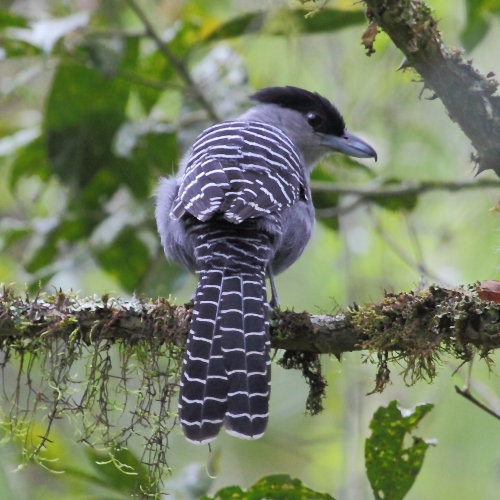
Willis's Antbird
Cercomacra laeta
Order: Passeriformes / Family: Thamnophilidae

Wikimedia Commons
About the Willis's Antbird
Willis's Antbird, known scientifically as Cercomacra laeta, is a fascinating and charismatic member of the Thamnophilidae family, which includes the broad group of antbirds. These birds are primarily found in the Amazon Basin, a biodiverse region covering parts of Brazil, Peru, Colombia, and Bolivia. With its preference for dense undergrowth in humid tropical forests, Willis's Antbird plays a crucial role in the intricate ecological networks of these habitats.
The bird's significance lies in its feeding behavior and role in the ecosystem. As a regular participant in mixed-species flocks, it often follows army ant swarms to catch fleeing insects. This behavior not only helps control insect populations but also supports the antbird's survival in competitive environments. The bird's presence indicates a healthy, insect-rich habitat, making it an essential bioindicator for conservationists.
Willis's Antbird showcases notable seasonal behaviors. During the breeding season, which typically coincides with the rainy season, the males are more vocal, engaging in complex songs to establish territories and attract mates. Outside the breeding period, the bird's activity shifts slightly as it becomes part of larger mixed-species flocks, demonstrating its adaptability and social nature.
The bird's ecological role extends beyond its diet. By participating in mixed flocks, Willis's Antbird contributes to the maintenance of forest health and diversity. These flocks are dynamic networks that enhance foraging efficiency and predator vigilance, crucial for survival in the dense Amazonian undergrowth. Through its interactions and behaviors, Willis's Antbird exemplifies the interconnectedness of tropical forest ecosystems.
The Willis's Antbird belongs to the family Thamnophilidae, within the order Passeriformes. These birds typically live average 5 years with a max recorded of 7 years.
How to Identify a Willis's Antbird
The identification of Willis's Antbird begins with its distinctive plumage. Adult males typically exhibit a striking black coloration with subtle white markings on their wings, which can be a key field mark. In contrast, females have a more subdued appearance, featuring brownish tones with lighter, buffy underparts. This sexual dimorphism helps in differentiating males from females at a glance.
Juvenile Willis's Antbirds tend to resemble females but with even duller plumage, often lacking the distinct markings seen in adults. This difference in appearance not only aids in age identification but also offers some camouflage for the more vulnerable young birds.
Confusion with similar species may arise with other antbirds, such as the Black Antbird or the White-bellied Antbird. However, Willis's Antbird's specific vocalizations and habitat preferences help distinguish it from these relatives. In flight, its silhouette is compact with rounded wings, contributing to its agile maneuvers through dense forest canopies. When perched, it often sits with a slight forward lean, peering intently into the undergrowth, a posture that reflects its active and alert nature.
Having trouble telling birds apart? Upload a photo to our bird identification tool for an instant species match.
Willis's Antbird Habitat and Range
Preferred Habitat
Willis's Antbird inhabits the dense undergrowth of humid tropical forests within the Amazon Basin. It thrives in primary forests, where the canopy provides ample cover and the forest floor is rich with insect life. These birds prefer areas with thick vegetation, including vines and low shrubs, which offer both food sources and protection from predators.
In terms of elevation, Willis's Antbird is generally found from lowland areas up to about 500 meters. It does not typically venture into urban areas, remaining steadfastly bound to its forested environments. Seasonal habitat shifts are minimal, as it is a year-round resident of its preferred forest locales, adapting to minor seasonal changes in the forest structure and availability of prey.
The bird's presence is a reliable indicator of well-preserved forest areas, as it requires intact habitats with minimal human disturbance. Its avoidance of open or degraded areas underscores the importance of conserving large tracts of forest to maintain its populations.
Geographic Range
Willis's Antbird is primarily found within the expansive Amazon Basin, covering parts of Brazil, Peru, Colombia, and Bolivia. Its range is largely contiguous within these countries, favoring the dense, humid forests of this region. Unlike some migratory species, Willis's Antbird does not undertake long-distance migrations, remaining within its established range throughout the year.
While its exact population density can vary, hotspots of abundance often align with areas of complex, undisturbed forest ecosystems. Regions such as the western Amazon, particularly in Peru and western Brazil, are known for supporting robust populations of Willis's Antbird due to their rich biodiversity and forest cover.
The bird's range is limited by its habitat preferences, as it does not typically occupy deforested or heavily altered landscapes. Conservation efforts in these regions focus on safeguarding large forest tracts to ensure the continued presence of this species and the myriad other organisms dependent on these ecosystems.
Want to know which birds visit your area? Browse our backyard birds by location guides for region-specific species lists.
What Does the Willis's Antbird Eat?
Willis's Antbird primarily feeds on insects and other small arthropods, which it skillfully captures by following swarms of army ants. This behavior, known as ant-following, allows the bird to exploit the abundance of prey flushed out by the ant swarms. Its diet includes beetles, spiders, and various larvae, which are abundant in the humid forest floor.
Seasonal changes in prey availability can lead to slight variations in its diet, with the wet season typically offering a more diverse array of insects. The bird employs a gleaning technique, picking insects off leaves and branches with precision and agility.
The size of prey varies but generally includes small to medium-sized insects. Willis's Antbird is most active in the early morning and late afternoon, aligning its feeding schedule with the peak activity of army ants. This symbiotic relationship underscores the bird's adaptability and the importance of maintaining healthy ant populations within its habitat.
Willis's Antbird Behavior and Social Structure
Willis's Antbird exhibits a fascinating social structure, often seen in pairs or small family groups. Its territorial behavior becomes most pronounced during the breeding season, with males singing to mark their territory and attract mates. This bird is known for its distinct courtship displays, which involve wing flicking and tail movements designed to impress potential mates.
While it is not typically a flocking bird outside of the breeding season, Willis's Antbird frequently joins mixed-species flocks, enhancing its foraging success and predator awareness. This behavior highlights its adaptability and social nature, allowing it to thrive in the competitive environment of the Amazonian forest.
In response to predators, the bird employs a combination of vocal alarms and evasive maneuvers, utilizing its agility to navigate through dense vegetation. Daily activity patterns show a peak in the early morning and late afternoon, coinciding with optimal foraging conditions and ant activity. This timing maximizes its feeding efficiency and minimizes exposure to predators.
Willis's Antbird Nesting and Reproduction
Willis's Antbird builds its nest close to the ground, typically within dense vegetation or low shrubs. The nest itself is a cup-like structure constructed from fine plant materials, including twigs, leaves, and occasionally, bits of moss or lichen, providing excellent camouflage.
Clutch size generally ranges from two to three eggs, with both parents sharing incubation duties over a period of about 14 to 16 days. This shared parental investment continues after hatching, as both male and female contribute to feeding and caring for the young.
Fledging occurs approximately 12 to 14 days after hatching, with juveniles remaining close to their parents for guidance and protection as they learn to forage independently. Typically, Willis's Antbird produces one to two broods per year, depending on environmental conditions and food availability. The bird's nesting habits reflect its adaptation to the challenges of the forest floor, balancing the demands of reproduction with the risks of predation.
Willis's Antbird Sounds and Vocalizations
The primary song of Willis's Antbird is a series of sharp, clear notes delivered in a rhythmic pattern. The song typically begins with a few slow introductory notes, followed by a rapid series of high-pitched whistles. This vocalization serves both to establish territory and attract mates.
Call notes are generally shorter and used for communication between paired birds or family groups. Alarm calls, distinct for their urgency, consist of rapid chattering sounds intended to alert conspecifics to potential threats.
During the dawn chorus, Willis's Antbird's song can be heard prominently, its intensity and clarity cutting through the ambient sounds of the forest. Compared to other antbirds, its song is notably melodious, yet it retains the sharp, piercing quality common to the group.
Interesting Facts About the Willis's Antbird
- 1Willis's Antbird often follows army ant swarms, a behavior known as ant-following, to catch fleeing insects.
- 2The bird's scientific name, Cercomacra laeta, reflects its bright and cheerful vocalizations within its genus.
- 3Willis's Antbird can be an indicator species for forest health, thriving only in well-preserved habitats.
- 4Despite being a small bird, Willis's Antbird has a remarkably loud and clear song to communicate across dense forests.
- 5Males and females exhibit sexual dimorphism, with males displaying a striking black plumage and females a more subdued brown.
- 6This antbird species contributes to the control of insect populations, playing a vital role in its ecosystem.
- 7The bird's preference for dense, tangled vegetation makes it a challenging yet rewarding find for avid birdwatchers.
Willis's Antbird Conservation Status
According to the IUCN, Willis's Antbird is currently classified as Least Concern, with its population trend considered stable. However, primary threats include habitat loss due to deforestation and land conversion for agriculture in the Amazon Basin. Conservation efforts focus on preserving large tracts of primary forest, essential for maintaining healthy populations of this species. Historically, population changes have mirrored the extent of habitat preservation. As conservation areas expand and illegal logging decreases, there is optimism for the sustained presence of Willis's Antbird. Continued efforts to protect the Amazon's biodiversity are vital to prevent future declines and support the myriad species, including Willis's Antbird, that rely on this critical ecosystem.