
Wilson's Warbler
Cardellina pusilla
Order: Passeriformes / Family: Parulidae
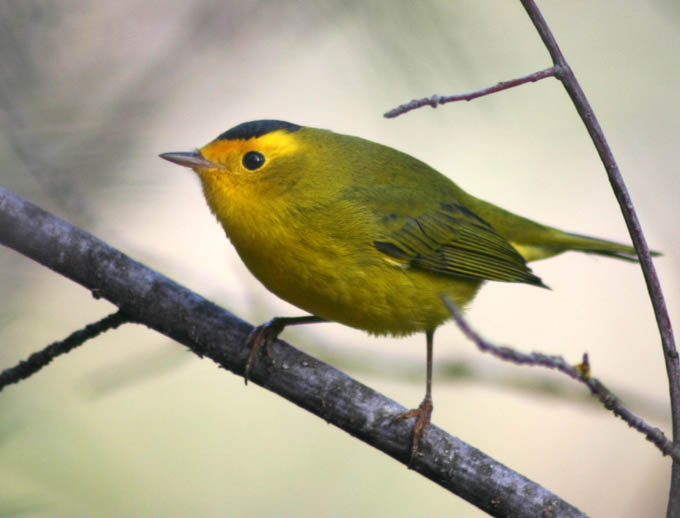
Wikimedia Commons
About the Wilson's Warbler
The Wilson's Warbler (Cardellina pusilla) is a vibrant and active member of the family Parulidae. Distinguished by its striking yellow coloring, it plays an essential role in the ecosystems it inhabits. This small warbler is prevalent in North America, where it breeds predominantly in the forests of Canada and the northern United States, particularly in dense shrubby areas near watercourses. The Wilson's Warbler is vital for controlling insect populations, as it consumes a variety of small arthropods, thus contributing to the ecological balance within its habitat. During the breeding season, from late spring to early summer, these warblers can be found nesting in underbrush and low vegetation. They prefer willow thickets, alder patches, and other dense shrubbery near streams and wetlands. The species is a long-distance migrant, wintering in Central America and parts of the southern United States. This migration involves traversing vast distances across multiple countries, showcasing the warbler's resilience and adaptability. The Wilson's Warbler's presence and activities are significant indicators of environmental health. As a bioindicator, changes in its population can reflect habitat quality and the impacts of climate change. This bird's reliance on specific habitats for breeding and wintering underscores the importance of habitat conservation efforts in maintaining biodiversity. Its seasonal movements and behavior also provide key insights into the ecological dynamics of North America's temperate forests and Central America's tropical regions. The Wilson's Warbler is not just a delightful bird for birdwatchers to observe; it is also a crucial participant in the natural world, underscoring the interconnectedness of species across continents and habitats.
The Wilson's Warbler belongs to the family Parulidae, within the order Passeriformes. These birds typically live average lifespan is 3-4 years with a maximum recorded of 8 years..
How to Identify a Wilson's Warbler
The Wilson's Warbler is unmistakable with its bright yellow plumage and distinctive black cap, which is most prominent in males. This cap contrasts sharply with the vivid yellow face and underparts. Females and juveniles display a similar coloration but with a less pronounced or absent black cap. The adult male measures around 11 to 12.5 cm in length and weighs approximately 8.5 grams, making it a small yet agile bird. Its wings are short and rounded, which facilitates quick, flitting movements through dense foliage. In flight, the Wilson's Warbler shows a rapid, fluttering wingbeat typical of many warblers. When perched, its posture is upright and alert, often flicking its tail and wings. Though it closely resembles other yellow warblers, the black cap is a reliable distinguishing feature. Confusion might arise with the Yellow Warbler, but the latter lacks the cap and has a more uniform yellow body. During migration, birders can spot Wilson's Warblers alongside mixed-species flocks, where their energetic movements and distinct coloration make them stand out.
Having trouble telling birds apart? Upload a photo to our bird identification tool for an instant species match.
Wilson's Warbler Habitat and Range
Preferred Habitat
Wilson's Warblers favor moist, shrubby environments, particularly near streams, wetlands, and forest edges. During the breeding season, they inhabit willow thickets, alder bogs, and other dense underbrush in boreal forests across Canada and the northern United States. These warblers are found at elevations ranging from sea level up to 3,000 meters, depending on geographic location. In winter, they migrate to tropical montane forests and edge habitats in Central America and the southern United States. While they occasionally visit urban parks and gardens during migration, they primarily prefer natural, undisturbed habitats for breeding and foraging.
Geographic Range
The Wilson's Warbler breeds across a vast range in North America, primarily from Alaska through Canada and into the northern United States. During migration, these warblers travel through the southwestern United States and Mexico, following established corridors that align with riparian zones and forested areas. In winter, they are found in Central America, including Honduras, Nicaragua, and Costa Rica, with some populations extending into northern Colombia. The species shows a preference for densely vegetated habitats throughout its range, resulting in localized population density hotspots, particularly in areas with abundant food resources.
Want to know which birds visit your area? Browse our backyard birds by location guides for region-specific species lists.
What Does the Wilson's Warbler Eat?
Wilson's Warblers primarily feed on insects and spiders, playing a crucial role as insectivores in their ecosystems. Their diet includes small flies, beetles, caterpillars, and other arthropods, which they glean from leaves and branches. During the breeding season, they focus on abundant, protein-rich insect prey to support nesting and rearing young. In winter, when insect availability decreases, they may supplement their diet with small berries and other plant material. These warblers forage actively, flitting through vegetation and occasionally sallying to catch insects in mid-air, a technique known as hawking.
Wilson's Warbler Behavior and Social Structure
Wilson's Warblers are solitary or found in pairs during the breeding season, exhibiting territorial behavior as males establish and defend nesting areas. Their courtship involves males singing persistently to attract females and establish territory dominance. During migration, they often join mixed-species flocks, which provides safety in numbers and enhances foraging efficiency. In response to predators, Wilson's Warblers employ evasive maneuvers, relying on their agility and speed. Daily activities include early morning singing, followed by active foraging throughout the day, with a lull during the hottest hours.
Wilson's Warbler Nesting and Reproduction
Wilson's Warblers construct cup-shaped nests using grass, moss, and leaves, typically placed low in dense shrubbery or on the ground near water. The female lays 3 to 6 eggs per clutch, which she incubates for about 12 days. Both parents participate in feeding the nestlings, which fledge approximately 10 to 12 days after hatching. These warblers often produce one brood per year, although some may attempt a second if conditions permit. The choice of nesting site and construction materials are crucial for protection against predators and environmental elements.
Wilson's Warbler Sounds and Vocalizations
The Wilson's Warbler's primary song is a rapid, high-pitched series of notes that can be described as 'chee-chee-chee-chit-chit.' This song serves both as a territorial marker and a mate attraction call. Their call notes are sharp and distinctive, often described as 'chip' or 'check' sounds. Alarm calls are more emphatic, serving to alert nearby warblers of potential threats. Their participation in the dawn chorus is notable in breeding territories, where males sing vigorously to establish dominance and attract mates.
Interesting Facts About the Wilson's Warbler
- 1Wilson's Warblers weigh less than a nickel, approximately 8.5 grams.
- 2They migrate thousands of miles annually between North America and Central America.
- 3The male's black cap resembles a monk's tonsure, leading to the nickname 'Black-capped Warbler.'
- 4Wilson's Warblers can be found at elevations up to 3,000 meters in the tropics.
- 5During migration, they can cover distances of up to 300 miles in a single night.
- 6The species was named after Alexander Wilson, a pioneering American ornithologist.
- 7Their rapid, fluttering flight is adapted for maneuvering through dense vegetation.
Wilson's Warbler Conservation Status
Currently, the Wilson's Warbler is classified as Least Concern on the IUCN Red List, with populations considered stable. However, habitat loss due to deforestation and land-use changes in both breeding and wintering grounds poses significant threats. Conservation efforts focus on preserving critical habitats and monitoring population trends. Historical data suggest fluctuations in numbers, correlated with habitat availability and climate conditions, emphasizing the need for ongoing research and habitat protection.
Other Parulidae Species


Birds Similar to the Wilson's Warbler
These species are often confused with the Wilson's Warbler due to similar appearance or overlapping range.


