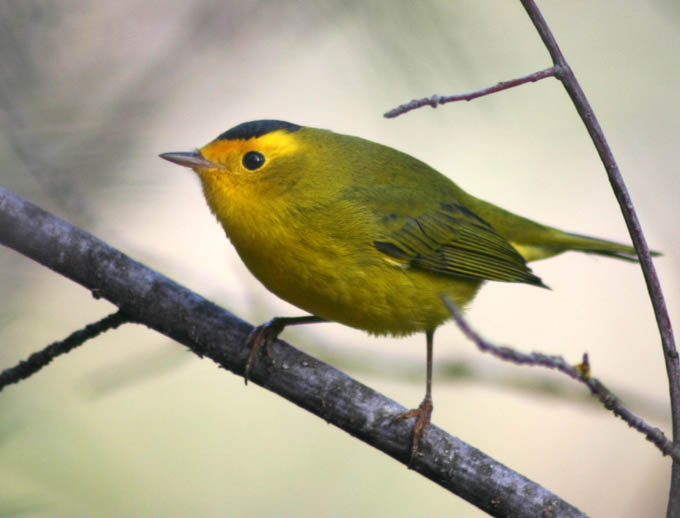
Yellow Warbler
Setophaga petechia
Order: Passeriformes / Family: Parulidae

Wikimedia Commons
About the Yellow Warbler
The Yellow Warbler (Setophaga petechia) is a vibrantly colored songbird belonging to the Parulidae family. This species is renowned for its striking yellow plumage, often accented by subtle reddish streaks on the males' breast. Yellow Warblers are widely distributed across North America, making them one of the most common warbler species. They thrive in a variety of habitats, including wetlands, riparian woodlands, and shrubby areas, where their bright coloration provides effective camouflage among the leaves. Their presence plays a significant ecological role as they help control insect populations, particularly during the breeding season when they feed voraciously on insects to meet the high energy demands of raising young. Seasonal behavior of the Yellow Warbler is pronounced; these birds are migratory, breeding in North America during the warmer months and traveling to Central America, the Caribbean, and northern South America for the winter. During spring and summer, they are most active in the early morning, filling the air with their cheerful songs. Male Yellow Warblers are particularly vocal during the breeding season, establishing and defending territories through song. As the weeks progress, their behavior shifts towards parental duties, with both males and females sharing responsibilities of feeding and caring for the young. In southern regions of the United States, such as Florida and southern Texas, Yellow Warblers may arrive earlier in the spring and stay later in the fall due to milder climates. Their adaptability to various habitats, coupled with their migratory nature, makes them an integral part of both temperate and tropical ecosystems. They serve as a food source for a variety of predators, including birds of prey and mammals, thus playing a crucial role in the food web. Yellow Warblers are also important indicators of environmental health, as their presence often reflects the availability of suitable habitat and the abundance of insect prey. Conservation efforts focus on preserving their natural habitats, especially in areas where wetland drainage and deforestation threaten their breeding grounds.
The Yellow Warbler belongs to the family Parulidae, within the order Passeriformes. These birds typically live average lifespan is around 4-5 years, with the maximum recorded at 11 years..
How to Identify a Yellow Warbler
The Yellow Warbler is a small, vibrant songbird easily identifiable by its bright yellow body. Adult males possess reddish streaks on their breast, while females and juveniles tend to have a more uniformly yellow appearance. Both sexes have a slightly olive tint on their wings and back, which can be more pronounced in younger birds. The Yellow Warbler's round head, medium-length tail, and relatively short wings contribute to its compact silhouette. In flight, it displays a rapid, fluttering wing beat and tends to stay low to the ground, often darting in and out of cover. Distinguishing between male and female Yellow Warblers can be challenging from a distance, but the reddish streaks on the male are a reliable indicator. Juveniles may be confused with other warbler species, such as the Wilson's Warbler, but the latter lacks the reddish breast streaks and has a distinctive black cap. Perching Yellow Warblers often adopt a slightly upright posture, accentuating their bright plumage against the backdrop of green foliage. Their active behavior and constant movement can make them a challenge to observe, but their vibrant color and distinctive song often give them away.
Having trouble telling birds apart? Upload a photo to our bird identification tool for an instant species match.
Yellow Warbler Habitat and Range
Preferred Habitat
Yellow Warblers occupy a range of habitats, with a preference for moist environments like riparian woodlands, shrubby wetlands, and edges of ponds and streams. They thrive at low to mid elevations, favoring areas where dense thickets provide ample cover and abundant insect prey. During migration, these warblers may appear in a variety of habitats, including suburban gardens and urban parks, where they utilize available trees and shrubs for foraging and resting. In their breeding range, they exhibit a preference for willow and alder thickets, especially in regions like the northeastern United States and southern Canada. As fall approaches and they prepare to migrate, Yellow Warblers can often be found in mixed-species flocks, taking advantage of diverse landscapes to support their long journeys southward.
Geographic Range
The Yellow Warbler's breeding range spans across most of North America, from Alaska and Canada down through the United States, reaching as far south as northern Mexico. During the winter months, these warblers migrate to Central America, the Caribbean, and the northern regions of South America, including countries like Colombia and Venezuela. Migration corridors often include the eastern seaboard of the United States and the Mississippi Flyway, where these birds travel in large numbers. Population density hotspots during the breeding season include the Great Lakes region and the northeastern United States, where suitable habitat and abundant food sources are plentiful. In contrast, their wintering range offers milder climates and diverse habitats, from coastal mangroves to tropical forests, providing ample resources for survival during the non-breeding season.
Want to know which birds visit your area? Browse our backyard birds by location guides for region-specific species lists.
What Does the Yellow Warbler Eat?
Yellow Warblers primarily consume a diet rich in insects, particularly caterpillars, beetles, and spiders during the breeding season. Their foraging technique involves gleaning insects from leaves and branches, often hovering momentarily to snatch prey from hard-to-reach spots. In the spring and summer, they focus on high-protein diets to support the energy demands of breeding and raising young. As fall approaches, their diet shifts slightly to include more fruit and berries, such as elderberries and dogwood berries, providing necessary energy reserves for migration. Prey size varies, but they generally target small to medium-sized insects, which they consume throughout the day with peaks in activity during cooler morning and evening hours.
Yellow Warbler Behavior and Social Structure
Yellow Warblers exhibit a moderate level of social structure, often seen in pairs or small family groups during the breeding season. Males establish territories early in the spring, using persistent singing to deter rivals and attract mates. Courtship displays include fluttering flights and soft calls to the female. Although they are generally solitary during the breeding season, Yellow Warblers become more social in the fall, joining mixed-species flocks as they prepare for migration. Their response to predators is typically a series of alarm calls, often accompanied by rapid, erratic flight to escape danger. During the day, they are most active in the early morning and late afternoon, when foraging conditions are optimal.
Yellow Warbler Nesting and Reproduction
Yellow Warblers build cup-shaped nests made primarily of plant fibers and fine grasses, often lined with softer materials like feathers and animal hair. Nests are typically located in shrubs or small trees, ranging from three to ten feet above the ground. Clutch sizes range from three to six eggs, with an incubation period of about 11 to 12 days. Both parents participate in feeding the chicks, which fledge approximately 9 to 12 days after hatching. Yellow Warblers usually produce one brood per year, although in some southern regions, they may attempt a second brood if conditions permit.
Yellow Warbler Sounds and Vocalizations
The primary song of the Yellow Warbler is a series of sweet, melodic notes, often described as "sweet-sweet-sweet, I'm so sweet." This song, characterized by its clear, piercing quality, is most frequently heard during the breeding season. Call notes include a sharp "chip" used for communication between mates and as an alarm signal. During the dawn chorus, males are particularly vocal, using song to establish territory and attract females. The Yellow Warbler's song can be likened to the sound of a tiny bell, easily cutting through the ambient noise of its woodland habitat.
Interesting Facts About the Yellow Warbler
- 1The Yellow Warbler's song varies slightly between individuals, with males from different regions exhibiting unique variations.
- 2This species migrates up to 3,000 miles from its breeding grounds in North America to wintering sites in Central and South America.
- 3Yellow Warblers often fall victim to brood parasitism by Brown-headed Cowbirds, which lay their eggs in warbler nests.
- 4The male Yellow Warbler's bright plumage and distinctive song are key factors in attracting mates during the breeding season.
- 5Yellow Warblers are known to be one of the earliest warblers to return north in the spring, often arriving as early as April.
- 6They can be found in a wide range of altitudes, from sea level up to 10,000 feet in some mountainous regions.
- 7Despite their small size, Yellow Warblers are a vital part of their ecosystem, controlling insect populations and serving as prey for larger animals.
Yellow Warbler Conservation Status
The Yellow Warbler is currently listed as a species of Least Concern by the IUCN, with stable population trends across most of its range. Primary threats include habitat loss due to deforestation and wetland drainage, as well as climate change, which may alter migration patterns. Conservation efforts focus on habitat preservation and restoration, particularly in key breeding and migratory corridors. Historically, the population has remained relatively stable, but local declines have been noted in areas where natural habitats have been significantly altered.
Other Parulidae Species


Birds Similar to the Yellow Warbler
These species are often confused with the Yellow Warbler due to similar appearance or overlapping range.