
Woodward's Batis
Batis fratrum
Order: Passeriformes / Family: Platysteiridae
Wikimedia Commons
About the Woodward's Batis
The Woodward's Batis, scientifically known as Batis fratrum, is a small passerine bird belonging to the family Platysteiridae. It is primarily found in subtropical and tropical forests of eastern Africa, particularly in Tanzania, Kenya, and Mozambique. These regions provide the ideal habitat with abundant insect prey and suitable nesting sites. The Woodward's Batis plays a significant role in the ecosystem by controlling insect populations, thus maintaining a balance within its habitat. This bird exhibits a preference for mid-level forest strata, where it actively forages for insects and small arthropods. Its presence is often detected by its distinctive call, which echoes through the forest as it communicates with mates and defends its territory. During the breeding season, which typically occurs during the wetter months, this bird's activity intensifies, and its vocalizations become more frequent. Ecologically, Woodward's Batis contributes to the health of its environment not only by controlling insects but also through its interactions with other species. It is often seen participating in mixed-species foraging flocks, enhancing its feeding efficiency and providing added protection from predators. The Woodward's Batis's adaptability to different forest types, including degraded and secondary forests, indicates its resilience, although it still faces challenges from habitat loss and fragmentation.
The Woodward's Batis belongs to the family Platysteiridae, within the order Passeriformes. These birds typically live approximately 5-7 years..
How to Identify a Woodward's Batis
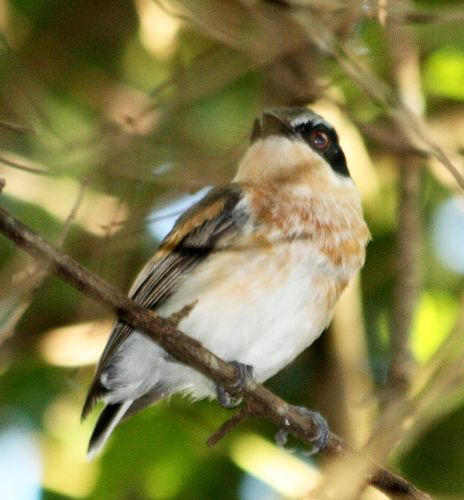
Adult Woodward's Batis are easily recognized by their contrasting black-and-white appearance. Males have a glossy black head, throat, and chest band, which starkly contrasts with their white underparts and a gray back. Females are similar but can be distinguished by a browner wash on the head and a less pronounced chest band. Juveniles display a more muted coloration, lacking the sharp contrasts seen in adults, with a buffier tone on the underparts and less defined head markings. The species is sometimes confused with other batis species; however, the distinct black facial mask and white wing bar help in differentiating it. In flight, Woodward's Batis shows a broad and rounded wing silhouette with white outer tail feathers visible. When perched, it exhibits an upright posture, often flicking its tail and wings, which is characteristic behavior among batises.
Having trouble telling birds apart? Upload a photo to our bird identification tool for an instant species match.
Woodward's Batis Habitat and Range
Preferred Habitat
Woodward's Batis thrives in subtropical and tropical forests, including both primary and secondary growth. It is commonly found at elevations ranging from sea level up to 2000 meters, adapting to various forest types, from coastal lowland forests to upland montane regions. This bird is less frequently observed in urban areas but can be found in rural settings where forest patches remain. Seasonal shifts in habitat preference are minimal, as the species is largely sedentary, maintaining territories within forested areas year-round.
Geographic Range
The Woodward's Batis has a relatively restricted range along the eastern coast of Africa, predominantly in Tanzania, Kenya, and parts of Mozambique. Its range does not extend far inland, favoring coastal and near-coastal forest habitats. It does not undertake long migrations but may exhibit limited altitudinal movements in response to seasonal changes in food availability. Population densities are highest in undisturbed forest areas, where the bird has access to optimal feeding and breeding conditions.
Want to know which birds visit your area? Browse our backyard birds by location guides for region-specific species lists.
What Does the Woodward's Batis Eat?
The diet of the Woodward's Batis primarily consists of insects and small arthropods. It employs a sallying technique from a perch, darting out to catch prey in flight or gleaning insects from foliage. During certain times of the year, it may consume more ants and beetles, shifting to softer-bodied insects like caterpillars in the breeding season to provide for its young. Prey size varies, but it generally targets small to medium-sized insects, optimizing its energy expenditure during foraging.
Woodward's Batis Behavior and Social Structure
Woodward's Batis is a socially monogamous species, with pairs maintaining territories throughout the year. It exhibits strong territorial behavior, often engaging in duet calls with its mate to establish presence and ward off intruders. Courtship involves aerial displays and mutual feeding. While generally solitary or found in pairs, it joins mixed-species flocks, benefiting from increased vigilance against predators. Activity peaks during the cooler morning and late afternoon hours, with periods of rest and preening occurring midday.
Woodward's Batis Nesting and Reproduction
Woodward's Batis constructs small cup-shaped nests, intricately woven with plant fibers and spider webs, often camouflaged with lichens and bark. Nests are typically placed in the fork of a tree branch, 1-5 meters above ground. The female lays a clutch of 2 to 3 eggs, which she incubates for approximately 14 days. Both parents participate in feeding the chicks, which fledge about 16-18 days after hatching. The species generally raises one to two broods per year, depending on environmental conditions.
Woodward's Batis Sounds and Vocalizations
The primary song of the Woodward's Batis is a series of high-pitched whistles, often described as 'tsip-tsip-tsip', delivered in rapid succession. This call serves both territorial and mate-communication purposes. Alarm calls are sharper and more abrupt, used to alert mates and youngsters of potential threats. During the dawn chorus, males are particularly vocal, establishing their presence in the territory. The song's rhythm and pitch are reminiscent of other forest-dwelling passerines, yet distinct in its clarity and repetition.
Interesting Facts About the Woodward's Batis
- 1Woodward's Batis has a unique hunting method called 'sallying', where it catches insects mid-air.
- 2Despite its small size, Woodward's Batis is known for its aggressive territorial behavior.
- 3The species is named after the ornithologist who first studied it, a tribute common among bird species.
- 4Woodward's Batis contributes to biodiversity by participating in mixed-species foraging flocks.
- 5Though primarily insectivorous, Woodward's Batis occasionally consumes small fruits.
- 6The intricate design of its nest, using spider silk, showcases the bird's remarkable construction skills.
- 7Woodward's Batis can be an indicator species for forest health, given its reliance on insect prey.
Woodward's Batis Conservation Status
The Woodward's Batis is currently listed as Least Concern by the IUCN, with populations considered stable. However, habitat destruction due to logging and agriculture poses ongoing threats. Conservation efforts focus on protecting forest habitats and maintaining ecological corridors. Historical data suggests that while populations have fluctuated, they have remained relatively stable over the long term, thanks in part to the species' adaptability to modified habitats.


