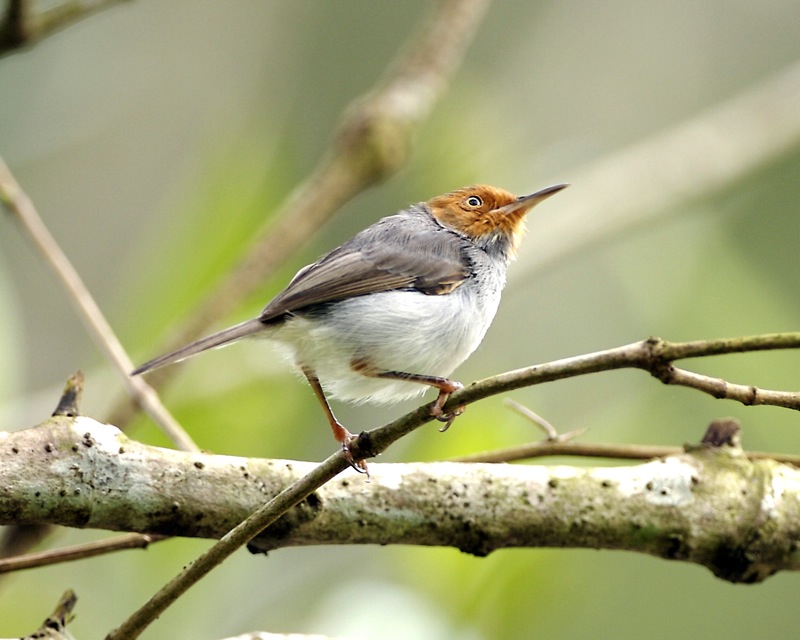
Yellow-breasted Tailorbird
Orthotomus samarensis
Order: Passeriformes / Family: Cisticolidae

Wikimedia Commons
About the Yellow-breasted Tailorbird
The Yellow-breasted Tailorbird (Orthotomus samarensis) is a small passerine bird that piques the interest of ornithologists due to its unique nesting habits and vibrant plumage. Found primarily in the Philippines, this species thrives in the lush, tropical regions of Samar, Leyte, and Bohol, showcasing an impressive adaptation to the dense, humid forests of these islands. As part of the Cisticolidae family, the Yellow-breasted Tailorbird shares its lineage with other tailorbirds, known for their remarkable ability to sew leaves together to build intricate nests.
The ecological significance of the Yellow-breasted Tailorbird is multifaceted. Primarily an insectivore, it contributes to controlling insect populations in its native habitats. In doing so, it plays a vital role in maintaining the ecological balance of the tropical forests. Additionally, the tailorbird's vibrant plumage and melodious song make it a key species for birdwatchers and ecotourism, fostering a deeper appreciation for the avian biodiversity of the Philippines.
Seasonally, the Yellow-breasted Tailorbird exhibits behaviors that are closely linked to the tropical climate of its habitat. The absence of harsh winters allows it to remain relatively sedentary throughout the year, with only minor local movements observed in response to food availability and breeding requirements. During the breeding season, the bird's presence becomes more pronounced as it engages in elaborate courtship displays and territorial defense, ensuring the continuation of its species in the dense canopies of its home.
The Yellow-breasted Tailorbird belongs to the family Cisticolidae, within the order Passeriformes. These birds typically live average 4-6 years with a maximum recorded of 8 years..
How to Identify a Yellow-breasted Tailorbird
The Yellow-breasted Tailorbird stands out with its bright yellow breast and olive-green back, a combination that makes it easily identifiable against the verdant backdrop of its habitat. Adult birds exhibit a sharp contrast between their yellow underparts and the darker tones of their wings and back, while juveniles have a slightly duller plumage, lacking the full vibrancy of the adults. Unlike many bird species, there is minimal sexual dimorphism in this tailorbird; both males and females appear similar, though males may occasionally show a slightly brighter breast during breeding season.
The tail of the Yellow-breasted Tailorbird is relatively long and often seen being flicked or wagged, a characteristic behavior that can aid in its identification. In flight, this bird presents a compact silhouette, with its wings beating rapidly as it navigates the dense canopy. When perched, its posture is upright, often accentuated by its active tail movements. These field marks, alongside its distinctive vocalizations, help distinguish it from other similar species that may share its range.
While the Grey-backed Tailorbird may inhabit overlapping areas, the Yellow-breasted Tailorbird's striking underparts serve as the key distinguishing feature. Additionally, the latter's more vibrant and consistent song further aids in differentiation.
Having trouble telling birds apart? Upload a photo to our bird identification tool for an instant species match.
Yellow-breasted Tailorbird Habitat and Range
Preferred Habitat
The Yellow-breasted Tailorbird primarily inhabits lowland tropical forests, where it thrives in dense underbrush and thickets. Such environments provide the necessary cover and resources for feeding and nesting. While it predominantly occupies primary forests, it can also adapt to secondary growth areas, showcasing some resilience to habitat modification. This adaptability allows it to persist in regions impacted by human activity, though it fares best in undisturbed forest environments.
The bird is usually found at elevations ranging from sea level to about 1,000 meters, with a preference for humid, forested locales. Despite its affinity for forested areas, the Yellow-breasted Tailorbird occasionally ventures into more open spaces, particularly when searching for food. However, it rarely, if ever, appears in urban settings, maintaining its preference for natural, lush habitats.
Seasonal shifts in habitat are minimal due to the stable tropical climate, with the bird's movements largely dictated by the availability of food and nesting sites rather than drastic environmental changes.
Geographic Range
The Yellow-breasted Tailorbird has a relatively limited geographical range, confined to the Philippine archipelago. It is primarily found on the islands of Samar, Leyte, and Bohol, with these islands serving as its core habitat. Within these regions, the bird occupies moist tropical forests and areas with dense vegetation, where it can find food and suitable nesting sites.
Unlike many migratory bird species, the Yellow-breasted Tailorbird does not partake in long-distance migrations. Its movements are generally restricted to local shifts within its home range, often in response to changes in food supply or breeding needs. This sedentary nature is common among birds residing in stable tropical environments, where climatic conditions remain conducive to year-round habitation.
Population densities tend to be highest in undisturbed forest regions, where the bird can thrive without significant human interference. The fragmented nature of its habitat, however, occasionally isolates populations, necessitating careful monitoring to ensure genetic diversity and long-term survival.
Want to know which birds visit your area? Browse our backyard birds by location guides for region-specific species lists.
What Does the Yellow-breasted Tailorbird Eat?
The Yellow-breasted Tailorbird primarily feeds on insects, playing a crucial role as an insectivore in its ecosystem. Its diet includes a variety of small invertebrates such as ants, beetles, caterpillars, and spiders. The bird's agile movements and keen eyesight allow it to efficiently forage among leaves and branches, often using its slender bill to probe into crevices where insects hide.
Seasonal variations in diet are minimal, owing to the year-round availability of insects in the tropical forests it inhabits. However, during the breeding season, the demand for protein-rich food increases, prompting the bird to intensify its foraging efforts to support its young.
The Yellow-breasted Tailorbird typically forages alone or in pairs, actively moving through the underbrush to uncover hidden prey. It exhibits a diurnal feeding pattern, with peak activity occurring in the early morning and late afternoon. This routine aligns with the behavior of many insect species, which are more active during these times, thus optimizing the bird's foraging success.
Yellow-breasted Tailorbird Behavior and Social Structure
The Yellow-breasted Tailorbird exhibits a range of behaviors that highlight its adaptability to the dense tropical forests of the Philippines. Socially, it tends to be solitary or found in pairs, particularly during the breeding season. Territoriality is a key aspect of its behavior, with both males and females vigorously defending their chosen area, particularly during nesting periods.
Courtship displays are subtle yet significant, often involving the male showcasing his plumage and vocal abilities to attract a mate. These displays are accompanied by gentle calls and mutual preening, strengthening pair bonds. Once paired, the birds exhibit cooperative behavior, with both partners involved in nest building and the rearing of young.
In response to predators, the Yellow-breasted Tailorbird relies on agility and stealth, often retreating into dense foliage to avoid detection. It may also emit alarm calls to warn conspecifics of potential threats. Daily activity patterns see the bird most active during the cooler morning and late afternoon hours, when it forages and engages in social interactions, while midday heat often finds it taking refuge in shaded areas.
Yellow-breasted Tailorbird Nesting and Reproduction
The nesting behavior of the Yellow-breasted Tailorbird is one of its most fascinating traits. True to its name, this bird constructs its nest by sewing leaves together, using plant fibers, spider silk, and other natural materials. The nest is typically cup-shaped and well-concealed within dense foliage, offering protection from predators and harsh weather conditions.
Preferred nesting sites are usually located within shrubs or low trees, at heights ranging from 1 to 3 meters above ground. The female primarily undertakes the construction of the nest, with occasional assistance from the male.
Clutch size generally consists of 2 to 3 eggs, which are incubated for approximately 12 to 14 days. Both parents share incubation duties and, upon hatching, are involved in feeding and caring for the chicks. Fledging occurs around 10 to 12 days after hatching, with the young birds remaining under parental supervision for a short period before becoming independent.
The Yellow-breasted Tailorbird typically raises one to two broods per year, depending on food availability and climatic conditions, ensuring the continuation of its lineage amidst the changing dynamics of its forest habitat.
Yellow-breasted Tailorbird Sounds and Vocalizations
The Yellow-breasted Tailorbird is known for its distinct and melodious song, which plays a crucial role in communication and territory defense. Its primary song consists of a series of clear, high-pitched notes delivered in rapid succession, creating a rhythmic pattern that is both pleasant and characteristic of the species. This song can often be heard echoing through the forest, particularly during the breeding season when males are most vocal.
In addition to its song, the Yellow-breasted Tailorbird emits various call notes, including sharp 'tseet' sounds that serve as contact calls between mates or family members. Alarm calls are more abrupt and loud, designed to alert others of potential threats in the vicinity.
During the dawn chorus, the tailorbird's song is particularly prominent, as it joins the symphony of other avian species greeting the new day. This behavior not only establishes its presence but also reinforces pair bonds, as mates often respond to each other's vocalizations, maintaining a strong connection.
Interesting Facts About the Yellow-breasted Tailorbird
- 1The Yellow-breasted Tailorbird is named for its unique nesting technique, sewing leaves together to create a secure cradle for its young.
- 2Unlike many songbirds, the Yellow-breasted Tailorbird remains in its tropical habitat year-round, avoiding long migrations.
- 3The bird's song, a rapid series of high-pitched notes, is used to establish territory and attract mates during the breeding season.
- 4Diet consists primarily of insects, making the Yellow-breasted Tailorbird an important control agent for pest populations in its habitat.
- 5The Yellow-breasted Tailorbird is part of the Cisticolidae family, known for their intricate nests and vibrant songs across diverse habitats.
Yellow-breasted Tailorbird Conservation Status
The Yellow-breasted Tailorbird is currently classified as Least Concern by the IUCN, indicating a relatively stable population across its range. However, ongoing habitat destruction and fragmentation pose significant threats to its long-term survival. Deforestation, driven by agricultural expansion and logging, reduces available habitat, potentially isolating populations and limiting resources. Conservation efforts focus on preserving the tropical forests of the Philippines, ensuring sustainable land-use practices that prioritize biodiversity. Initiatives include the establishment of protected areas and reforestation projects, which aim to restore and connect fragmented habitats. Historically, the Yellow-breasted Tailorbird has maintained a stable presence within its range, thanks in part to its adaptability to secondary habitats. Continued monitoring is essential to detect any changes in population dynamics and address emerging threats promptly, safeguarding the future of this vibrant species.
Other Cisticolidae Species


Birds Similar to the Yellow-breasted Tailorbird
These species are often confused with the Yellow-breasted Tailorbird due to similar appearance or overlapping range.