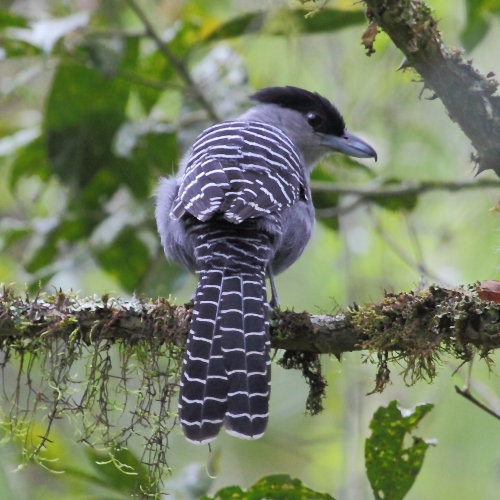
Yellow-breasted Warbling-Antbird
Hypocnemis subflava
Order: Passeriformes / Family: Thamnophilidae

Wikimedia Commons
About the Yellow-breasted Warbling-Antbird
The Yellow-breasted Warbling-Antbird (Hypocnemis subflava) inhabits the lush and diverse ecosystems of the Amazon Basin, stretching across countries such as Brazil, Peru, and Bolivia. These birds are integral to the intricate tapestry of rainforest life, where they play a role in controlling insect populations, thus contributing to the ecological balance. Their presence is often noted in the dense understory of tropical lowland forests, where they deftly maneuver through foliage in search of prey. This species is particularly adapted to the humid conditions of the Amazon, thriving in areas where sunlight filters through the canopy to the forest floor. During the breeding season, typically from September to February, the Yellow-breasted Warbling-Antbird becomes more vocal and conspicuous as it establishes territories and attracts mates. Its territorial calls reverberate through the forest, signaling its presence to potential rivals and mates alike. Outside the breeding season, these birds exhibit a degree of nomadism, moving subtly through the forest in search of abundant food sources. Their movements are influenced by the availability of prey, which fluctuates with seasonal rains. As part of the Thamnophilidae family, the Yellow-breasted Warbling-Antbird, along with its relatives, is an iconic representative of the antbird group, renowned for its specialized feeding habits and vocalizations. The species' adaptability to the dynamic environment of the Amazon ensures its continued role as a vital component of this rich biodiversity hotspot.
The Yellow-breasted Warbling-Antbird belongs to the family Thamnophilidae, within the order Passeriformes. These birds typically live average 4-5 years with a max recorded of 7 years..
How to Identify a Yellow-breasted Warbling-Antbird
The Yellow-breasted Warbling-Antbird is easily recognized by its bright yellow breast, which contrasts sharply with its gray upperparts and distinctive black facial markings. Adult males and females share this striking coloration, although males tend to exhibit slightly more vibrant hues. Juveniles, on the other hand, display a duller plumage, with a more muted yellow and less defined facial markings, aiding in camouflage from predators. When observing this species in the field, note the subtle differences in size and shape compared to similar species, such as the White-flanked Antwren. The Yellow-breasted Warbling-Antbird is generally smaller and exhibits a more rounded body compared to its relatives. In flight, its silhouette is compact and agile, allowing it to navigate the dense forest understory efficiently. Its perching posture is characterized by an upright stance, often with its tail flicked upwards, a common behavior among antbirds. This posture, along with its vocalizations, can serve as key identification markers when visual confirmation is challenging due to dense foliage.
Having trouble telling birds apart? Upload a photo to our bird identification tool for an instant species match.
Yellow-breasted Warbling-Antbird Habitat and Range
Preferred Habitat
The Yellow-breasted Warbling-Antbird primarily inhabits the dense understory of tropical lowland rainforests. These birds are most commonly found at elevations ranging from sea level to about 900 meters. They prefer humid environments where the canopy provides ample cover and the forest floor is rich with leaf litter and insect activity. Seasonal habitat shifts are minimal, as the species is non-migratory and remains within its rainforest home year-round. The Yellow-breasted Warbling-Antbird is less frequently observed in urban areas, as it relies on the intact forest ecosystems for foraging and nesting. In regions where deforestation has occurred, these birds may be forced to adapt to edge habitats, although they are generally more successful in undisturbed forest interiors.
Geographic Range
The Yellow-breasted Warbling-Antbird's range is confined to the Amazon Basin, where it is found throughout the expansive rainforests of Brazil, Peru, and Bolivia. The species does not undertake long-distance migrations, instead residing within its tropical range year-round. Within this range, population densities are highest in regions with undisturbed primary forest, as these environments provide optimal conditions for feeding and breeding. In areas where the forest has been fragmented, the species may still persist, although population densities tend to be lower. The lack of migratory behavior means that the Yellow-breasted Warbling-Antbird does not utilize specific migration corridors, instead relying on the continuity of the rainforest to meet its ecological needs.
Want to know which birds visit your area? Browse our backyard birds by location guides for region-specific species lists.
What Does the Yellow-breasted Warbling-Antbird Eat?
The Yellow-breasted Warbling-Antbird has a diet predominantly composed of insects and other arthropods, which it gleans from leaves and branches in the forest understory. Its foraging technique involves a combination of active searching and ambush, where the bird remains still to detect movement before pouncing on its prey. During the wet season, when insect activity is at its peak, the bird's diet becomes more diverse, encompassing a wider range of prey sizes and types. In contrast, the dry season may require the antbird to expend more energy in search of scarce resources. The Yellow-breasted Warbling-Antbird feeds throughout the day, with peak activity occurring during the cooler morning and late afternoon hours, when prey is most active.
Yellow-breasted Warbling-Antbird Behavior and Social Structure
The Yellow-breasted Warbling-Antbird exhibits a complex social structure, with pairs often remaining together throughout the year. These birds are territorial, defending their territory through vocalizations and occasional physical confrontations. During the breeding season, males perform elaborate courtship displays to attract females, involving both vocal and visual components. Outside of the breeding season, the species may join mixed-species foraging flocks, which provide increased protection against predators through the advantage of numbers. The Yellow-breasted Warbling-Antbird is primarily diurnal, with most of its activity concentrated in the early morning and late afternoon. When faced with predators, these birds rely on their cryptic plumage and the dense forest cover to evade detection.
Yellow-breasted Warbling-Antbird Nesting and Reproduction
The Yellow-breasted Warbling-Antbird constructs cup-shaped nests, which are typically placed low in the understory of dense forests. These nests are built using materials such as twigs, leaves, and plant fibers, providing camouflage and stability. Clutch size is generally two to three eggs, which are incubated primarily by the female for about 14 days. Both parents participate in feeding the young, which fledge approximately two weeks after hatching. The species may raise one or two broods per year, depending on environmental conditions and food availability. Parental care extends for several weeks post-fledging, ensuring the young are adequately prepared for independence.
Yellow-breasted Warbling-Antbird Sounds and Vocalizations
The song of the Yellow-breasted Warbling-Antbird is a series of melodious whistles, with a distinct rhythm and pitch that make it easily recognizable. These songs serve both to establish territory and attract mates, and they can vary slightly between individuals and regions. The bird also emits sharp call notes, which are used in communication between mates and as alarm calls when predators are near. During the dawn chorus, the Yellow-breasted Warbling-Antbird's song is particularly prominent, often one of the first sounds heard resonating through the forest. These vocalizations are essential for maintaining social bonds and territorial boundaries.
Interesting Facts About the Yellow-breasted Warbling-Antbird
- 1The Yellow-breasted Warbling-Antbird is named for its distinct vocalizations, which are often heard before the bird is seen.
- 2Unlike many bird species, both male and female Yellow-breasted Warbling-Antbirds share similar plumage, making them difficult to distinguish in the field.
- 3These antbirds are known to follow army ant swarms, benefiting from insects flushed out by the ants' movements.
- 4Despite being a non-migratory species, the Yellow-breasted Warbling-Antbird can cover vast areas within its territory while foraging.
- 5The species' dense rainforest habitat helps shield it from predators, relying on both camouflage and cover for protection.
- 6Yellow-breasted Warbling-Antbirds participate in mixed-species flocks, enhancing their foraging efficiency and reducing predation risk.
- 7Their presence is a good indicator of a healthy and intact forest ecosystem, as they are sensitive to habitat disturbances.
Yellow-breasted Warbling-Antbird Conservation Status
The Yellow-breasted Warbling-Antbird is currently listed as Least Concern by the IUCN, with populations considered stable. However, the primary threat to this species is habitat loss due to deforestation in the Amazon Basin. Conservation efforts focus on habitat preservation and sustainable land-use practices to ensure the protection of its rainforest home. Historical population changes have been minimal, but continued monitoring is essential to detect any future declines. Conservation organizations work alongside local communities to promote awareness and implement strategies that benefit both biodiversity and human livelihoods.