
Yellow-rumped Antwren
Terenura sharpei
Order: Passeriformes / Family: Thamnophilidae

Wikimedia Commons
About the Yellow-rumped Antwren
The Yellow-rumped Antwren, scientifically known as Terenura sharpei, is a small passerine bird belonging to the family Thamnophilidae. This bird is most commonly found in the humid lowland forests of the western Amazon Basin, particularly in Brazil and Peru. The dense undergrowth and canopy layers of these forests provide the ideal environment for the Yellow-rumped Antwren to thrive. This species plays a significant ecological role as both a predator and prey within its ecosystem. By consuming insects and other small invertebrates, it helps control pest populations, while also serving as a food source for larger predators. The Yellow-rumped Antwren is a resident bird, meaning it does not undertake long migratory journeys. Instead, it is adapted to the stable, year-round climate of the tropical forests. During the breeding season, which typically coincides with the wetter months, its activities may become more concentrated around nesting sites. The Yellow-rumped Antwren's presence in these forests is a key indicator of the health of its habitat, as it relies on intact forest ecosystems for survival. Conservation efforts in regions like the Amazon are crucial for maintaining the populations of this and many other forest-dependent species.
The Yellow-rumped Antwren belongs to the family Thamnophilidae, within the order Passeriformes. These birds typically live average 4-6 years with a max recorded of 7 years..
How to Identify a Yellow-rumped Antwren
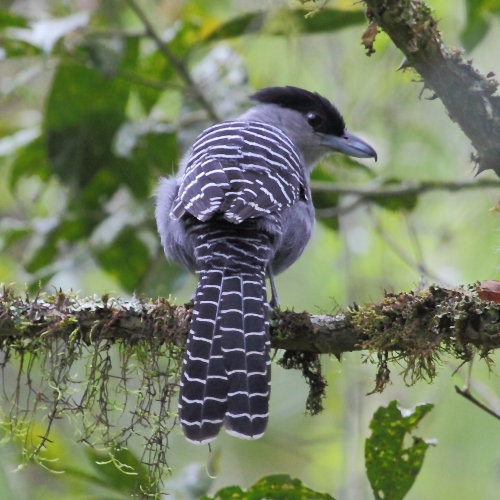
The adult Yellow-rumped Antwren is characterized by its small size, measuring approximately 11 cm in length. The most distinctive feature of this bird is the bright yellow patch on its rump, which is visible when it flits through the foliage. The rest of its plumage is predominantly gray with subtle black streaks on the wings and tail. Males and females are similar in appearance, though males may exhibit slightly darker coloration. Juveniles are generally duller, lacking the vibrant yellow of the adults until they mature. In flight, the Yellow-rumped Antwren exhibits a rapid, fluttering flight pattern, often staying close to the cover of trees and shrubs. When perched, it maintains an upright posture, often flicking its wings and tail nervously. Due to its habitat preferences and behavior, it is less likely to be confused with other species, though its size and coloration may lead to initial confusion with other small forest-dwelling birds.
Having trouble telling birds apart? Upload a photo to our bird identification tool for an instant species match.
Yellow-rumped Antwren Habitat and Range
Preferred Habitat
The Yellow-rumped Antwren predominantly inhabits the dense, humid lowland forests of the Amazon Basin. It thrives in areas with rich undergrowth and complex canopy structures, which provide ample foraging opportunities and protection from predators. This species is typically found at elevations ranging from sea level up to 500 meters. The bird shows a strong preference for undisturbed primary forests but can occasionally be found in secondary growth areas, provided there is sufficient cover. Unlike some other antbirds, the Yellow-rumped Antwren is not commonly found in urban or suburban areas, as it requires the specific conditions provided by dense forest habitats. Seasonal habitat shifts are minimal, given its non-migratory nature, but individuals may move locally to take advantage of food availability and breeding opportunities.
Geographic Range
The Yellow-rumped Antwren's range is concentrated in the western Amazon Basin, primarily within Brazil and Peru, though it may also be found in adjacent parts of Bolivia and Colombia. This bird is a year-round resident of these regions, with no significant migratory behavior observed. Within its range, the species is most commonly found in the lowland rainforest areas where population densities can be relatively high in suitable habitats. However, the distribution can be patchy, influenced by the availability of optimal forest conditions. Conservation areas such as the Tambopata National Reserve in Peru are crucial strongholds for this species, providing protected environments where populations can flourish without the threat of habitat destruction.
Want to know which birds visit your area? Browse our backyard birds by location guides for region-specific species lists.
What Does the Yellow-rumped Antwren Eat?
The Yellow-rumped Antwren primarily feeds on insects and other small arthropods, which it gleans from leaves and branches in the forest undergrowth. Its diet consists of ants, beetles, spiders, and caterpillars, which it captures using its sharp, pointed bill. The bird forages actively, moving quickly through the foliage and using short flights to cover ground. It is most active during the early morning and late afternoon when insect activity is heightened. During the breeding season, the demand for food increases, prompting pairs to forage more intensively. While the diet remains consistent throughout the year, seasonal fluctuations in prey availability can influence foraging behavior and success.
Yellow-rumped Antwren Behavior and Social Structure
The Yellow-rumped Antwren exhibits territorial behavior, often defending small patches of forest from intruding conspecifics. Pairs establish and maintain territories, with both members participating in defense. Courtship displays are subtle, involving mutual preening and synchronized movements through the canopy. This species is generally solitary or found in pairs, though it may join mixed-species flocks, particularly outside the breeding season, to improve foraging efficiency and predator detection. Its response to predators includes rapid retreat into dense foliage and alarm calls to alert partners. Daily activity patterns are influenced by temperature and light levels, with peak activity occurring during cooler, low-light periods.
Yellow-rumped Antwren Nesting and Reproduction
The nest of the Yellow-rumped Antwren is a delicate cup structure made from plant fibers, leaves, and spider silk, suspended from horizontal branches or vines within the forest understory. Typically, nests are located about 1-3 meters above the ground, offering concealment from predators. The female lays 2-3 eggs per clutch, which are incubated by both parents for a period of about 14-16 days. After hatching, chicks remain in the nest for approximately two weeks before fledging. Parental care is shared, with both adults involved in feeding and protecting the young. In some regions, the Yellow-rumped Antwren may produce two broods per year, depending on environmental conditions and food availability.
Yellow-rumped Antwren Sounds and Vocalizations
The Yellow-rumped Antwren's primary song is a series of sharp, high-pitched notes delivered in rapid succession, often described as a 'tsee-tsee-tsee' sound. These vocalizations serve both territorial and mate attraction purposes. Call notes are short and sharp, used for communication between paired individuals. Alarm calls are higher-pitched and more frantic, alerting conspecifics to potential threats. The bird participates in the dawn chorus, with males typically singing from concealed perches in the early morning hours. Its vocal repertoire is less varied than some other antbird species, focusing on efficiency and clarity.
Interesting Facts About the Yellow-rumped Antwren
- 1The Yellow-rumped Antwren is often found in mixed-species flocks, benefiting from the collective vigilance of other birds.
- 2Despite its small size, the Yellow-rumped Antwren can be quite aggressive when defending its territory from intruders.
- 3The bright yellow rump, a signature feature of the Yellow-rumped Antwren, helps in species identification during quick movements.
- 4Insects make up the majority of the Yellow-rumped Antwren's diet, with a particular preference for ants and beetles.
- 5The species plays a vital role in controlling insect populations within its forest habitat, contributing to ecosystem balance.
Yellow-rumped Antwren Conservation Status
The Yellow-rumped Antwren is currently listed as Least Concern by the IUCN, with stable population trends. However, the species faces threats from habitat destruction due to logging and agricultural expansion in the Amazon Basin. Conservation efforts focus on habitat protection and sustainable land management practices. Historical population changes are not well-documented, but ongoing deforestation poses a significant long-term risk. Protected areas such as national parks and reserves play a critical role in safeguarding the species' future by preserving critical habitats.
Other Thamnophilidae Species



Birds Similar to the Yellow-rumped Antwren
These species are often confused with the Yellow-rumped Antwren due to similar appearance or overlapping range.

