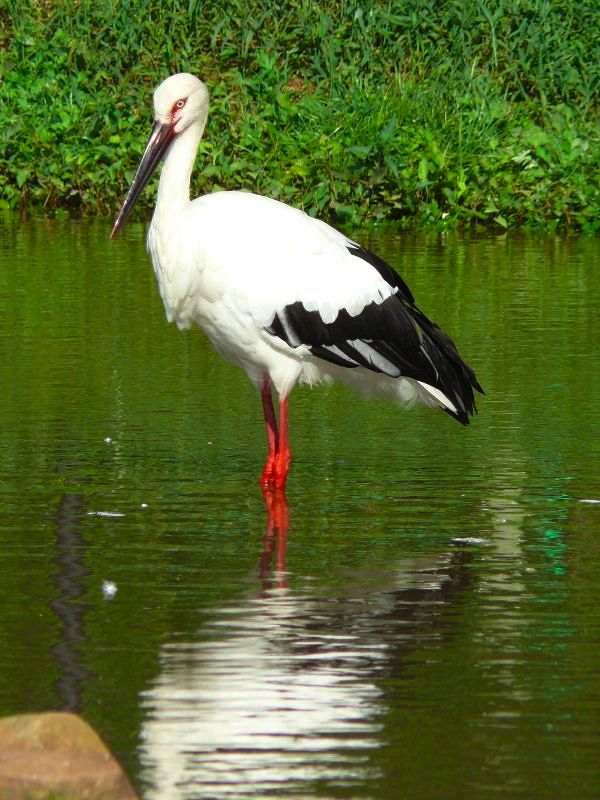
Abdim's Stork
Ciconia abdimii
Order: Ciconiiformes / Family: Ciconiidae

Wikimedia Commons
About the Abdim's Stork
The Abdim's Stork, scientifically known as Ciconia abdimii, is a striking wading bird that stands out with its black and white plumage, complemented by distinctive red legs and a blue-green facial patch. This species is widely distributed across sub-Saharan Africa, where it inhabits open savannas, grasslands, and agricultural fields. The significance of the Abdim's Stork extends beyond its visual appeal; it plays an integral role in the ecosystems it inhabits. As a predator of various insects and small vertebrates, it helps control pest populations, thereby benefiting agricultural activities.
The Abdim's Stork is highly adaptive and exhibits notable seasonal behaviors, which include long migratory journeys. During the breeding season, which coincides with the rainy season in its range, the stork can be observed in large numbers in countries such as Tanzania, Ethiopia, and Sudan. The rains stimulate the emergence of insects, providing a rich food source for the storks and their chicks. Outside the breeding season, the storks migrate to regions in West Africa, such as Mali and Senegal, where they spend the dry season, exploiting available food resources.
Ecologically, the Abdim's Stork is considered a migratory indicator species. Its presence and population dynamics can reflect changes in environmental conditions, such as climate fluctuations and habitat integrity. Despite facing some threats from habitat destruction and environmental changes, the species is not currently regarded as threatened, partly due to its adaptability and wide distribution. However, continued monitoring is essential to ensure that it remains a thriving part of Africa's avian biodiversity.
The Abdim's Stork belongs to the family Ciconiidae, within the order Ciconiiformes. These birds typically live average 15-20 years with max recorded 25 years.
How to Identify a Abdim's Stork
The Abdim's Stork is easily identified by its striking coloration and slender build. Adults possess a predominantly black body with a glossy sheen that appears green or purple in certain lights. Their underparts, specifically the lower belly and vent, contrast sharply with bright white feathers. Notably, the stork's facial skin and upper legs are a vivid red, while a blue-green patch around the eye adds to its distinctive appearance.
Juvenile Abdim's Storks are generally duller, with more muted tones of brown and less pronounced facial coloration compared to adults. As they mature, these young birds gradually acquire the dramatic contrast of the adult plumage. In terms of sexual dimorphism, there are no significant differences between males and females, making it challenging to distinguish between the sexes in the field.
In flight, Abdim's Stork displays a characteristic silhouette with wings held in a gentle V-shape, long legs trailing behind, and a neck stretched forward. This posture, combined with its slow, deliberate wingbeats, is typical of storks. When perched, they often stand erect with a slight forward lean, showcasing their leg and feather colors. While they might be confused with other storks, their smaller size and unique coloration help differentiate them from species like the White Stork or Marabou Stork.
Having trouble telling birds apart? Upload a photo to our bird identification tool for an instant species match.
Abdim's Stork Habitat and Range
Preferred Habitat
Abdim's Stork primarily inhabits open landscapes such as savannas, grasslands, and cultivated areas. It thrives at elevations ranging from sea level to around 1,500 meters. The stork is a frequent visitor to agricultural fields where it benefits from plowing activities that expose insects and small vertebrates. It is less common in dense forests but may venture into wetlands and areas near human settlements, especially during migration.
Seasonally, the stork's habitat preferences shift slightly. During the breeding season, it favors areas that experience heavy rains, which encourage the emergence of insects. Conversely, in the dry season, it moves to more arid regions like the Sahel, where it exploits remaining food resources. In urban settings, the Abdim's Stork can occasionally be seen in parks and gardens, although its presence is more typical in rural environments where open spaces are abundant.
Geographic Range
The Abdim's Stork boasts a broad range that primarily spans sub-Saharan Africa. During the breeding season, it occupies eastern and southern regions including Ethiopia, Uganda, and Kenya. Southward, its breeding range extends to Zimbabwe and Botswana. As the season concludes, these storks undertake long migrations to their wintering grounds in West Africa, reaching countries like Senegal, Mali, and northern Nigeria.
Migration corridors often follow major river systems and open landscapes that provide stopover sites rich in food. While the species is widespread, certain regions such as the Rift Valley in Kenya and the Lake Victoria basin serve as population density hotspots, especially during breeding times. This stork's adaptability allows it to thrive in varied environments throughout its range.
Want to know which birds visit your area? Browse our backyard birds by location guides for region-specific species lists.
What Does the Abdim's Stork Eat?
Abdim's Stork has a diverse diet primarily composed of insects, making it an important biological control agent. Its primary food sources include grasshoppers, locusts, and beetles, which it hunts opportunistically in open fields and along roadsides. The stork's diet expands to include small reptiles, amphibians, and mammals such as mice during the breeding season when food demands increase. Seasonal changes influence its diet, with a higher intake of insects during the rainy season due to their abundance.
Foraging techniques are straightforward yet effective; the stork walks methodically through grasslands, picking off prey items with precision. It may also follow agricultural machinery to capitalize on insects disturbed by plowing. Prey size varies, but the stork generally targets small to medium-sized animals that can be easily swallowed whole. Feeding generally occurs throughout the day, with peaks in activity during the cooler morning and late afternoon hours.
Abdim's Stork Behavior and Social Structure
Social behavior in Abdim's Stork is notably gregarious, with individuals frequently forming large flocks, especially during migration and at communal feeding sites. These flocks can number in the hundreds, providing protection from predators and increasing foraging efficiency. While generally non-territorial, the stork exhibits some territorial behaviors during the breeding season, defending nesting sites against intruders.
Courtship displays are subdued, involving mutual preening and bill clattering between potential mates. Once paired, the storks show strong pair bonds, often returning to the same nesting sites each year. Flocking patterns are dynamic, with storks moving in unison from feeding grounds to roosting sites, often along predictable routes. The stork's response to predators involves collective vigilance, with individuals issuing alarm calls to alert the flock.
Daily activity patterns include a balance of feeding, social interaction, and resting. The stork is primarily diurnal, with activity peaking during cooler parts of the day. At night, it roosts in trees or on large structures, often in close proximity to water sources.
Abdim's Stork Nesting and Reproduction
Abdim's Stork constructs simple nests made of sticks and twigs, often lined with grasses and leaves for added comfort. These nests are typically located in trees, on cliffs, or on man-made structures like buildings and power poles. The choice of nesting site is influenced by the availability of foraging grounds and proximity to water.
The clutch size usually consists of 2 to 4 eggs, which are incubated by both parents over a period of approximately 30 days. After hatching, the fledging period lasts around 50 to 60 days, during which time both parents participate in feeding and protecting the chicks. Abdim's Stork typically raises one brood per year, although in optimal conditions, a second brood may occur. Parental care is strong, with both partners investing significant time and resources to ensure the survival of their young.
Abdim's Stork Sounds and Vocalizations
Abdim's Stork is relatively quiet compared to many other bird species, lacking a true song. Its vocalizations are limited to low, guttural croaks and soft clattering noises produced by snapping its bill. These sounds play a role in communication between mates and signaling alarm within flocks. The stork's calls are most often heard during the breeding season, particularly around nesting sites where they serve to strengthen pair bonds and deter intruders.
Alarm calls are more abrupt and louder, functioning to alert fellow storks to potential threats. While not a prominent participant in the dawn chorus typical of songbirds, Abdim's Stork does contribute to the aural landscape of its habitat through its distinctive bill clattering.
Interesting Facts About the Abdim's Stork
- 1Abdim's Stork is the smallest of all stork species, with an average height of just 73 centimeters.
- 2This stork is named after the Turkish governor of Wadi Halfa in Sudan, Bey El-Arnaut Abdim.
- 3Unlike many storks, Abdim's Stork frequently migrates in large flocks, sometimes numbering over 10,000 birds.
- 4During migration, Abdim's Stork can travel up to 1,000 kilometers in a single day, aided by thermal air currents.
- 5The species is commonly referred to as the 'White-bellied Stork' due to its contrasting white underbelly.
- 6In some African cultures, the arrival of Abdim's Stork is seen as a harbinger of rain and prosperity.
- 7Abdim's Stork often follows locust swarms, capitalizing on the abundance of prey during such events.
Abdim's Stork Conservation Status
Currently listed as 'Least Concern' by the IUCN, Abdim's Stork enjoys a stable population trend, largely due to its wide distribution and adaptability to various environments. However, threats such as habitat destruction, particularly wetland drainage and agricultural expansion, pose potential risks to certain local populations. Conservation efforts are focused on habitat preservation and monitoring population dynamics to preclude any future decline. Historical records suggest the species has maintained a stable presence across its range, although localized declines have occurred in areas heavily impacted by human development.