
African Oystercatcher
Haematopus moquini
Order: Charadriiformes / Family: Haematopodidae
Wikimedia Commons
About the African Oystercatcher
The African Oystercatcher (Haematopus moquini) is a remarkable shorebird endemic to the coastal regions of southern Africa. Renowned for its striking black plumage and vivid orange-red bill, this species is an unmistakable presence along rocky shorelines and sandy beaches. As a member of the Haematopodidae family, the African Oystercatcher plays a crucial role in the coastal ecosystem, primarily feeding on mussels and other shellfish, which it expertly pries open with its specialized bill. This bird's ecological significance extends beyond its feeding habits; it serves as an indicator of coastal health, as its presence often reflects the abundance and quality of intertidal resources. The species is particularly concentrated along the southern coasts of South Africa and Namibia, where it finds ample feeding grounds and suitable nesting sites. The African Oystercatcher is a non-migratory species, generally residing in the same area year-round, although some local movements may occur in response to food availability and breeding conditions. During the breeding season, which typically spans from September to March, pairs establish territories along the coast. These territories are fiercely defended against intruders. Breeding pairs display a high degree of site fidelity, often returning to the same nesting sites each year. The bird's role as both predator and prey in the coastal ecosystem underscores its importance; it not only helps control populations of shellfish but also provides food for predators such as gulls and other larger birds. The African Oystercatcher's presence is a testament to the vibrant life found along Africa's shores, highlighting the intricate relationships between species and their habitats.
The African Oystercatcher belongs to the family Haematopodidae, within the order Charadriiformes. These birds typically live average 12-15 years, with some living up to 35 years..
How to Identify a African Oystercatcher
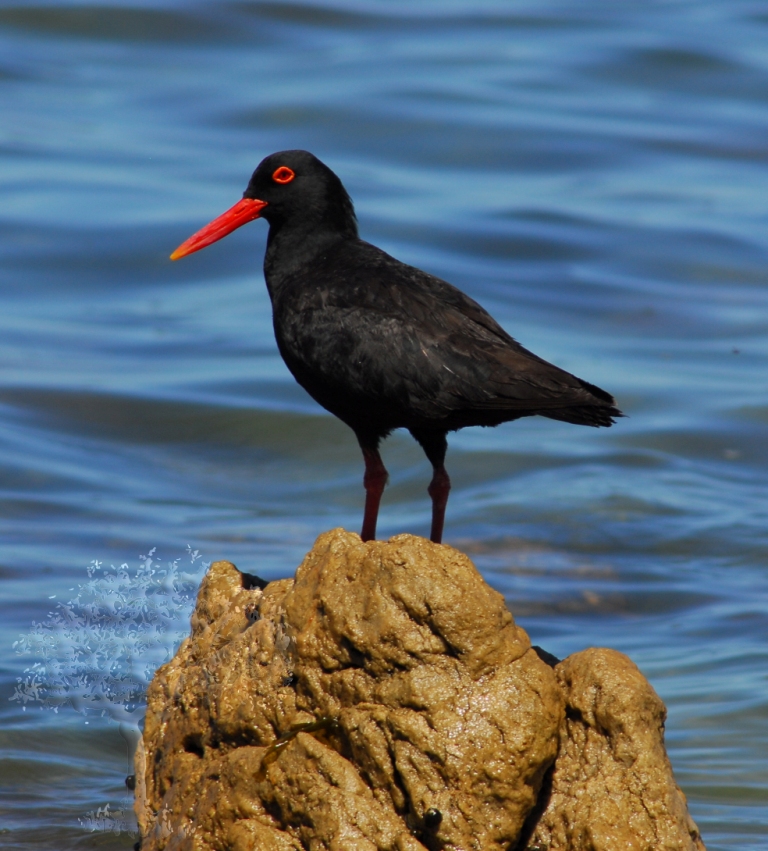
The African Oystercatcher is easily identified by its bold black plumage, contrasting sharply with its bright red bill and pinkish-red legs. Adult birds exhibit these characteristic features, making them relatively easy to distinguish from other shorebirds. Juveniles, however, present a more subdued appearance, with browner plumage and a duller bill coloration, gradually acquiring the distinctive adult features as they mature. Both males and females look similar, although males may be slightly larger on average. In flight, the African Oystercatcher shows a distinctive silhouette with broad wings and a steady, direct flight pattern. On the ground, its posture is upright and alert, often observed walking or running along the shoreline in search of food. While the African Oystercatcher is unlikely to be confused with other species within its range, its striking coloration sets it apart from similar-sized shorebirds, such as the Pied Avocet or various sandpipers, which generally exhibit lighter or more varied plumage. The bird's vibrant bill is not only a tool for foraging but also a key identification feature that distinguishes it from other coastal birds.
Having trouble telling birds apart? Upload a photo to our bird identification tool for an instant species match.
African Oystercatcher Habitat and Range
Preferred Habitat
The African Oystercatcher is predominantly found along rocky coastlines and sandy beaches, where it exploits the intertidal zone for feeding. It thrives in habitats where mussels, limpets, and other shellfish are abundant. These birds are often seen on the coasts of South Africa, Namibia, and occasionally Mozambique, where the combination of rocky outcrops and sandy stretches provide optimal conditions. The species prefers areas with little human disturbance, although it can sometimes be found in more populated regions if food resources are plentiful. Elevation is generally at sea level, as the bird is closely tied to marine environments. Unlike many other bird species, the African Oystercatcher does not exhibit significant seasonal habitat shifts, maintaining a consistent presence along its preferred coastal habitats year-round. Despite its preference for natural landscapes, the bird has occasionally been spotted in urban coastal areas, as long as its environmental needs are met.
Geographic Range
The African Oystercatcher's range is confined to the southern coast of Africa, with significant populations in South Africa and Namibia. It is a resident species, meaning it does not undertake long-distance migrations like many other shorebirds. Instead, it remains relatively localized within its range, moving short distances in response to environmental conditions and food availability. The bird's breeding range is closely aligned with its overall distribution, largely concentrated along the western and southern coasts of South Africa, including the Cape Peninsula and the West Coast National Park. In Namibia, it is found along the central and southern coastline, where suitable habitats exist. Although the species' range is limited compared to more widely distributed shorebirds, it maintains a stable presence within its preferred habitats. Population density hotspots include areas with abundant food resources and minimal human disturbance, such as protected coastal reserves.
Want to know which birds visit your area? Browse our backyard birds by location guides for region-specific species lists.
What Does the African Oystercatcher Eat?
The African Oystercatcher's diet consists primarily of bivalve mollusks, such as mussels and limpets, which it expertly pries open using its strong, pointed bill. This bird exhibits remarkable foraging skills, often observed working diligently along the rocky shoreline during low tide. It uses its bill to insert into the narrow openings of shells, applying pressure to open them and access the soft tissue inside. Secondary food sources include small crustaceans and other intertidal invertebrates. Seasonal diet variations are minimal, as the bird's primary food sources are consistently available throughout the year. The African Oystercatcher typically feeds during daylight hours, taking advantage of low tides when shellfish are most accessible. Prey size can vary, with the bird targeting shellfish that are small enough to be handled easily yet large enough to provide sufficient nourishment.
African Oystercatcher Behavior and Social Structure
African Oystercatchers display a range of fascinating behaviors, particularly during the breeding season. These birds are monogamous, forming long-term pair bonds and often returning to the same nesting sites each year. Territoriality is a prominent aspect of their behavior, with pairs vigorously defending their chosen stretch of coastline from rivals. Courtship displays involve mutual preening and synchronized displays, such as parallel walking and calling. Outside the breeding season, African Oystercatchers can be seen in small groups, particularly around abundant food sources. Their response to predators includes loud alarm calls and aggressive mobbing behavior, particularly when eggs or chicks are threatened. Daily activity patterns are largely dictated by tidal cycles, with peak foraging activity occurring during low tide. Although generally not vocal, these birds communicate effectively through a variety of calls, especially during courtship and territorial disputes.
African Oystercatcher Nesting and Reproduction
The nesting habits of the African Oystercatcher are closely tied to the coastal environment. Nests are simple scrapes in the sand or gravel, often positioned just above the high tide line to avoid flooding. Both male and female participate in nest building and incubation. The clutch size typically consists of 1 to 2 eggs, occasionally 3, with an incubation period of around 28 to 30 days. Once hatched, chicks are precocial, leaving the nest shortly after hatching but remaining under parental care. Both parents take an active role in feeding and protecting the young, leading them to feeding areas and guarding against predators. Fledging occurs approximately 6 to 7 weeks after hatching, but parental care can extend beyond this period as chicks learn essential foraging skills. Generally, African Oystercatchers produce one brood per year, though they may attempt a second brood if the first is lost.
African Oystercatcher Sounds and Vocalizations
The African Oystercatcher's vocal repertoire is distinctive, characterized by high-pitched, piping whistles that carry over the crashing waves. Its primary call, often heard during territorial disputes or when warning of predators, consists of a series of sharp, repetitive notes. These calls can be described as 'kleep-kleep' or 'peep-peep' sounds, delivered in rapid succession with a penetrating quality. During the breeding season, their vocalizations become more frequent and varied as they establish and defend territories. Alarm calls are particularly intense and are used to mobilize other oystercatchers in the area. While not known for a melodious song, the African Oystercatcher's calls are an integral part of its communication, especially in the dynamic coastal environment where sound can be quickly drowned out by ambient noise.
Interesting Facts About the African Oystercatcher
- 1African Oystercatchers can live for over 20 years, making them one of the longer-lived shorebirds.
- 2Despite the name, African Oystercatchers rarely eat oysters, preferring mussels and limpets instead.
- 3They are known for their strong pair bonds, with some pairs staying together for over a decade.
- 4African Oystercatchers can be aggressive in defending their territory, often seen chasing off larger birds.
- 5Their bright red bill serves as a tool and a visual signal, playing a role in both feeding and communication.
African Oystercatcher Conservation Status
The African Oystercatcher is currently listed as Near Threatened on the IUCN Red List. Its population trend is stable, though it faces several threats that could impact its future. These threats include habitat disturbance from coastal development, human recreational activities, and pollution. Conservation efforts are focused on protecting critical habitats and minimizing human impact through the establishment of protected coastal areas and public awareness campaigns. Historically, the population has experienced fluctuations due to environmental changes and human activities. Ongoing research and conservation initiatives aim to ensure the species' long-term viability by maintaining healthy coastal ecosystems and addressing emerging threats.
Other Haematopodidae Species


Birds Similar to the African Oystercatcher
These species are often confused with the African Oystercatcher due to similar appearance or overlapping range.

