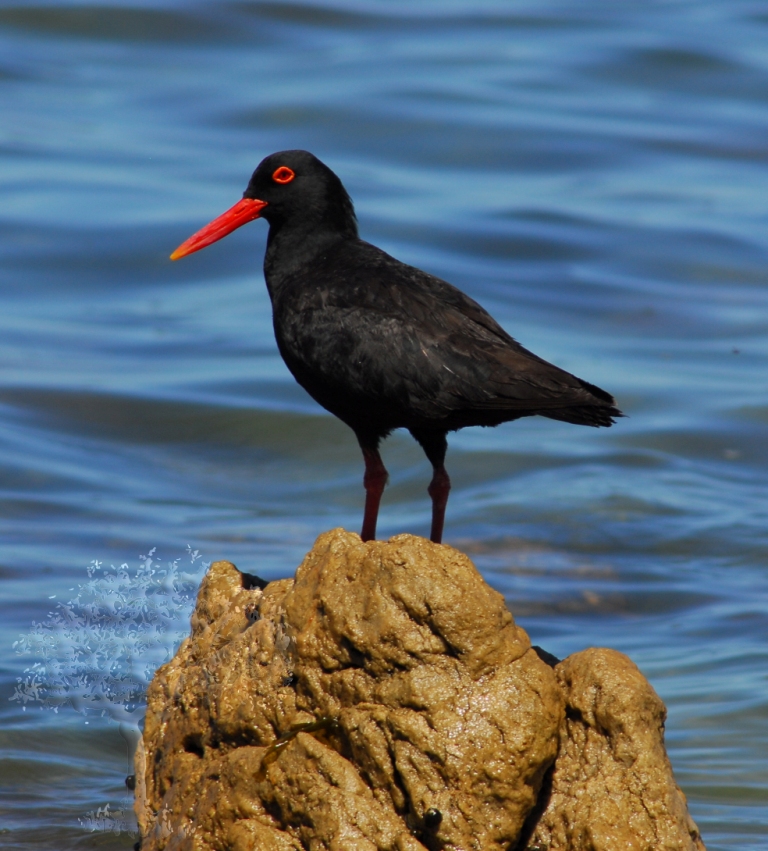
Variable Oystercatcher
Haematopus unicolor
Order: Charadriiformes / Family: Haematopodidae

Wikimedia Commons
About the Variable Oystercatcher
The Variable Oystercatcher, or Haematopus unicolor, is a compelling member of the Haematopodidae family, characterized by its remarkable adaptability and distinctive appearance. Found primarily in New Zealand, this bird is known for its striking black and white color morphs, although a completely black variant is also common. Unlike many shorebirds, the Variable Oystercatcher displays a preference for rocky shorelines and sandy beaches where it deftly navigates the intertidal zones.
These oystercatchers play a significant ecological role in their native habitats, acting as both predators and prey within the coastal ecosystems. Their presence is a good indicator of the health of these environments. During the breeding season, which typically spans from October to March, these birds exhibit strong site fidelity, often returning to the same nesting grounds year after year. This behavior underscores their importance in maintaining the ecological balance of their chosen locales.
Variable Oystercatchers primarily inhabit the coastal regions of both the North and South Islands of New Zealand. They are particularly concentrated in areas such as the Bay of Plenty and the Otago Peninsula. These sites provide the necessary resources and conditions for breeding and feeding. Outside of the breeding season, some individuals may disperse over short distances, yet they remain largely coastal, seldom venturing far inland.
In addition to their ecological significance, Variable Oystercatchers are a subject of interest for ornithologists and birdwatchers alike, not only for their striking appearance but also for their intriguing behaviors. Their role as a keystone species in coastal ecosystems makes them a focal point for conservation efforts aimed at preserving the delicate balance of New Zealand's unique coastal environments.
The Variable Oystercatcher belongs to the family Haematopodidae, within the order Charadriiformes. These birds typically live typically 15-20 years, with some individuals living over 30 years..
How to Identify a Variable Oystercatcher
The Variable Oystercatcher is easily recognized by its robust build and long, bright orange bill. Adult birds exhibit a range of plumage, from pure black to a pied form with black and white patterns. The most common form is entirely black, giving it an elegant yet striking appearance. Both male and female Variable Oystercatchers exhibit similar plumage, making sex differentiation in the field challenging without observing behavioral cues during the breeding season. Juveniles are generally duller, with a more muted black coloration, and their bills are shorter and less vividly colored compared to adults.
These birds can be distinguished from similar species, such as the South Island Pied Oystercatcher, by their unicolored or pied appearance rather than the stark black and white contrast seen in their relatives. In flight, the Variable Oystercatcher presents a distinctive silhouette due to its long, pointed wings and relatively short tail. Its flight is strong and direct, often accompanied by loud, piping calls.
When foraging or at rest, the Variable Oystercatcher maintains an upright posture, with its long legs contributing to its elegant stance. The bird's eyes are bright red, adding to its distinctive look, and are framed by a narrow orange eye-ring, providing a subtle yet distinguishing feature for the keen observer.
Having trouble telling birds apart? Upload a photo to our bird identification tool for an instant species match.
Variable Oystercatcher Habitat and Range
Preferred Habitat
Variable Oystercatchers predominantly inhabit coastal regions, favoring sandy beaches, rocky shorelines, and estuarine environments. They are well adapted to these habitats, where they forage for bivalves and other marine invertebrates. Typically found at elevations ranging from sea level to just above the high-tide mark, these birds rely heavily on the intertidal zone for feeding.
During the breeding season, they show a preference for nesting on sandy or gravelly beaches, often just above the high-tide line. This choice of location ensures that their nests are safe from flooding while remaining close to their food resources. In urban areas, Variable Oystercatchers can sometimes be observed in parks or near coastal developments, provided suitable habitat is available. However, they are more commonly associated with rural and less disturbed coastal areas where human activity is minimal.
Seasonal habitat shifts in Variable Oystercatchers are minimal, as they do not undertake long migrations. Some birds may move slightly inland or to different parts of the coast outside of the breeding season, but such movements are generally limited and not characteristic of large-scale migration.
Geographic Range
The Variable Oystercatcher is endemic to New Zealand, with its range spanning both the North and South Islands and extending to some offshore islands. Their distribution is largely coastal, with a notable presence in regions such as Auckland, the Bay of Plenty, and the Otago Peninsula. These areas are known for their extensive beaches and rich tidal zones, which provide ideal feeding and breeding grounds.
While the majority of the population remains within these coastal areas year-round, small-scale movements occur outside the breeding season. These movements are typically limited to different sections of the coast rather than long-distance migrations.
Population density hotspots include the Coromandel Peninsula and the northern regions of the South Island, where these birds are frequently observed foraging and nesting. The absence of significant migration corridors reflects the species' adaptation to the stable coastal environments of New Zealand, where they have evolved to thrive without the need for extensive seasonal travel.
Want to know which birds visit your area? Browse our backyard birds by location guides for region-specific species lists.
What Does the Variable Oystercatcher Eat?
The diet of the Variable Oystercatcher primarily consists of marine invertebrates, with bivalves being the most significant component. These birds are adept at using their long, sharp bills to pry open the shells of clams and mussels, which constitute their primary food source. Their diet varies seasonally, with a greater emphasis on bivalves during the breeding season when energy demands are higher.
In addition to bivalves, they consume a variety of other marine creatures, including worms, crustaceans, and small fish. The foraging technique of the Variable Oystercatcher is quite specialized. They are known for their ability to probe deeply into sand and mudflats to extract hidden prey. The size of prey varies, but they often target medium-sized bivalves that are easy to handle and consume.
Variable Oystercatchers typically forage during low tide when the intertidal zone is exposed, providing access to their preferred prey. Their feeding schedule is closely aligned with tidal patterns, and they often feed in small groups, which can enhance foraging success through cooperative behavior.
Variable Oystercatcher Behavior and Social Structure
Variable Oystercatchers exhibit a fascinating array of behaviors, particularly during the breeding season. They are generally monogamous, forming long-term pair bonds that can last several breeding seasons. These birds are highly territorial, especially during nesting, aggressively defending their chosen stretch of beach from intruders.
Courtship displays are elaborate and include synchronized flights, vocalizations, and mutual preening. Such behaviors strengthen pair bonds and ensure successful breeding. Outside of the breeding season, Variable Oystercatchers may form small flocks, although they do not exhibit the large-scale flocking behavior seen in some other shorebirds.
Their response to predators is noteworthy; they employ distraction displays to lead potential threats away from their nests. This involves running or flying short distances while making loud, persistent calls. Daily activity patterns are largely diurnal, with peak activity occurring during low tide. At high tide, they often rest or engage in social interactions, maintaining vigilance over their territory.
The Variable Oystercatcher's social structure is centered around the breeding pair, with both male and female sharing duties such as incubation and chick-rearing.
Variable Oystercatcher Nesting and Reproduction
Nesting for the Variable Oystercatcher begins in earnest by October, with pairs selecting nesting sites on sandy or gravelly beaches. Nests are simple scrapes in the sand, sometimes lined with small pebbles or shells for added camouflage and insulation. The typical clutch size is two to three eggs, though occasionally a pair may lay only one.
Incubation duties are shared between the male and female, lasting approximately 28 to 32 days. Both parents are highly attentive and take turns incubating while the other forages. Upon hatching, the chicks are precocial, meaning they are relatively mature and mobile, but they remain dependent on their parents for food and protection.
Fledging occurs roughly six to seven weeks after hatching, though young birds often stay with their parents for several weeks post-fledging as they learn to forage and become independent. In most cases, Variable Oystercatchers raise only one brood per year, although in optimal conditions, a second brood may be attempted. Parental roles are shared equally, with both adults involved in feeding and protecting their young.
Variable Oystercatcher Sounds and Vocalizations
The Variable Oystercatcher is known for its distinctive vocalizations, which play a vital role in communication among individuals. Its primary song is a series of clear, high-pitched piping notes that can be heard over great distances. This call is often used to establish territory and during courtship displays.
Additionally, the bird emits a variety of short, sharp alarm calls when threatened by predators or when intruders approach their nesting area. These calls are rapid and urgent, designed to alert other oystercatchers of potential danger.
During the dawn chorus, the Variable Oystercatcher's calls are most prominent, as individuals announce their presence and reinforce territorial boundaries. Their vocalizations are comparable to a clear whistle and serve as a key identifier for birders. The consistency and rhythm of their calls make them easily distinguishable from other shorebirds, aiding in their identification in the field.
Interesting Facts About the Variable Oystercatcher
- 1Variable Oystercatchers can live up to 25 years, making them long-lived for shorebirds.
- 2Despite their name, oystercatchers rarely eat oysters, preferring mussels and clams instead.
- 3Their bright orange bill is not just for show; it is a highly specialized tool for prying open bivalves.
- 4They exhibit strong site fidelity, often returning to the same nesting site year after year.
- 5Variable Oystercatchers can be either all black or pied, making them unique among their relatives.
- 6These birds use a technique called 'hammering' to access the meat inside hard-shelled prey.
- 7Chicks are able to leave the nest and follow their parents within hours of hatching.
Variable Oystercatcher Conservation Status
The Variable Oystercatcher is currently classified as 'Least Concern' by the IUCN, reflecting a stable population trend. However, certain localized threats, such as habitat disturbance and coastal development, pose ongoing challenges to their conservation. Efforts to preserve vital nesting habitats have been undertaken, particularly in regions where human activity is prevalent. Conservationists focus on protecting breeding sites and managing predator populations, such as introduced mammals that threaten eggs and chicks. Historically, the Variable Oystercatcher's population experienced declines due to habitat loss, but recent conservation measures have helped stabilize their numbers. Public awareness and involvement in beach conservation initiatives also contribute to their preservation. While the overall population remains stable, continued vigilance is necessary to ensure that these birds can thrive in their coastal environments amid increasing human pressures.
Other Haematopodidae Species


Birds Similar to the Variable Oystercatcher
These species are often confused with the Variable Oystercatcher due to similar appearance or overlapping range.