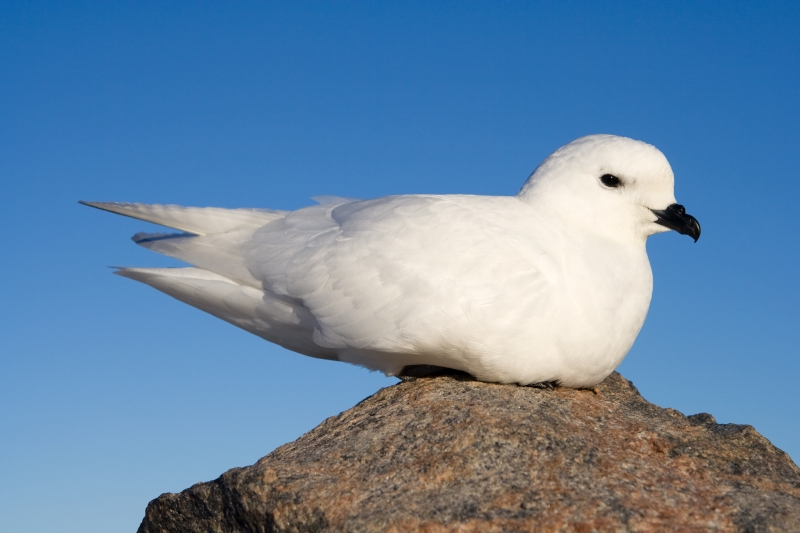
Antarctic Petrel
Thalassoica antarctica
Order: Procellariiformes / Family: Procellariidae

Wikimedia Commons
About the Antarctic Petrel
The Antarctic Petrel (Thalassoica antarctica) is a formidable seabird that thrives in the harsh and inhospitable environments of the Southern Ocean. This species is a member of the family Procellariidae, which includes many of the world’s most accomplished oceanic fliers. The Antarctic Petrel is perfectly adapted to its cold, remote habitat, marked by its striking plumage that provides excellent camouflage against the ice and snow. Found primarily in the Antarctic region, particularly around the Ross Sea, these birds are a quintessential feature of the Antarctic marine ecosystem. They play a critical role in the food web, both as predators of small marine organisms and as prey for larger birds and mammals. Their presence also indicates the health of the marine environment, as they are sensitive to changes in the availability of their food sources, such as krill and small fish. During the breeding season, these petrels nest on rocky cliffs and ice-free areas of the Antarctic coast, often forming large colonies that can number in the thousands. The colonies are a hive of activity, with constant movement and the cacophony of calls filling the air. Outside the breeding season, the Antarctic Petrel spends much of its life on the wing, roaming the vast Southern Ocean in search of food. This lifestyle requires them to be agile and efficient fliers, capable of covering great distances with minimal energy expenditure. In recent years, the Antarctic Petrel's significance has grown as scientists study its responses to climate change. Changes in sea ice patterns and temperatures can impact their food supply and breeding success, making them valuable indicators of environmental shifts. As such, the conservation of this species is becoming increasingly important, though they currently maintain a stable population. Their adaptability and resilience to extreme conditions continue to fascinate ornithologists and nature enthusiasts worldwide.
The Antarctic Petrel belongs to the family Procellariidae, within the order Procellariiformes. These birds typically live average 15 years with a maximum recorded of 30 years..
How to Identify a Antarctic Petrel
The Antarctic Petrel is a medium-sized seabird, measuring between 42 to 47 centimeters in length, with a wingspan reaching up to 110 centimeters. Its most striking feature is its bold, contrasting plumage, predominantly brown on the upper parts and head, with a white face and underparts. The wings are distinctly patterned, showcasing a combination of brown and white that forms a strikingly beautiful pattern, aiding in identification even from a distance. Juveniles resemble adults but are slightly duller, with less distinct contrast in their plumage. Both males and females look similar, making sexual dimorphism negligible in this species. When observing the Antarctic Petrel in flight, birders will note its stiff-winged, gliding flight pattern. This petrel exhibits a unique flight silhouette with its long, slender wings and a slightly wedge-shaped tail, which sets it apart from other seabirds. Unlike many other petrel species, the Antarctic Petrel does not spend much time perched, preferring to remain on the wing or resting on water surfaces. This behavior can make it challenging to observe on land, except during the breeding season. While confusion with similar species such as the Cape Petrel can occur, the Antarctic Petrel's more uniform brown head and upperparts are key distinguishing features.
Having trouble telling birds apart? Upload a photo to our bird identification tool for an instant species match.
Antarctic Petrel Habitat and Range
Preferred Habitat
The Antarctic Petrel inhabits the frigid southern reaches of the planet, predominantly within the Antarctic Circle. Its preferred habitats include ice-covered seas and the rocky, ice-free coastal regions of Antarctica for breeding. During the breeding season, these petrels favor nesting sites on steep cliffs or rocky outcrops that provide some protection from predators and the elements. Elevation at these nesting sites can vary but is usually found at moderate heights where ice is absent. Outside the breeding season, the Antarctic Petrel remains largely pelagic, inhabiting the open ocean and often ranging far from any land. It rarely, if ever, ventures into urban environments or areas heavily influenced by human activity. Seasonal shifts in habitat are minimal, as these birds are well-adapted to the cold year-round conditions of their environment.
Geographic Range
The range of the Antarctic Petrel is primarily confined to the Southern Ocean and the Antarctic continent. During the breeding season, they are largely found around the Ross Sea and the Antarctic Peninsula, where large colonies form in ice-free coastal areas. These colonies are significant in size, often hosting tens of thousands of birds. In the non-breeding season, the Antarctic Petrel becomes highly pelagic, roaming widely across the Southern Ocean. They can venture as far north as the subantarctic islands, including South Georgia and the South Sandwich Islands, although their presence there is less common. Migration corridors are not well-defined, as these birds are more influenced by the availability of food rather than fixed migratory paths. Population density is highest near breeding colonies, but they can be observed throughout their oceanic range, particularly in areas with abundant marine life.
Want to know which birds visit your area? Browse our backyard birds by location guides for region-specific species lists.
What Does the Antarctic Petrel Eat?
The Antarctic Petrel primarily feeds on small marine organisms, with krill constituting a significant portion of its diet. Additionally, it consumes fish and squid, which it captures through surface-seizing techniques. These birds are adept at foraging both individually and in flocks, often capitalizing on the abundance of prey in nutrient-rich waters. Seasonal changes in diet are minimal, given the consistent availability of krill throughout the year, though the proportion of fish and squid may vary. The Antarctic Petrel typically forages during the day, though it can take advantage of the extended daylight hours of the Antarctic summer to feed at any time. Prey size typically ranges from 1 to 10 centimeters in length, making it well-suited for the petrel's slender bill and agile feeding methods.
Antarctic Petrel Behavior and Social Structure
The Antarctic Petrel exhibits a social and colonial nature, particularly evident during the breeding season when large colonies form on coastal cliffs. These birds are generally non-aggressive towards one another, which facilitates the formation of densely packed colonies. Courtship displays involve synchronized flight patterns and vocalizations, with pairs forming monogamous bonds that can last multiple seasons. Flocking behavior is common, especially outside the breeding season when they roam the open ocean in search of food. These flocks are not strictly organized but are instead loosely associated groups that benefit from shared foraging opportunities. The Antarctic Petrel displays a lack of territorial aggression outside of nesting sites, allowing multiple pairs to nest in close proximity. In response to predators or intruders, these petrels rely on vocal alarms and evasive flight rather than direct confrontation. Their daily activity patterns align with the presence of prey, often dictated by the availability of food rather than a strict diurnal cycle.
Antarctic Petrel Nesting and Reproduction
Antarctic Petrels nest in colonies located on rocky cliffs and ice-free areas of the Antarctic coast. The nests are simple scrapes in the ground, often lined with small stones and bits of vegetation. Clutch size is typically a single egg per breeding season, reflecting the harsh conditions of their environment. Incubation duties are shared by both parents, lasting about 40 to 45 days before the chick hatches. After hatching, both parents continue to provide for the chick, feeding it through regurgitation. The fledging period extends for about 50 to 60 days, during which the chick grows rapidly, supported by the calorific richness of krill and fish. The Antarctic Petrel typically raises one brood per year, with breeding success highly dependent on environmental conditions and food availability.
Antarctic Petrel Sounds and Vocalizations
The Antarctic Petrel's vocalizations are primarily composed of harsh, guttural calls that serve multiple functions within their colonies. These calls feature a rhythmic and repetitive pattern, often described as a series of squawks and croaks. Courtship calls are softer and more musical, aimed at attracting mates and reinforcing pair bonds. Alarm calls are sharper and more urgent, designed to alert other petrels to potential threats. Unlike many songbirds, Antarctic Petrels do not participate in a dawn chorus, as their vocalizations are more functional than melodic. Their calls can be compared to the harsh cries of gulls, although with a more throaty and lower pitch.
Interesting Facts About the Antarctic Petrel
- 1The Antarctic Petrel is one of only three bird species endemic to the Antarctic continent, highlighting its unique adaptation to extreme conditions.
- 2These petrels can travel thousands of kilometers over the open ocean, showcasing their remarkable endurance and navigational skills.
- 3The Antarctic Petrel's breeding colonies can host up to 200,000 individuals, forming some of the largest seabird colonies in the world.
- 4Unlike many birds, the Antarctic Petrel relies heavily on krill, a small crustacean, as a primary food source throughout the year.
- 5Despite their remote habitat, the Antarctic Petrel has been observed as far north as New Zealand, demonstrating their extensive range.
- 6Their unique plumage pattern not only provides camouflage against snow and ice but also aids in thermoregulation by reflecting solar radiation.
- 7The species' name, Thalassoica antarctica, is derived from Greek, meaning 'sea wanderer of Antarctica,' reflecting its oceanic lifestyle.
Antarctic Petrel Conservation Status
The Antarctic Petrel currently holds a conservation status of Least Concern according to the IUCN. The population remains stable, with no immediate threats causing significant declines. However, potential threats include climate change, which may impact sea ice patterns and food availability. Conservation efforts focus on monitoring population trends and the health of their marine environment. Historically, the population has fluctuated with changes in the Antarctic ecosystem, but recent data suggests a stable trend due to the vastness of their range and adaptability. Maintaining the integrity of their habitat is crucial to ensure long-term stability.
Other Procellariidae Species


Birds Similar to the Antarctic Petrel
These species are often confused with the Antarctic Petrel due to similar appearance or overlapping range.