
Snow Petrel
Pagodroma nivea
Order: Procellariiformes / Family: Procellariidae
Wikimedia Commons
About the Snow Petrel
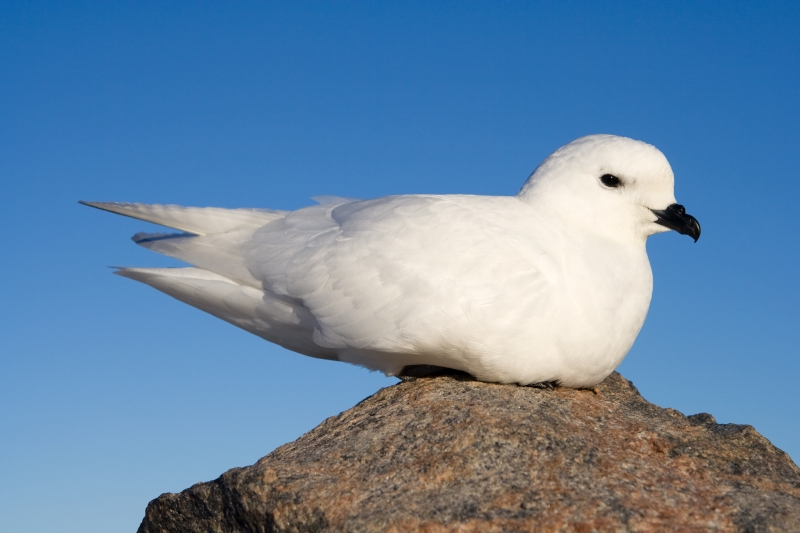
The Snow Petrel, scientifically known as Pagodroma nivea, holds a special place among the seabirds of the Antarctic due to its striking all-white plumage and remarkable adaptation to one of the harshest climates on Earth. This bird, belonging to the family Procellariidae and order Procellariiformes, is one of the few bird species that venture into the deep interior of Antarctica. Its presence is often considered symbolic of the pristine Antarctic environment. Snow Petrels are relatively small, measuring about 30 to 40 centimeters in length, with a wingspan of approximately 75 to 95 centimeters. Their pure white plumage, contrasted with their dark eyes and black bill, makes them easily identifiable against the icy backdrop of their habitat. These birds are often seen gliding effortlessly over the sea ice and open waters, demonstrating their highly adept flying skills. Snow Petrels play a crucial ecological role in the Antarctic ecosystem. As a seabird, they primarily feed on fish, cephalopods, and crustaceans, thereby maintaining a balance in the marine food web. Their guano also contributes to nutrient cycling, enriching the soils of the few ice-free areas where they nest. The diet of Snow Petrels varies seasonally, with a preference for krill, fish, and squid during the breeding season. The Snow Petrel breeds exclusively in Antarctica, and their nesting period aligns with the austral summer, when food availability is at its peak. They build their nests on the rocky outcrops and cliffs that protrude from the ice and snow, often choosing sites that offer some protection against the harsh winds and provide proximity to food sources. During the breeding season, Snow Petrels are territorial and monogamous, with pairs returning to the same nesting sites each year. Despite the extreme conditions, they are highly successful breeders, adapting to the challenges posed by their environment. These birds exhibit a fascinating array of behaviors that are finely tuned to their environment. During the austral winter, when the ice expands, Snow Petrels move northward, following the receding ice edge to forage. Their seasonal movements are closely linked to the availability of open water and prey. In addition to their ecological contributions, Snow Petrels hold cultural significance for researchers and travelers who brave the Antarctic conditions. Their presence is often a highlight for expeditions, and they serve as indicators of environmental change, with scientists using their population dynamics and distribution shifts as proxies for monitoring the health of the Antarctic ecosystem.
The Snow Petrel belongs to the family Procellariidae, within the order Procellariiformes. These birds typically live average 20 years, with a maximum recorded of over 40 years..
How to Identify a Snow Petrel
The Snow Petrel's all-white plumage stands out as one of its most distinctive features. This pure white coloring provides excellent camouflage against the snow and ice of its Antarctic habitat. Adults have dark eyes and a black bill, accentuating their pristine appearance. The legs and feet are blue-gray, a subtle contrast to the overall whiteness. Juveniles resemble adults but may have slightly darker markings on the bill. Unlike many bird species, there is no significant difference in plumage between male and female Snow Petrels, making sex identification in the field challenging without behavioral cues. In flight, Snow Petrels exhibit a graceful and buoyant style, with wings that appear relatively broad at the base and taper slightly towards the tips. Their flight silhouette is compact, and they often fly low over the water, using the updrafts from waves and ice edges to sustain long periods of gliding. When perched, they display a characteristic upright posture, often on rocky outcrops or icebergs. Confusion with other species is minimal, but the Ivory Gull, another white seabird, can superficially resemble the Snow Petrel. However, the Ivory Gull is generally found further north and has a distinct, more gull-like shape with black feet and a more rounded head.
Having trouble telling birds apart? Upload a photo to our bird identification tool for an instant species match.
Snow Petrel Habitat and Range
Preferred Habitat
The Snow Petrel thrives in the frigid and remote regions of Antarctica, favoring the ice-covered continent for breeding and feeding. Their preferred habitats include the rocky outcrops and cliffs that punctuate the otherwise ice-dominated landscape, providing safe nesting sites away from predators. Snow Petrels are typically found at elevations ranging from sea level up to 2,000 meters in mountainous regions near the coast. These birds are closely associated with the pack ice and frequently seen at the ice edges where they forage. During the non-breeding season, Snow Petrels remain in the Southern Ocean, following the circumpolar current and the retreating ice edge. They exhibit minimal presence in urban or human-inhabited areas due to their preference for remote, pristine environments. While they do not inhabit urban areas, they occasionally venture closer to research stations on the continent during foraging trips.
Geographic Range
The range of the Snow Petrel is largely confined to the Antarctic region, where it breeds exclusively on the continent itself. Snow Petrels establish breeding colonies on almost all coastal areas of Antarctica, with notable concentrations around the Antarctic Peninsula, the South Shetland Islands, and various island groups in the Southern Ocean, such as South Georgia. During the austral summer, these birds remain close to their breeding sites, but as winter approaches and the ice expands, they migrate northward, following the ice edge. This seasonal movement ensures they have access to open water for feeding. The Snow Petrel's wintering range extends into the subantarctic waters, where they are commonly observed in the southern parts of the Indian Ocean, the Weddell Sea, and the Ross Sea. Although their range is vast, population densities are highest near productive feeding grounds along the ice edge, where prey abundance peaks.
Want to know which birds visit your area? Browse our backyard birds by location guides for region-specific species lists.
What Does the Snow Petrel Eat?
The diet of the Snow Petrel consists mainly of marine organisms found in the icy waters of the Southern Ocean. Krill, small fish, and cephalopods form the bulk of their diet, with krill being particularly important during the breeding season. These birds employ a variety of foraging techniques, including surface seizing and shallow diving, to capture their prey. Snow Petrels are opportunistic feeders, occasionally scavenging on carrion or feeding on zooplankton. Seasonal changes influence their diet, with a shift towards more fish and squid during the austral winter when krill becomes less accessible. Prey size varies, but they generally target small to medium-sized organisms that are abundant in their environment. Snow Petrels feed both day and night, taking advantage of the perpetual daylight during the Antarctic summer to maximize their foraging success.
Snow Petrel Behavior and Social Structure
Snow Petrels exhibit a range of fascinating behaviors adapted to their extreme environment. They are generally monogamous, forming long-term pair bonds that often last for multiple breeding seasons. During the breeding season, Snow Petrels are territorial, with pairs defending their nesting sites from intruders. Courtship displays include synchronized flights and mutual preening, reinforcing pair bonds. These birds are colonial nesters, with colonies ranging from a few pairs to several thousand individuals. Snow Petrels exhibit strong site fidelity, often returning to the same nesting location each year. Despite their harsh surroundings, they are highly social, often seen in flocks near foraging areas. Their response to predators, such as skuas, includes aggressive mobbing and vocal alarms to protect their eggs and chicks. Daily activity patterns are dictated by the availability of food and the need to incubate eggs or feed chicks, resulting in alternating periods of foraging and nesting.
Snow Petrel Nesting and Reproduction
The nesting habits of the Snow Petrel are adapted to the extreme conditions of Antarctica. They nest on rocky outcrops and cliffs, where they build simple nests using pebbles and other small stones. These sites offer protection from the elements and predators. The clutch size is typically one egg, which is incubated by both parents for about 40 to 50 days. After hatching, the chick remains in the nest for approximately 7 to 8 weeks before fledging. During this period, both parents share responsibilities, alternating between foraging and guarding the nest. Snow Petrels typically have one brood per year, taking advantage of the short Antarctic summer to breed and rear their young. The nesting season is synchronized with the peak availability of food, ensuring that chicks have a steady supply of nourishment.
Snow Petrel Sounds and Vocalizations
Snow Petrels are not known for their vocal repertoire, but they do produce a range of calls that serve important communicative functions. The primary call is a soft, whistling sound, used in various social interactions and during courtship displays. These calls are often described as melodious, with a rhythmic pattern that may vary in pitch and intensity. Alarm calls, on the other hand, are harsher and more abrupt, serving to warn colony members of potential threats, such as predators. The Snow Petrel does not participate in dawn chorus activities typical of many songbirds, as its habitat and lifestyle do not align with such behaviors.
Interesting Facts About the Snow Petrel
- 1The Snow Petrel's pure white plumage helps it blend seamlessly into the icy Antarctic environment, providing camouflage against predators.
- 2Snow Petrels are among the few bird species that venture deep into the Antarctic continent, often seen far from the coast.
- 3These birds can cover large distances while foraging, sometimes traveling over 1,000 kilometers from their nesting sites in search of food.
- 4The Snow Petrel has a unique adaptation allowing it to drink seawater, thanks to specialized glands that excrete excess salt.
- 5Their nests are often built in crevices and gaps between rocks, providing shelter from the harsh Antarctic winds and predators.
- 6Snow Petrels have been known to live over 20 years in the wild, displaying remarkable resilience in one of the harshest environments on Earth.
- 7The Snow Petrel's presence is often used by scientists as an indicator of environmental changes in the Antarctic ecosystem.
Snow Petrel Conservation Status
The Snow Petrel is currently listed as Least Concern on the IUCN Red List, with a stable population trend. Despite the challenges of their environment, these birds have adapted well to the Antarctic conditions, and their populations are thought to be stable. However, they face potential threats from climate change, which may alter their habitat and food availability. Conservation efforts focus on monitoring population trends and the impacts of environmental changes on their breeding and foraging habitats. Historical population changes have been relatively minor, but continued vigilance is required to ensure their long-term survival in the face of a changing climate.
Other Procellariidae Species


Birds Similar to the Snow Petrel
These species are often confused with the Snow Petrel due to similar appearance or overlapping range.

