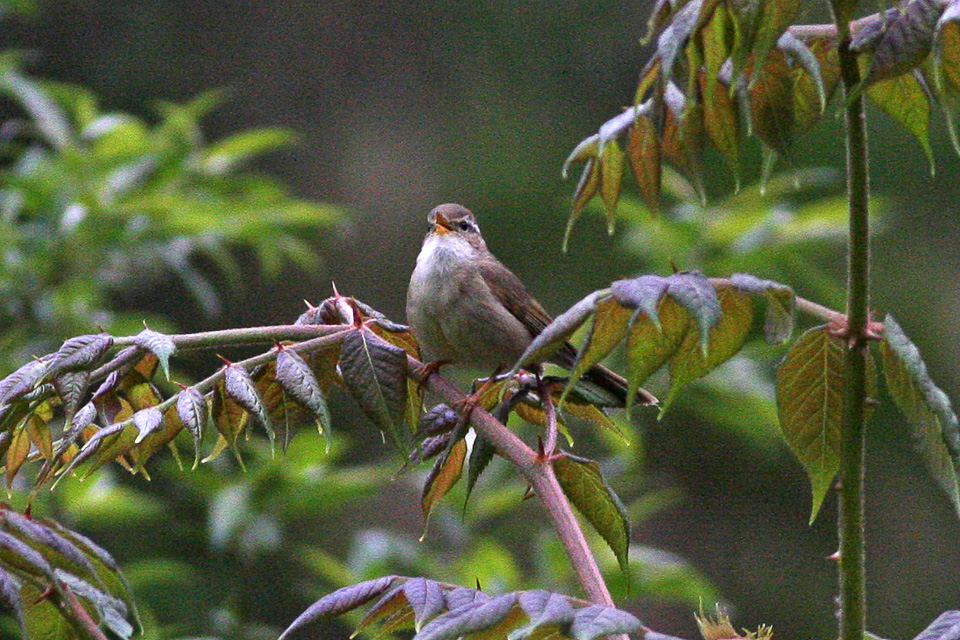
Ashy-throated Warbler
Phylloscopus maculipennis
Order: Passeriformes / Family: Phylloscopidae

Wikimedia Commons
About the Ashy-throated Warbler
The Ashy-throated Warbler, scientifically known as Phylloscopus maculipennis, is a small, active songbird belonging to the family Phylloscopidae. This species is native to the temperate and subtropical montane forests of the Himalayas and Southeast Asia. Renowned for its vibrant green upperparts and distinctive ashy throat, the Ashy-throated Warbler is a quintessential forest dweller, providing a vital role in the ecosystem as an insectivore. Its presence indicates a healthy, biodiverse forest environment, as it thrives in regions with dense foliage and rich insect populations. Typically, this warbler inhabits areas ranging from eastern Nepal through Bhutan, northeastern India, and into Myanmar and Thailand, preferring elevations between 1,500 and 3,500 meters. The Ashy-throated Warbler plays a crucial role in controlling insect populations, including caterpillars and other pests, thus maintaining the ecological balance within its habitat. During the breeding season, which occurs from April to June, the male Ashy-throated Warbler becomes particularly territorial, establishing and defending its breeding grounds with vigor. As a migratory species, it exhibits seasonal movements, descending to lower elevations during the colder months in search of food and milder climates. Its adaptability to different altitudes and conditions highlights its ecological significance beyond its breeding territories. Although not currently threatened, the Ashy-throated Warbler faces challenges from habitat destruction due to deforestation and human encroachment. Conservation efforts focusing on preserving its natural habitat are critical to ensuring the continued survival of this and other forest-dependent species. Understanding the Ashy-throated Warbler's ecological role helps underscore the importance of conserving montane forest ecosystems, which serve as critical biodiversity hotspots.
The Ashy-throated Warbler belongs to the family Phylloscopidae, within the order Passeriformes. These birds typically live typically 4-7 years, with some living up to 10 years..
How to Identify a Ashy-throated Warbler
The Ashy-throated Warbler is a small bird, measuring around 9 to 10 centimeters in length, with a wingspan of approximately 16 centimeters. Adults exhibit striking greenish upperparts, contrasting sharply with their ashy-gray throat and chest, which serve as key identifying features. The face is marked with a prominent whitish supercilium that stands out against a darker ear coverts, giving the bird a distinctive facial pattern. Both male and female Ashy-throated Warblers share similar plumage, making them difficult to differentiate in the field. Juveniles resemble adults but often display slightly duller tones with less distinct markings. In flight, the Ashy-throated Warbler presents a compact silhouette, with rapid wingbeats and a habit of flitting through the understorey and mid-canopy levels of the forest. When perched, this bird often adopts an upright posture, flicking its wings and tail nervously, a behavior common to many warbler species. The Ashy-throated Warbler may be confused with the similar-looking Lemon-rumped Warbler, but the latter lacks the ashy throat and has a more pronounced lemon-yellow rump. Observing these subtle differences can aid birdwatchers in making accurate identifications in the field.
Having trouble telling birds apart? Upload a photo to our bird identification tool for an instant species match.
Ashy-throated Warbler Habitat and Range
Preferred Habitat
The Ashy-throated Warbler predominantly inhabits montane forests, favoring broadleaf evergreen and mixed oak-rhododendron woodlands. These habitats provide ample cover and a rich insect population, essential for its sustenance. Typically found at elevations between 1,500 and 3,500 meters, this warbler descends to lower altitudes during the winter months. Its adaptability to different forest types allows it to occupy a variety of microhabitats, from dense understorey to more open canopy regions. While primarily a forest species, the Ashy-throated Warbler can occasionally be found in more open areas, such as forest edges and clearings, especially during migration. Unlike some bird species, it shows limited presence in urban environments, preferring the tranquility and seclusion of its natural forested habitats. Seasonal movements may lead it to temporarily inhabit lower montane regions, where it continues to fulfill its ecological role as an insectivore, contributing to pest control and forest health.
Geographic Range
The Ashy-throated Warbler's range extends across parts of the Himalayas and Southeast Asia, encompassing countries such as Nepal, Bhutan, northeastern India, Myanmar, and northern Thailand. During the breeding season, this species is predominantly found in the higher elevations of the Himalayas, thriving in the temperate and subtropical montane forests. As autumn approaches, the Ashy-throated Warbler undertakes migratory movements, descending to lower altitudes and regions such as the foothills of the Himalayas, where it spends the winter months. This seasonal migration helps it avoid the harsh conditions of high-altitude winters while continuing to find abundant food sources. Throughout its range, the Ashy-throated Warbler is commonly observed in areas with dense forest cover, which provides both food and shelter. Population density tends to be higher in regions with extensive, contiguous forest tracts, as these areas support larger insect populations necessary for the warbler's survival. Despite its wide range, localized threats such as deforestation can impact specific populations, highlighting the need for targeted conservation efforts.
Want to know which birds visit your area? Browse our backyard birds by location guides for region-specific species lists.
What Does the Ashy-throated Warbler Eat?
The diet of the Ashy-throated Warbler primarily consists of insects and other small invertebrates. This warbler is an adept forager, gleaning prey from leaves and branches with quick, precise movements. Caterpillars form a significant part of its diet, especially during the breeding season when the demand for protein is high to support growing chicks. In addition to caterpillars, it consumes a variety of beetles, spiders, and other arthropods, which it skillfully extracts from crevices in bark and foliage. Seasonal changes influence its dietary habits, with the Ashy-throated Warbler adjusting its foraging techniques and prey selection according to availability. During late summer and early autumn, it may also consume small quantities of berries and seeds, supplementing its insect-based diet. This dietary flexibility aids its survival during periods when insect populations are lower, such as in the cooler months at lower elevations. The Ashy-throated Warbler's foraging behavior includes active searching through the mid and upper canopy, often joining mixed-species flocks to enhance feeding efficiency and reduce the risk of predation.
Ashy-throated Warbler Behavior and Social Structure
The Ashy-throated Warbler exhibits behaviors typical of many small woodland songbirds, including a preference for solitary or paired living outside of the breeding season. During breeding, males become highly territorial, singing persistently to establish and defend their territories against rivals. The Ashy-throated Warbler's song serves both to attract mates and to delineate territorial boundaries. Courtship involves a combination of song and visual displays, with the male often performing a series of hops and wing-flicks to capture the female's attention. Outside the breeding season, this warbler often joins mixed-species flocks, a behavior that provides increased protection from predators and enhances foraging success through collective vigilance. The Ashy-throated Warbler exhibits a distinct daily activity pattern, being most active during the early morning and late afternoon when insect prey is abundant. It responds to predators with quick, erratic flights and loud alarm calls, often taking cover in dense foliage. Despite its small size, the Ashy-throated Warbler plays a significant role in the forest ecosystem, participating in the complex web of interactions that sustain forest health and biodiversity.
Ashy-throated Warbler Nesting and Reproduction
The nesting habits of the Ashy-throated Warbler reflect its adaptation to montane forest environments. Nests are typically constructed in low shrubs or small trees within the dense understorey, providing concealment from predators. The female builds the nest, using a variety of materials such as moss, grass, and fine twigs, creating a compact, cup-shaped structure. The clutch usually consists of 3 to 4 eggs, which the female incubates over a period of about 12 to 14 days. During this time, the male plays a supportive role, providing food for the female as she remains on the nest. Once hatched, both parents actively participate in feeding the chicks, delivering a steady supply of insects to the hungry brood. The fledging period lasts approximately 10 to 12 days, after which the young birds leave the nest but remain dependent on parental care for several more weeks. The Ashy-throated Warbler typically raises one or two broods per year, depending on environmental conditions and food availability.
Ashy-throated Warbler Sounds and Vocalizations
The Ashy-throated Warbler's song is a series of high-pitched, melodious notes, delivered in a rapid, cascading sequence. The rhythm is quick and lively, with a quality that can be likened to tinkling glass or the gentle ringing of small bells. This distinctive song serves as a primary means of communication, particularly during the breeding season when establishing territory and attracting a mate are paramount. In addition to its song, the Ashy-throated Warbler produces a variety of call notes, including sharp, metallic chips used to maintain contact with mates or flock members. Alarm calls are more strident and urgent, signaling the presence of predators and prompting evasive action. The dawn chorus is a particularly active time, with males singing vigorously from prominent perches to assert their presence and territorial claims.
Interesting Facts About the Ashy-throated Warbler
- 1The Ashy-throated Warbler can migrate over altitudinal ranges of more than 2,000 meters between breeding and wintering grounds.
- 2Despite its small size, the Ashy-throated Warbler contributes significantly to forest pest control by consuming large numbers of insects.
- 3The Ashy-throated Warbler's song is often one of the first sounds heard during the Himalayan dawn chorus.
- 4This species is known to form mixed-species flocks with other small birds during the non-breeding season, enhancing foraging efficiency.
- 5The Ashy-throated Warbler's nest is often placed low to the ground, camouflaged among dense undergrowth to avoid detection.
- 6In some regions, the Ashy-throated Warbler is considered an indicator species for forest health due to its sensitivity to environmental changes.
- 7The supercilium of the Ashy-throated Warbler is so prominent that it is often a key field mark used to distinguish it from similar species.
Ashy-throated Warbler Conservation Status
The Ashy-throated Warbler is currently listed as Least Concern by the IUCN, with a stable population trend observed across its range. However, this does not preclude potential threats from habitat loss due to deforestation and land conversion for agriculture. Conservation efforts focus on protecting forest habitats within its range, particularly in key breeding areas in the Himalayas and Southeast Asia. These efforts involve creating protected areas, promoting sustainable forest management practices, and raising awareness of the importance of preserving montane ecosystems. Historical data indicate that the Ashy-throated Warbler has maintained a relatively stable population, though local declines may occur in regions experiencing significant habitat disturbance. Continued monitoring and conservation initiatives are essential to ensure this species remains a vibrant part of its ecosystem.