
Bamboo Antshrike
Cymbilaimus sanctaemariae
Order: Passeriformes / Family: Thamnophilidae

Wikimedia Commons
About the Bamboo Antshrike
The Bamboo Antshrike, known scientifically as Cymbilaimus sanctaemariae, is a medium-sized passerine bird belonging to the family Thamnophilidae. This bird inhabits the dense bamboo forests within the extensive Amazon basin, particularly thriving in regions like southeastern Peru and western Brazil. The species is often associated with terra firme forests, which are non-flooded lowland areas. Its presence in these dense thickets highlights its role as a specialized forager, often relying on the unique microhabitats that bamboo ecosystems provide.
The ecological significance of the Bamboo Antshrike is evident through its interactions within the avian community and its role in pest control. As an insectivore, it helps maintain a balance in the ecosystem by controlling insect populations, particularly those that may harm bamboo growth. This bird has adapted well to exploit the resources available in its environment, showcasing a deep ecological relationship with the bamboo forests.
Throughout the year, the Bamboo Antshrike exhibits certain seasonal behaviors that reflect its adaptation to climatic patterns. During the rainy season, the abundance of insects allows the bird to thrive, while the dry season may see a shift in its foraging areas within the forest. The species does not undertake long-distance migrations but may perform local movements in response to food availability or habitat changes caused by seasonal flooding.
Culturally, the Bamboo Antshrike holds interest among indigenous peoples and bird watchers due to its elusive nature and the challenge it presents for observation. Its presence is a clear indicator of healthy bamboo forest ecosystems, making it a focal species for conservation efforts aimed at preserving these unique habitats.
The Bamboo Antshrike belongs to the family Thamnophilidae, within the order Passeriformes. These birds typically live average 4 years with a maximum recorded of 7 years..
How to Identify a Bamboo Antshrike
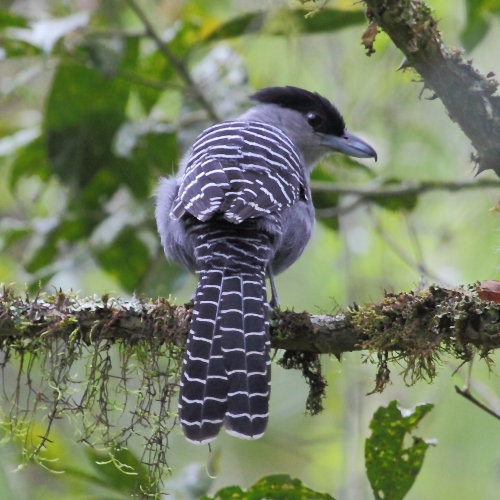
Adult Bamboo Antshrikes display a striking black-and-white plumage, which serves as excellent camouflage among the shaded bamboo canes. Males and females both exhibit this pattern, although males tend to have slightly more vivid black markings on their heads and wings. The contrast between the black and white is sharp, making them easier to identify from a distance when in the right light. Their stout, hooked bill is adapted for insect consumption, a trait common within the Thamnophilidae family.
Juvenile Bamboo Antshrikes resemble adults but with less defined markings, often appearing more grayish and less distinct. This helps them blend into the dense understory while they mature. The bird's flight silhouette is compact and agile, allowing it to navigate through the dense thickets of its bamboo habitat with ease. Its perching posture is often upright, aiding in its scanning of the surroundings for prey.
While similar species exist, such as the Barred Antshrike, the Bamboo Antshrike can be distinguished by its exclusive association with bamboo habitats and its more pronounced black-and-white coloration. Observers should note the bird's preference for remaining within shadowed areas, enhancing its cryptic nature.
Having trouble telling birds apart? Upload a photo to our bird identification tool for an instant species match.
Bamboo Antshrike Habitat and Range
Preferred Habitat
The Bamboo Antshrike predominantly inhabits terra firme forests with a strong affinity for dense stands of bamboo. These areas are typically found within the Amazon basin, encompassing parts of southeastern Peru, northern Bolivia, and western Brazil. The bird thrives at lowland elevations, usually not exceeding 400 meters above sea level. The specialized habitat preference for bamboo thickets means the Bamboo Antshrike is rarely found in urban areas or open landscapes.
Seasonal shifts in habitat are minimal, as the species remains within its preferred bamboo forests year-round. However, local movements may occur in response to resource availability or environmental conditions such as water levels during the dry season. Unlike many forest birds, the Bamboo Antshrike shows little inclination to venture into the fringes of human-altered landscapes, emphasizing the importance of intact forest habitats for its survival.
Geographic Range
The Bamboo Antshrike's range is largely confined to the Amazon basin, with known populations in southeastern Peru, northern Bolivia, and the western regions of Brazil. It is a resident species, meaning it does not undertake long migratory journeys but remains in its core habitat throughout the year. This bird is primarily found within the countries of Peru, Brazil, and Bolivia, with its range closely overlapping areas rich in bamboo growth.
Population density tends to be higher in regions with extensive bamboo thickets, as these areas provide the necessary resources for foraging and nesting. While specific migration corridors are not applicable to this species, its presence can serve as an indicator of healthy bamboo forest ecosystems. Conservation of its habitat is critical to maintaining its range, as deforestation and habitat fragmentation pose significant threats.
Want to know which birds visit your area? Browse our backyard birds by location guides for region-specific species lists.
What Does the Bamboo Antshrike Eat?
The Bamboo Antshrike's diet consists predominantly of insects, making it a vital player in controlling insect populations within its habitat. Its primary prey includes ants, beetles, and other small arthropods, which it skillfully captures using its strong, hooked bill. The bird forages by moving methodically through the understory, often probing into leaf litter and crevices within bamboo stalks to access hidden insects.
Seasonal changes in diet are influenced by insect availability, often peaking during the rainy season when insect populations are at their highest. During this time, the Bamboo Antshrike may expand its diet to include small invertebrates and spiders. The bird typically feeds during daylight hours, with peak foraging activity observed during the early morning and late afternoon when insects are most active.
The Bamboo Antshrike's foraging technique is largely solitary, although it may occasionally join mixed-species feeding flocks. This opportunistic behavior allows it to exploit feeding opportunities presented by the disturbances created by other birds in the flock.
Bamboo Antshrike Behavior and Social Structure
The Bamboo Antshrike exhibits a largely solitary lifestyle, though it may occasionally join mixed-species flocks, particularly during periods of abundant food supply. This bird is territorial, often defending its bamboo thicket home with distinctive vocalizations and physical displays. Its territory size varies depending on the density of bamboo and the availability of food resources.
Courtship displays involve a series of vocalizations coupled with subtle posturing, aimed at attracting mates and establishing pair bonds. These displays are most common during the breeding season, which aligns with the availability of food resources to support offspring.
In response to predators, the Bamboo Antshrike relies on its cryptic coloration and the dense cover of bamboo to evade detection. The bird often remains motionless, blending seamlessly with the surroundings to avoid capture. Daily activity patterns follow a diurnal schedule, with peak activity occurring in the morning and late afternoon. During the midday heat, the bird reduces activity, seeking shelter in the cooler understory.
Bamboo Antshrike Nesting and Reproduction
The Bamboo Antshrike constructs its nest in the dense bamboo thickets it calls home. The nest is typically a small cup-shaped structure made from leaves and twigs, carefully woven together and placed securely in the fork of a bamboo stem. This location provides both camouflage and protection from predators.
Clutch size generally consists of two to three eggs, which are incubated primarily by the female, although the male may assist in this task. The incubation period lasts approximately 14 to 16 days, during which time the female remains vigilant, leaving the nest only for short feeding trips.
Once hatched, the chicks are cared for by both parents, who share the responsibilities of feeding and protecting the young. Fledging occurs within 12 to 14 days post-hatching, with the young leaving the nest but remaining under parental supervision for several weeks. The Bamboo Antshrike typically raises one brood per year, though favorable conditions may lead to a second.
Bamboo Antshrike Sounds and Vocalizations
The primary song of the Bamboo Antshrike is a series of sharp, staccato notes delivered in rapid succession. This song serves both as a territorial call and a means of communication between mates. The pitch varies slightly, with a characteristic rhythmic pattern that can be likened to the sound of tapping on bamboo.
In addition to its primary song, the Bamboo Antshrike uses a variety of call notes, including soft churrs and sharp chips, to alert others of potential threats or communicate during foraging. Alarm calls are sharper and more insistent, serving to warn of predators.
During the dawn chorus, the Bamboo Antshrike's song is more prominent, contributing to the symphony of sounds that mark the beginning of the day in the forest. Birdwatchers often use these vocalizations to locate this otherwise elusive species.
Interesting Facts About the Bamboo Antshrike
- 1The Bamboo Antshrike is highly specialized, relying almost exclusively on bamboo thickets, unlike many generalist bird species.
- 2Despite its vibrant plumage, the Bamboo Antshrike is notoriously difficult to spot due to its preference for dense, shaded habitats.
- 3This species showcases sexual dimorphism, with males displaying slightly brighter black markings than females.
- 4The Bamboo Antshrike uses its stout, hooked bill not only for feeding but also for crafting its intricately woven nests.
- 5During courtship, Bamboo Antshrikes engage in a duet of calls, reinforcing pair bonds and territorial claims.
- 6The bird's cryptic nature makes it an indicator of pristine bamboo forest health, often used in ecological studies.
- 7The Bamboo Antshrike has adapted to a sedentary lifestyle, showing little migration despite seasonal changes in its environment.
Bamboo Antshrike Conservation Status
The Bamboo Antshrike is currently listed as a species of Least Concern on the IUCN Red List, reflecting its relatively stable population across its range. However, ongoing threats such as deforestation, habitat fragmentation, and the conversion of bamboo forests for agriculture pose significant risks to its habitat. Conservation efforts focus on preserving intact bamboo forest ecosystems, particularly within protected reserves and national parks in the Amazon basin. While the Bamboo Antshrike itself is not endangered, the destruction of its habitat could lead to future declines if not addressed. Historically, the population of the Bamboo Antshrike has remained stable, but continued monitoring is necessary to detect any changes in population trends that may arise due to environmental pressures.
Other Thamnophilidae Species



Birds Similar to the Bamboo Antshrike
These species are often confused with the Bamboo Antshrike due to similar appearance or overlapping range.
