
Band-tailed Antwren
Myrmotherula urosticta
Order: Passeriformes / Family: Thamnophilidae

Wikimedia Commons
About the Band-tailed Antwren
The Band-tailed Antwren (Myrmotherula urosticta) is a small bird that is emblematic of the rich biodiversity found in Brazil's Atlantic Forest. It plays a crucial role in maintaining the ecological balance by consuming insects and thereby controlling their populations. The species is endemic to Brazil, primarily inhabiting the southeastern coastal regions. The Band-tailed Antwren is often found in lowland forests, but it can also be seen in secondary growth and edge habitats, which highlights its adaptability to different forest conditions. During the breeding season, which typically occurs from September to February, the bird's activity increases as it engages in courtship displays and territorial defense. Its presence is a sign of a well-preserved environment, as it relies on dense vegetation for foraging and nesting. The Band-tailed Antwren contributes to the complex food web of its habitat, acting as both predator and prey, and its interactions with other species highlight the interconnectedness of forest ecosystems. It is a bird that not only captivates ornithologists with its behavior but also inspires conservation efforts aimed at preserving the Atlantic Forest's unique biodiversity.
The Band-tailed Antwren belongs to the family Thamnophilidae, within the order Passeriformes. These birds typically live up to 5 years in the wild with a maximum recorded lifespan of 7 years..
How to Identify a Band-tailed Antwren
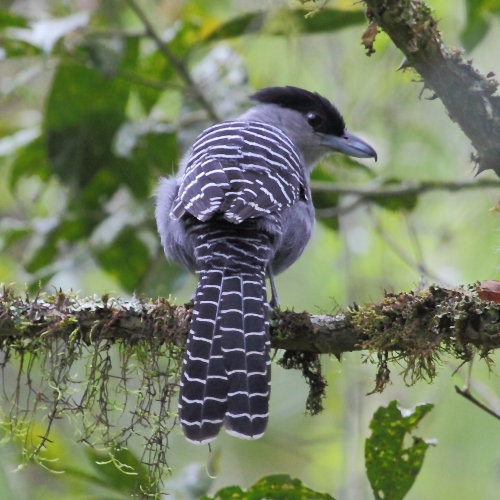
The Band-tailed Antwren is a small songbird with a length of about 11 cm. Adults exhibit a striking pattern, with males having a predominantly gray body and distinctive black bands on their tails, which give the bird its name. Females, on the other hand, are more subtly colored with brownish tones and less pronounced tail bands, making sexual dimorphism evident. Juveniles resemble females but display even duller plumage, which can cause confusion during field identification. In flight, the Band-tailed Antwren shows a rapid wingbeat and a tail that fans out, revealing its unique banded pattern. When perched, these birds often flick their tails, a behavior that further accentuates the bands. Compared to other antwrens, the Band-tailed Antwren’s tail bands are more distinct, making it easier to distinguish from similar species in its range.
Having trouble telling birds apart? Upload a photo to our bird identification tool for an instant species match.
Band-tailed Antwren Habitat and Range
Preferred Habitat
The Band-tailed Antwren inhabits the dense understory of Brazil's Atlantic Forest, a hotspot of biodiversity known for its high levels of endemism. These forests stretch along Brazil’s southeastern coastline, providing the humid, shaded conditions that the antwren favors. It is typically found at elevations ranging from sea level to around 1,000 meters, though it most commonly inhabits lowland areas. While primarily a forest dweller, the Band-tailed Antwren can adapt to secondary forests and woodland edges, especially where human activity has fragmented the landscape. Unlike some antbirds, it does not frequently venture into urban settings, preferring the cover and resources of natural habitats.
Geographic Range
The Band-tailed Antwren is endemic to Brazil, with its range restricted to the Atlantic Forest biome. This includes the states of Rio de Janeiro, São Paulo, Espírito Santo, and Minas Gerais. It does not migrate, maintaining a year-round presence in the humid forests of these regions. While it is not considered migratory, some local movements may occur in response to seasonal availability of food and changes in habitat conditions. Population density tends to be higher in well-preserved forest areas where insect abundance supports their dietary needs. Key conservation areas within its range include the Serra do Mar and the Serra da Mantiqueira, which provide vital refuges for the species.
Want to know which birds visit your area? Browse our backyard birds by location guides for region-specific species lists.
What Does the Band-tailed Antwren Eat?
The diet of the Band-tailed Antwren primarily consists of small insects and arthropods, which it gleans from foliage in the dense understory. This insectivorous bird employs a variety of foraging techniques, often moving in mixed-species flocks that help reduce the risk of predation while increasing foraging efficiency. During the rainy season, when insect abundance peaks, the Band-tailed Antwren can be seen actively foraging throughout the day. In drier periods, its diet may diversify slightly to include small fruits and seeds, reflecting its adaptability to fluctuating food resources. Prey items are typically small, matching the bird's diminutive size, and the Band-tailed Antwren shows a preference for spiders and caterpillars.
Band-tailed Antwren Behavior and Social Structure
The Band-tailed Antwren is a social bird, often found in pairs or small family groups. It exhibits strong territorial behavior, especially during the breeding season, when males actively defend their territories from rivals. Courtship involves vocal displays and physical posturing, with males using their distinctive tail bands as a visual signal. Despite its territorial nature, the Band-tailed Antwren also participates in mixed-species flocks, which increases its foraging success and provides safety in numbers. These flocks can include a variety of other antbirds and insectivores. In response to predators, the antwren relies on the cover of dense vegetation, and it often freezes or makes rapid, evasive movements to avoid detection. Its daily activity peaks during the early morning and late afternoon, aligning with the periods of highest insect activity.
Band-tailed Antwren Nesting and Reproduction
The nesting habits of the Band-tailed Antwren involve constructing cup-shaped nests that are expertly hidden in the understory. These nests are made from fine plant fibers, leaves, and spider webs, providing both camouflage and structural integrity. Preferred nesting sites are typically low to the ground, often within dense shrubbery, which offers protection from predators. The female lays two eggs per clutch, and both parents participate in incubation, which lasts approximately 15 days. Once hatched, the chicks are altricial and require constant care and feeding from both parents, fledging after about 12 days. The species generally raises one to two broods per year, depending on environmental conditions and food availability.
Band-tailed Antwren Sounds and Vocalizations
The vocalizations of the Band-tailed Antwren are characterized by a series of short, sharp notes that form a rapid trill. This primary song serves as both a territorial declaration and a mate attraction call. In addition to its song, the antwren also produces a variety of call notes, which include high-pitched whistles and soft chirps used for communication between mates. Alarm calls are harsher and more insistent, alerting nearby birds to potential threats. During the early morning hours, the Band-tailed Antwren contributes to the dawn chorus, its calls blending into the cacophony of forest sounds.
Interesting Facts About the Band-tailed Antwren
- 1The Band-tailed Antwren's tail bands are so distinctive that they can be used to identify individual birds in the wild.
- 2This species was first described in 1859 by the British ornithologist Philip Sclater, known for his work in South American avifauna.
- 3Despite being a forest bird, the Band-tailed Antwren is capable of adapting to secondary growth, highlighting its ecological flexibility.
- 4The Atlantic Forest, home to the Band-tailed Antwren, is one of the most diverse ecosystems on the planet, yet it is also one of the most threatened.
- 5Studies have shown that the Band-tailed Antwren's presence is an indicator of forest health, as it is sensitive to environmental changes.
- 6The species is part of the Thamnophilidae family, which includes over 200 species of antbirds, known for their insectivorous diets.
- 7The Band-tailed Antwren's song has been compared to the sound of a distant insect chorus, blending seamlessly into its natural habitat.
Band-tailed Antwren Conservation Status
The Band-tailed Antwren is currently listed as Near Threatened by the IUCN due to habitat loss from deforestation in the Atlantic Forest. Its population is decreasing, primarily because of agricultural expansion, urban development, and illegal logging. Conservation efforts are focused on protecting and restoring critical habitat areas, with several nature reserves and protected areas established within its range. Historical population declines have been significant, but recent initiatives aim to stabilize numbers through sustainable forestry practices and community engagement.
Other Thamnophilidae Species



Birds Similar to the Band-tailed Antwren
These species are often confused with the Band-tailed Antwren due to similar appearance or overlapping range.

