
White-flanked Antwren
Myrmotherula axillaris
Order: Passeriformes / Family: Thamnophilidae

Wikimedia Commons
About the White-flanked Antwren
The White-flanked Antwren, scientifically known as Myrmotherula axillaris, inhabits the lower strata of tropical and subtropical forests across South and Central America. This small passerine bird is a member of the Thamnophilidae family, which is composed of over 230 species known colloquially as antbirds. The species plays a critical role in the ecosystem by controlling insect populations, particularly within the dense undergrowth where it resides.
Primarily found in the Amazon Basin, the White-flanked Antwren has adapted to life in a variety of forest types. These include terra firme forests, which are not subject to seasonal flooding, as well as várzea and igapó forests, which are seasonally inundated. This adaptability in habitat selection is one reason for its relatively stable population.
The ecological significance of the White-flanked Antwren also extends to its interactions with mixed-species flocks. These flocks are common in the Amazon and provide mutual benefits such as increased vigilance against predators. The antwren is often seen participating in these flocks, moving through the lower canopy and understory in search of insects, which are its primary food source.
The White-flanked Antwren's breeding season varies geographically, often coinciding with the rainy season when insect abundance peaks. During this time, the birds become more vocal and are observed in pairs. Although not migratory, these birds may make localized movements in response to food availability and habitat changes.
The White-flanked Antwren belongs to the family Thamnophilidae, within the order Passeriformes. These birds typically live around 4-5 years in the wild, occasionally longer in captivity..
How to Identify a White-flanked Antwren
The adult White-flanked Antwren is a small bird, typically measuring around 10 centimeters in length and weighing approximately 8-10 grams. The male is particularly striking with its black plumage contrasted by bold white flanks and wing bars. Females, while similar in size, are less conspicuous with brownish tones replacing the black of the males, though they retain the distinctive white wing markings.
Juveniles resemble females but can be identified by their slightly duller plumage and lack of well-defined wing bars. Both sexes possess a slender bill adapted for insectivory, and their eyes are dark, providing a sharp contrast against their plumage.
In flight, the White-flanked Antwren's short, rounded wings and rapid wingbeats are characteristic. When perched, it often adopts an upright posture with tail slightly cocked, aiding in quick escapes from predators. This bird can be confused with other antwrens, such as the Long-winged Antwren, but the latter lacks the distinct white flanks.
Having trouble telling birds apart? Upload a photo to our bird identification tool for an instant species match.
White-flanked Antwren Habitat and Range
Preferred Habitat
The White-flanked Antwren predominantly inhabits tropical lowland forests. It is commonly found in the Amazon Basin, stretching from eastern Colombia, through Peru and Bolivia, to the northern regions of Brazil. These birds prefer dense undergrowth and are commonly associated with understory vegetation in both terra firme and seasonally flooded forests.
While they are mostly found at elevations below 1,200 meters, they can occasionally be spotted at higher altitudes in montane forests. Seasonal habitat shifts are minimal, as the species does not typically migrate. However, they may adjust their range slightly in response to food availability, often moving to areas where insect populations are more abundant.
Geographic Range
The range of the White-flanked Antwren extends across a broad swath of northern South America. It is widespread in the Amazon Basin, with notable populations in Brazil, Colombia, Venezuela, Ecuador, Peru, and Bolivia. To the north, its range includes parts of Central America, such as Panama and Costa Rica.
This antwren is considered resident throughout its range, lacking any significant migratory behavior. However, localized movements within its territory are not uncommon, particularly in response to changes in food resources or habitat conditions. Population densities are higher in regions where the forest understory is dense and insect prey is plentiful.
Want to know which birds visit your area? Browse our backyard birds by location guides for region-specific species lists.
What Does the White-flanked Antwren Eat?
The diet of the White-flanked Antwren primarily consists of insects and other small arthropods. These birds are adept foragers, often seen meticulously inspecting leaves, twigs, and bark in search of prey. Their feeding technique involves rapid movements through the understory, where they glean insects from surfaces or snatch them in mid-air.
During the wet season, when insect populations surge, the diet of Myrmotherula axillaris becomes more varied. They consume a wide array of insects such as ants, beetles, and spiders, adjusting their foraging behavior to exploit the abundance. As the dry season approaches and prey becomes less available, the antwrens may increase their foraging range while maintaining a primarily insectivorous diet.
White-flanked Antwren Behavior and Social Structure
The White-flanked Antwren exhibits fascinating social behavior, often participating in mixed-species foraging flocks. These flocks provide safety in numbers and increase foraging efficiency. Within these groups, the antwrens maintain a noticeable level of vigilance, responding quickly to potential threats.
Territorially, these birds are known to be quite vocal, especially during the breeding season. Males sing to establish and defend territories, as well as to attract mates. Courtship displays are subtle, involving soft calls and mutual preening between mates.
Daily activity patterns are largely diurnal, aligning with periods of insect activity. The White-flanked Antwren is most active during the early morning and late afternoon, with periods of rest during the hottest part of the day.
White-flanked Antwren Nesting and Reproduction
White-flanked Antwrens construct cup-shaped nests typically placed low in shrubs or small trees. The nests, woven from fine plant fibers and leaves, offer camouflage within the dense undergrowth. Pairs often choose secluded spots to minimize predation risk.
The breeding season varies geographically but often aligns with the rainy season. Clutch size is usually two eggs, which are incubated by both parents for about 14 days. Once hatched, the chicks are altricial, requiring significant parental care. They fledge approximately 10-12 days post-hatching, during which time both parents participate in feeding and protecting the young.
Typically, the species produces one brood per year, though environmental conditions such as food availability can influence this.
White-flanked Antwren Sounds and Vocalizations
The vocalizations of the White-flanked Antwren include a rapid, high-pitched trill that serves as its primary song. This trill comprises a series of evenly spaced notes that rise in intensity, often used by males to assert territorial presence and attract mates.
Call notes are sharp and quick, consisting of repetitive 'chip' sounds that facilitate communication with flock members. Alarm calls are harsher and more abrupt, serving as alerts to potential threats.
During the dawn chorus, the White-flanked Antwren is particularly vocal, contributing to the cacophony of sounds that define the early morning rainforest atmosphere.
Interesting Facts About the White-flanked Antwren
- 1The White-flanked Antwren is often found in mixed-species flocks, which can include over 20 different bird species.
- 2Despite their name, antwrens do not primarily eat ants but are named for their relation to the antbird family.
- 3The species is one of the smallest in its family, with adults weighing as little as 8 grams.
- 4White-flanked Antwrens have a rapid metabolism, requiring them to feed frequently throughout the day.
- 5Their nests are often built in locations that are hard to spot, such as dense shrubbery or low branches.
- 6The species can thrive in both primary and secondary forests, showing a degree of resilience to habitat changes.
- 7During the breeding season, males increase their singing frequency to attract mates and defend territories.
White-flanked Antwren Conservation Status
The White-flanked Antwren is currently classified as Least Concern by the IUCN. Its population trend is considered stable, largely due to its extensive range and adaptability to various forest types. However, habitat destruction, particularly due to deforestation in the Amazon, poses a significant threat. Conservation efforts focus on preserving large tracts of intact forest, which are essential for sustaining viable populations. Historical population changes are not well-documented, but ongoing habitat loss could increase pressure on this species in future.
Other Thamnophilidae Species

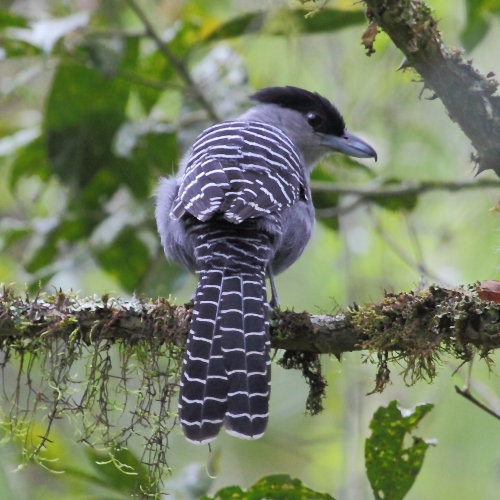


Birds Similar to the White-flanked Antwren
These species are often confused with the White-flanked Antwren due to similar appearance or overlapping range.

