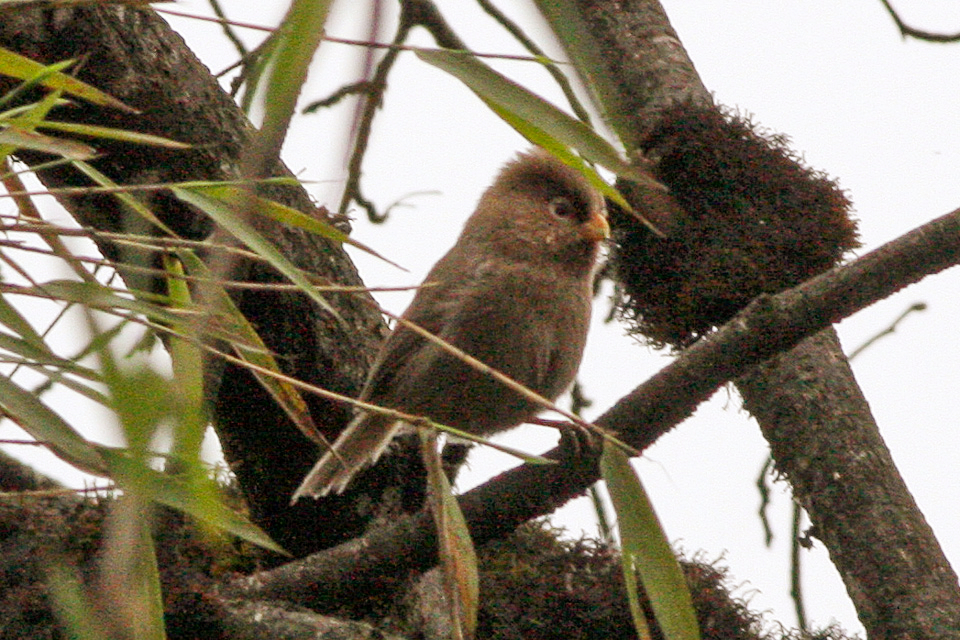
Banded Warbler
Sylvia boehmi
Order: Passeriformes / Family: Sylviidae

Wikimedia Commons
About the Banded Warbler
The Banded Warbler, or Sylvia boehmi, is a captivating bird found primarily in the sylviidae family. It inhabits various regions across sub-Saharan Africa, notably in countries such as Kenya, Tanzania, and Uganda. This warbler thrives in diverse habitats, from tropical forests to savannas, demonstrating remarkable adaptability which aids its survival in different ecological niches. The Banded Warbler plays an essential role in its ecosystems by regulating insect populations, which in turn benefits the plant communities. Its presence is often a sign of healthy ecosystems, as it prefers areas with well-developed vegetative cover. During the breeding season, which typically coincides with the rainy season, these warblers engage in complex vocal displays that serve both to attract mates and to establish territories. Their melodic songs are a defining feature, often heard in the early mornings and late afternoons, creating a vibrant soundscape. In non-breeding seasons, they may migrate locally depending on food availability and climatic conditions. The Banded Warbler contributes to seed dispersal through its foraging habits, inadvertently aiding in the propagation of various plant species. This mutualistic relationship highlights the warbler's ecological importance beyond its role as an insectivore. Observers may encounter these birds in forest edges, clearings, and sometimes even in gardens and parks, where they actively forage and sing. The species' adaptability has allowed it to maintain stable populations despite habitat changes in certain regions. However, ongoing deforestation and land conversion pose potential threats, making it crucial to understand and protect the habitats that support this resilient avian species.
The Banded Warbler belongs to the family Sylviidae, within the order Passeriformes. These birds typically live average 5 years with a maximum recorded of 7 years..
How to Identify a Banded Warbler
Identifying the Banded Warbler involves noting several key characteristics. Adult Banded Warblers exhibit a distinct pattern of plumage, featuring olive-green upperparts with a subtle grayish tinge and lighter underparts with a slight yellow hue. A conspicuous white eye-ring and a dark band across the chest are defining field marks. Juveniles display a more subdued coloration, lacking the prominent chest band, making them less conspicuous. Male and female Banded Warblers appear similar, though males may exhibit slightly brighter plumage during the breeding season. When comparing the Banded Warbler to similar species, the Chestnut-backed Sparrow-Lark may cause some confusion due to overlapping habitats but can be distinguished by its chestnut back and different song. In flight, the Banded Warbler exhibits a small, agile silhouette with rapid, undulating wingbeats. Perched, it maintains an upright posture, often flicking its tail as it surveys its surroundings. These behaviors, coupled with its unique vocalizations, make it a distinctive presence in its native habitats.
Having trouble telling birds apart? Upload a photo to our bird identification tool for an instant species match.
Banded Warbler Habitat and Range
Preferred Habitat
The Banded Warbler inhabits a range of environments from tropical moist forests to dry savannas. It is commonly found in the understories and edges of these forests, venturing into open woodlands and shrubby areas. The species tends to prefer elevations ranging from sea level to 2,000 meters, with a pronounced presence in mid-elevation zones where vegetation is dense. Seasonal habitat shifts may occur as the warbler follows food resources, sometimes moving into more urban areas such as parks and gardens. In rural settings, it thrives in farmlands with hedgerows and scattered trees, demonstrating its adaptability to varying landscapes. These habitats provide ample foraging opportunities while offering protection from predators.
Geographic Range
The Banded Warbler's range extends across several countries in East Africa, with significant populations in Kenya, Tanzania, and Uganda. During the breeding season, its range contracts slightly as it focuses on territories favorable for nesting. In contrast, during non-breeding times, the warbler may exhibit local migrations in response to food availability, often moving towards areas with abundant insect populations. Migration corridors are typically localized within the East African region, with no long-distance migrations noted. Population density tends to be higher in regions with well-preserved natural habitats, such as national parks and reserves, where human disturbance is minimal.
Want to know which birds visit your area? Browse our backyard birds by location guides for region-specific species lists.
What Does the Banded Warbler Eat?
The Banded Warbler primarily feeds on insects, making it an important insectivore in its ecosystem. Its diet includes caterpillars, beetles, and small arthropods, which it skillfully gleans from foliage. During the breeding season, the warbler's diet may expand to include a higher proportion of protein-rich insects to support the energy demands of nesting and rearing young. In non-breeding seasons, it may also consume small quantities of fruit and seeds, aiding in seed dispersal. Foraging occurs mainly during dawn and dusk when insect activity is high, and the cooler temperatures allow for more efficient hunting. The Banded Warbler employs a technique known as 'hover-gleaning,' where it hovers momentarily to pick off insects hidden in leaves. This method, along with its persistent searching behavior, enables it to exploit food resources effectively.
Banded Warbler Behavior and Social Structure
The Banded Warbler exhibits a range of interesting behaviors, particularly during the breeding season. This period sees increased territoriality, with males vigorously defending their patches through song and display flights. Courtship involves males performing elaborate song displays to attract females, often accompanied by fluttering and showcasing their plumage. The species generally prefers solitary or paired living arrangements, although small family groups may form outside the breeding season. Flocking is uncommon, but temporary associations may occur during migrations or in response to abundant resources. The Banded Warbler responds to predators with a series of sharp alarm calls, often retreating into dense cover. Daily activity patterns are largely diurnal, with peak foraging activity occurring during the early morning and late afternoon. During these times, the warbler is most vocal, contributing to the vibrant soundscape of its habitat.
Banded Warbler Nesting and Reproduction
The Banded Warbler constructs its nest with meticulous care, utilizing grasses, leaves, and spider webs to form a compact cup. Nest placement is typically within dense shrubs or low trees, providing concealment from predators. Clutch size averages three to five eggs, with females primarily responsible for incubation over a period of about 12 to 14 days. After hatching, both parents participate in feeding and caring for the chicks. The fledging period lasts approximately 10 to 12 days, during which time the young remain near the nest, gradually gaining independence. The Banded Warbler often raises two broods per year, especially in favorable conditions where food is abundant. Parental roles are well defined, with males often taking on territorial defense while females focus on nurturing the young.
Banded Warbler Sounds and Vocalizations
The Banded Warbler's song is a melodic sequence of whistles and trills, characterized by a rhythmic pattern that rises and falls in pitch. These songs serve as both mating calls and territorial markers. Call notes are short and sharp, often used in communication between mates or as alarms. During the dawn chorus, the Banded Warbler's voice stands out with its clarity and sweetness, akin to a well-tuned musical instrument. In response to threats, alarm calls are rapid and piercing, alerting nearby individuals of danger. This rich vocal repertoire not only facilitates communication but also plays a crucial role in social interactions and survival.
Interesting Facts About the Banded Warbler
- 1The Banded Warbler's song can be heard over 100 meters away, making it a prominent feature of its habitat.
- 2Despite its wide range, the Banded Warbler remains elusive due to its preference for dense cover.
- 3The species exhibits a unique foraging behavior known as 'hover-gleaning,' allowing it to catch insects mid-air.
- 4Banded Warblers often use spider webs to reinforce their nests, providing extra strength and elasticity.
- 5Studies show that Banded Warblers can identify individual songs of neighboring warblers, aiding in territory establishment.
- 6The Banded Warbler can adjust its breeding timing based on local rainfall patterns, optimizing chick survival.
- 7Unlike many birds, both male and female Banded Warblers contribute equally to chick rearing.
Banded Warbler Conservation Status
Currently, the Banded Warbler holds a status of Least Concern on the IUCN Red List, with stable population trends observed across its range. However, habitat loss due to deforestation and agricultural expansion poses a potential threat. Conservation efforts focus on habitat protection and restoration, particularly in regions experiencing rapid environmental changes. Historical data indicate that populations have remained relatively stable, but continued monitoring is essential to detect and mitigate any negative impacts. Collaborative projects between governments and conservation organizations aim to preserve key habitats and ensure the long-term survival of the Banded Warbler.