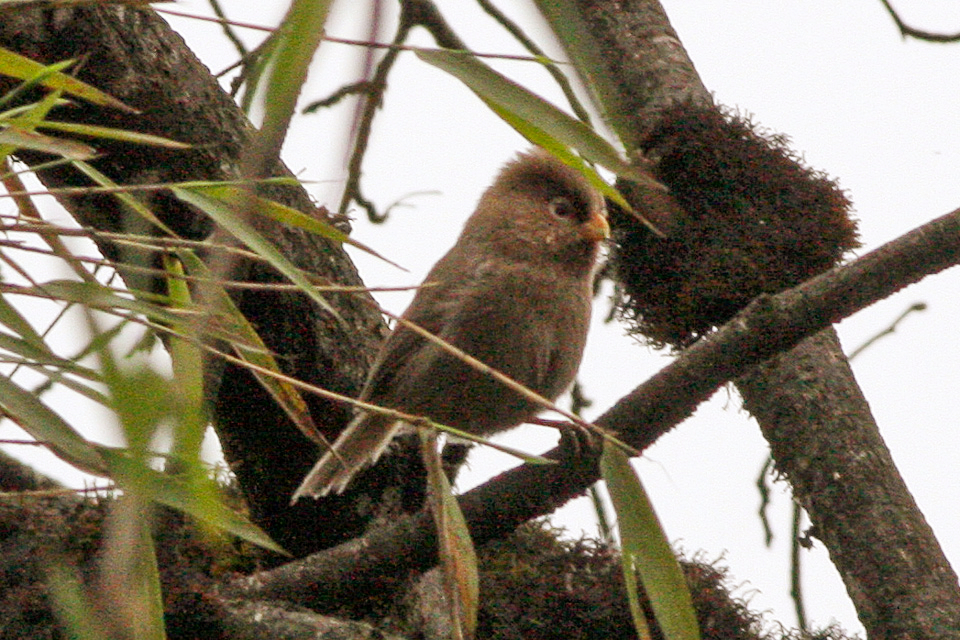
Pale-billed Parrotbill
Chleuasicus atrosuperciliaris
Order: Passeriformes / Family: Sylviidae

Wikimedia Commons
About the Pale-billed Parrotbill
The Pale-billed Parrotbill, Chleuasicus atrosuperciliaris, is a fascinating avian species found primarily in the subtropical and tropical forests of Southeast Asia. This bird belongs to the Sylviidae family, which comprises a diverse range of small to medium-sized songbirds. The Pale-billed Parrotbill is recognized for its ecological significance as a vital component of forest ecosystems, where it plays a crucial role in insect population control and seed dispersal. Its distribution spans across several countries, including Myanmar, Thailand, Laos, Vietnam, and parts of southern China. The bird thrives in dense undergrowth, particularly in lowland and montane forests, where it can find ample food and cover.
The Pale-billed Parrotbill's behavior and life cycle are closely tied to its habitat. During the breeding season, which typically occurs in the warmer months, these birds become more vocal and active. They employ a variety of calls and songs for communication and territorial defense. Outside the breeding season, Pale-billed Parrotbills may form small, mixed-species flocks, which provide increased protection against predators. These flocks often include other insectivorous birds, creating a dynamic and interdependent community.
Ecologically, the Pale-billed Parrotbill contributes significantly to the forest environment. By consuming a wide range of insects, it helps to maintain a balanced ecosystem and prevent overpopulation of certain insect species. Furthermore, its foraging habits assist in the dispersal of seeds, thereby promoting plant diversity and regeneration. The bird's presence in various forest types underscores its adaptability and resilience, making it a key species for studying ecosystem health and biodiversity in Southeast Asia.
The Pale-billed Parrotbill belongs to the family Sylviidae, within the order Passeriformes. These birds typically live average 5-7 years, with longevity records up to 9 years..
How to Identify a Pale-billed Parrotbill
The Pale-billed Parrotbill is a small bird, measuring approximately 15 cm in length. Its most distinguishing feature is its pale, almost ivory-colored bill, which contrasts sharply with its darker plumage. Adult birds exhibit a rich brown coloration on the upperparts, while the underparts are lighter with a subtle buff hue. The head is adorned with a distinctive black supercilium, which adds to its striking appearance. Juvenile birds resemble adults but tend to have slightly duller plumage and a less pronounced supercilium.
Sexual dimorphism in the Pale-billed Parrotbill is minimal, with males and females appearing very similar in the field. This lack of pronounced differences between the sexes can make individual identification challenging without close observation. When perched, the bird often holds its tail slightly cocked, a characteristic behavior that aids in identification.
In flight, the Pale-billed Parrotbill exhibits a distinctive silhouette with rapid, fluttering wingbeats. Its flight is usually short and direct, often moving from one dense thicket to another. The species can sometimes be confused with other parrotbills or similar-sized sylviid warblers, but the combination of its pale bill and distinctive head markings helps to differentiate it from similar species.
Having trouble telling birds apart? Upload a photo to our bird identification tool for an instant species match.
Pale-billed Parrotbill Habitat and Range
Preferred Habitat
The Pale-billed Parrotbill primarily inhabits dense, subtropical, and tropical forests. It shows a preference for areas with thick undergrowth and abundant foliage, which provide ample feeding and nesting opportunities. This species is commonly found in lowland forests, but it can also adapt to montane forests at elevations up to 2,000 meters.
Seasonal habitat shifts are minimal for the Pale-billed Parrotbill, as it tends to remain in forested areas throughout the year. However, during the breeding season, it may move to slightly different forest strata to locate suitable nesting sites. The bird occasionally visits secondary forests and forest edges, but it is less commonly found in urban areas, preferring natural settings with dense vegetation.
The presence of the Pale-billed Parrotbill in both primary and secondary forests highlights its adaptability and ability to thrive in various forest conditions. This adaptability is crucial for its survival, especially in regions undergoing habitat modification.
Geographic Range
The range of the Pale-billed Parrotbill extends across several countries in Southeast Asia. It is a resident bird, primarily found in Myanmar, Thailand, Laos, and Vietnam, with some populations in southern China. The species does not exhibit long-distance migratory behavior but may undertake minor local movements in response to food availability and breeding requirements.
Within its range, the Pale-billed Parrotbill is most abundant in areas with dense, continuous forest cover. It is particularly prevalent in the lowland and montane forests of northern Thailand and northern Vietnam. Population density can vary significantly depending on habitat quality and availability. In regions where deforestation is prevalent, the bird's numbers may be reduced, highlighting the importance of conserving its natural habitat.
While the Pale-billed Parrotbill does not migrate, it may utilize certain corridors for local movements, such as riverine forests and forest edges, which provide suitable foraging and nesting sites. Conservation efforts in these regions are crucial to maintaining stable populations of this species.
Want to know which birds visit your area? Browse our backyard birds by location guides for region-specific species lists.
What Does the Pale-billed Parrotbill Eat?
The diet of the Pale-billed Parrotbill primarily consists of insects and other small invertebrates. These birds are adept foragers, often seen flitting through dense foliage in search of prey. Their diet includes a variety of arthropods such as beetles, caterpillars, and spiders, which they glean from leaves and branches.
Seasonal changes can influence the availability of food sources, and the Pale-billed Parrotbill may adjust its diet accordingly. During the breeding season, when the demand for food is higher, these birds may increase their foraging activity and diversify their diet to include more insect larvae and pupae. They employ a methodical foraging technique, using their sharp, pale bills to probe bark and foliage.
While insects form the bulk of their diet, Pale-billed Parrotbills may occasionally consume seeds and fruits, especially during periods when insect prey is less abundant. Their feeding schedule is primarily diurnal, with peak activity occurring during the early morning and late afternoon when insect activity is highest.
Pale-billed Parrotbill Behavior and Social Structure
Pale-billed Parrotbills are social birds, often seen in small groups or mixed-species flocks. These flocks provide safety in numbers and allow for cooperative foraging. Within these groups, the Pale-billed Parrotbill maintains a hierarchical social structure, with dominant individuals often leading foraging parties.
Territorial behavior in the Pale-billed Parrotbill is most pronounced during the breeding season. Males become more vocal and engage in displays to establish and defend their territories. Courtship displays include a combination of vocalizations and physical displays, such as wing flicking and tail spreading.
These birds exhibit adaptability in their daily activities, often altering their behavior in response to environmental changes and predator presence. They are generally more active during the cooler parts of the day, avoiding the midday heat. When faced with potential threats, Pale-billed Parrotbills employ alarm calls and take cover in dense vegetation, demonstrating a keen awareness of their surroundings.
Pale-billed Parrotbill Nesting and Reproduction
Nesting for the Pale-billed Parrotbill involves constructing a cup-shaped nest, usually placed in a dense bush or low tree. The nest is made from fine twigs, grasses, and leaves, woven together to provide a secure environment for the eggs. These birds prefer locations with ample cover to protect against predators.
Clutch size typically ranges from 2 to 4 eggs, which are incubated by both parents over a period of approximately 12 to 14 days. The shared incubation duties ensure that the eggs are kept at a consistent temperature, increasing the likelihood of successful hatching.
Once hatched, the fledglings remain in the nest for about 10 to 14 days, during which time they are fed by both parents. After fledging, the young birds continue to receive parental care for several weeks until they are fully independent. The Pale-billed Parrotbill usually raises one or two broods per year, depending on environmental conditions and food availability.
Pale-billed Parrotbill Sounds and Vocalizations
The Pale-billed Parrotbill is known for its distinctive vocalizations, which include a variety of songs and calls. The primary song is a melodic series of whistles and trills, delivered at a moderate pitch with a rhythmic quality. It often serves as a territorial call during the breeding season.
In addition to their songs, these birds produce a range of call notes, including soft chirps and sharp alarm calls. The alarm calls are typically used to alert other flock members to potential threats. During the dawn chorus, Pale-billed Parrotbills contribute to the symphony of forest sounds, their songs blending with those of other bird species.
The vocal repertoire of the Pale-billed Parrotbill is complex, aiding in communication and social interactions within flocks. Their calls can be compared to the clear and resonant notes of a flute, adding a melodious charm to their forest habitat.
Interesting Facts About the Pale-billed Parrotbill
- 1The Pale-billed Parrotbill's distinctive pale bill is not just for show; it is adapted for precise foraging in dense foliage.
- 2Despite being a small bird, the Pale-billed Parrotbill can consume a surprising amount of insects daily, aiding in pest control.
- 3These parrotbills are known for their cooperative behavior, often participating in mixed-species flocks that enhance foraging efficiency.
- 4Unlike many birds, the Pale-billed Parrotbill does not undertake long migrations, preferring to stay within its forest home year-round.
- 5The nests of Pale-billed Parrotbills are often so well-camouflaged that they can be difficult to spot even by experienced birders.
- 6Their melodic songs contribute to the rich acoustic tapestry of Southeast Asian forests, especially during the early morning hours.
- 7The Pale-billed Parrotbill's habitat choice makes it a valuable indicator species for assessing the health of forest ecosystems.
Pale-billed Parrotbill Conservation Status
The IUCN currently lists the Pale-billed Parrotbill as a species of Least Concern, indicating a stable population trend. However, habitat loss due to deforestation poses a significant threat to its long-term survival. The expansion of agriculture and logging activities in Southeast Asia has led to the fragmentation of its forest habitat. Conservation efforts aimed at protecting and restoring forest habitats are crucial for maintaining healthy populations of the Pale-billed Parrotbill. These efforts include the establishment of protected areas and the promotion of sustainable land-use practices. Historical data suggest that while the species has experienced some fluctuations in population size, it has shown resilience in adapting to changes in its environment. Continued monitoring of population trends and habitat conditions will be essential in ensuring the conservation of the Pale-billed Parrotbill. By supporting initiatives that prioritize biodiversity and ecosystem health, we can help safeguard this species for future generations.