
Bearded Scrub Robin
Erythropygia quadrivirgata
Order: Passeriformes / Family: Muscicapidae

Wikimedia Commons
About the Bearded Scrub Robin
The Bearded Scrub Robin (Erythropygia quadrivirgata) is a captivating songbird belonging to the Muscicapidae family. This species is primarily found across sub-Saharan Africa, inhabiting a range of wooded and scrubland areas. Its presence is significant in countries like Kenya, Tanzania, Zimbabwe, and Mozambique, where it contributes to the diverse avian life. As an insectivore, the Bearded Scrub Robin plays a vital role in controlling insect populations, maintaining the ecological balance in its habitats. The bird's preference for dense undergrowth provides insight into its role as both a predator and prey within the food web. The Bearded Scrub Robin is a year-round resident, favoring areas with thick vegetation that offer ample cover and feeding opportunities. In terms of behavior, these robins exhibit territorial tendencies, particularly during the breeding season, when males become more vocal and visible in their efforts to attract mates and defend nesting territories. Seasonally, the Bearded Scrub Robin may exhibit slight shifts in habitat preference, seeking areas with optimal cover and food availability during the dry and wet seasons. This adaptability ensures its survival across diverse environmental conditions. Observers in the bird's range often note its distinctive vocalizations, which contribute to the rich soundscape of African woodlands. Its song is a mix of melodious trills and whistles, often delivered from a concealed perch within the shrubbery. This behavior underscores the robin's adaptability and its well-developed communication skills, essential for breeding success and territory maintenance.
The Bearded Scrub Robin belongs to the family Muscicapidae, within the order Passeriformes. These birds typically live typically around 5-7 years, with a maximum recorded of 10 years..
How to Identify a Bearded Scrub Robin
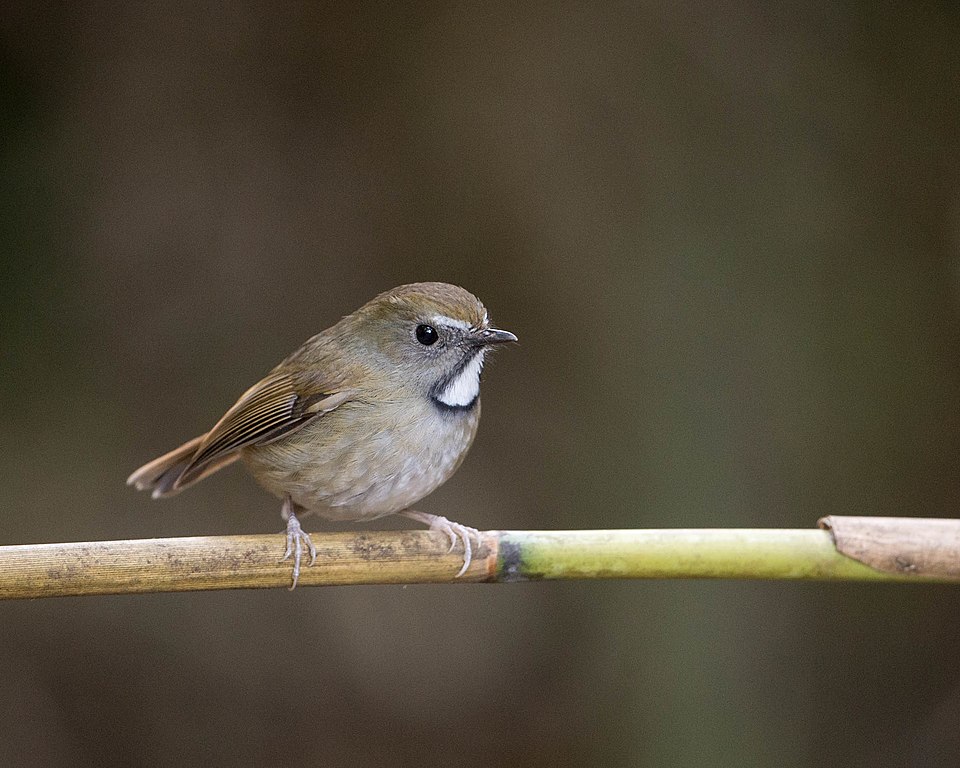
The Bearded Scrub Robin is a medium-sized songbird, typically measuring around 16-18 centimeters in length. It displays a striking plumage characterized by a rich, rufous tail and a contrasting white belly. The upperparts are predominantly brown, offering excellent camouflage against the forest floor. One of the most distinctive features is its black eye stripe, which runs from the beak through the eye, giving the bird its 'bearded' appearance. This stripe is set against a white supercilium that adds to its striking facial pattern. Adult males and females look similar, though females may exhibit slightly duller plumage. Juveniles tend to have more mottled and less distinct markings compared to adults, aiding in their camouflage. In flight, the Bearded Scrub Robin displays a rounded wing silhouette, and its flight pattern is typically undulating. When perching, it often adopts an upright posture, flicking its tail frequently, a behavior characteristic of this species. The robin's appearance can sometimes lead to confusion with the White-browed Scrub Robin, but the Bearded Scrub Robin can be distinguished by its more pronounced eye stripe and rufous tail.
Having trouble telling birds apart? Upload a photo to our bird identification tool for an instant species match.
Bearded Scrub Robin Habitat and Range
Preferred Habitat
The Bearded Scrub Robin thrives in woodland and scrub habitats, often favoring areas with dense undergrowth and thickets. It predominantly inhabits lowland forests, woodland edges, and savanna regions, where it finds both cover and food. These robins prefer elevations from sea level up to about 1,800 meters, depending on the availability of suitable habitat. While primarily a bird of rural landscapes, it can occasionally be found in urban fringes where natural vegetation persists. During the dry season, the Bearded Scrub Robin may seek out areas near water sources, where insects remain more abundant. It tends to avoid open grasslands and areas with sparse vegetation, as these do not provide the necessary cover or food resources. Within its preferred habitats, the bird often stays close to the ground, moving quietly through the undergrowth in search of food, making it a challenge to spot despite its distinctive calls.
Geographic Range
The Bearded Scrub Robin's range extends throughout much of sub-Saharan Africa, with populations concentrated in East and Southern Africa. It is commonly found in countries such as Kenya, Tanzania, Zimbabwe, and Mozambique. Within these regions, the bird is a resident species, not undertaking long-distance migrations. However, it may exhibit local movements in response to seasonal changes in food availability or habitat conditions. The Bearded Scrub Robin is notably absent from the arid zones of southwestern Africa, preferring more humid and vegetated environments. Population densities tend to be higher in areas with extensive woodland and scrub, such as the miombo woodlands of Zimbabwe and Mozambique. In such locations, the robin can be a common sight, with individuals establishing territories in suitable habitats.
Want to know which birds visit your area? Browse our backyard birds by location guides for region-specific species lists.
What Does the Bearded Scrub Robin Eat?
The Bearded Scrub Robin primarily feeds on insects, making it an important insectivore in its ecosystem. Its diet consists of beetles, ants, termites, and various larvae, which it forages from the leaf litter and undergrowth. The bird employs a methodical feeding technique, hopping along the ground and using its keen eyesight to detect prey. During the wet season, when insect populations surge, the robin benefits from an abundant food supply. In drier periods, it may expand its diet to include small fruits and seeds, although insects remain its primary food source. The robin typically forages alone or in pairs, and its feeding activity peaks during the cooler parts of the day, such as early morning and late afternoon, to avoid the midday heat.
Bearded Scrub Robin Behavior and Social Structure
The Bearded Scrub Robin exhibits a solitary and territorial nature, particularly during the breeding season. Males establish and defend territories with vocal displays, using their song to attract females and deter rivals. The bird's song is a complex series of whistles and trills, often delivered from a concealed perch. Courtship involves a combination of song and visual displays, with males performing a series of hops and wing flicks to impress potential mates. While generally solitary, the robin may join mixed-species flocks outside the breeding season, benefiting from the increased vigilance against predators. Its response to threats typically involves retreating into dense cover, where its cryptic plumage provides effective camouflage. Daily activity peaks during the morning and late afternoon, with periods of rest during the hottest parts of the day.
Bearded Scrub Robin Nesting and Reproduction
The Bearded Scrub Robin constructs a cup-shaped nest made from grass, leaves, and rootlets, often lined with softer materials such as feathers or hair. Nests are typically placed low in shrubs or small trees, providing both concealment and protection from predators. The breeding season varies across its range, often coinciding with the rainy season when food is plentiful. A typical clutch consists of 2-4 eggs, which are incubated mainly by the female for about 14-16 days. Both parents participate in feeding the chicks, which fledge approximately 14-16 days after hatching. The species may raise two broods per season if conditions are favorable, ensuring a higher rate of reproductive success.
Bearded Scrub Robin Sounds and Vocalizations
The Bearded Scrub Robin's song is a melodious mix of whistles, trills, and chatters, often delivered from a hidden perch within the undergrowth. Its primary song consists of a varied sequence of clear, ringing notes that can be heard over considerable distances. Call notes include soft chips and chatters used in communication between mates or to signal alarm. During the dawn chorus, the robin's song contributes to the rich tapestry of woodland sounds, often beginning before sunrise and peaking shortly thereafter. Compared to other scrub robins, its song is more musical and less harsh, making it a favorite among birdwatchers.
Interesting Facts About the Bearded Scrub Robin
- 1The Bearded Scrub Robin's distinctive black eye stripe is a key feature for identification, setting it apart from other scrub robins in its range.
- 2Despite its name, the Bearded Scrub Robin is not confined to scrubland habitats and thrives in a variety of wooded environments.
- 3This robin is known for its musical song, which can be heard throughout the day but is particularly prominent during early morning.
- 4The species is non-migratory, residing year-round in sub-Saharan Africa, with local movements influenced by seasonal food availability.
- 5Bearded Scrub Robins are adept at using their environment for cover, often remaining hidden in dense foliage despite their vocal presence.
- 6Both male and female Bearded Scrub Robins participate in feeding the young, showcasing a strong parental partnership.
- 7The robin's role as an insectivore makes it an important biological pest controller in its natural habitat.
Bearded Scrub Robin Conservation Status
Currently, the Bearded Scrub Robin is listed as Least Concern by the IUCN, with stable population trends across most of its range. The primary threats to its population include habitat loss due to agricultural expansion and deforestation. However, its adaptability to various woodland and scrub habitats has allowed it to maintain stable numbers in many areas. Conservation efforts focus on protecting key habitats and promoting sustainable land use practices. Historically, the species has shown resilience to moderate habitat changes, but ongoing monitoring ensures that any significant population shifts are promptly addressed.
Other Muscicapidae Species


Birds Similar to the Bearded Scrub Robin
These species are often confused with the Bearded Scrub Robin due to similar appearance or overlapping range.

