Bernier's Vanga
Oriolia bernieri
Order: Passeriformes / Family: Vangidae

Wikimedia Commons
About the Bernier's Vanga
Bernier's Vanga (Oriolia bernieri) represents a fascinating member of the Vangidae family, exclusively inhabiting the lush forests of Madagascar. This medium-sized passerine bird displays a captivating blend of black and white plumage, making it an iconic species among the island's avian fauna. Its ecological significance is noteworthy as it occupies a niche predominantly within the evergreen humid forests of eastern Madagascar. These forests provide a critical habitat, offering a rich array of insects and small fruits, essential to the vanga's diet.
The bird's presence is particularly significant in maintaining the ecological balance within these biodiverse habitats. As an insectivore, Bernier's Vanga plays a vital role in controlling insect populations, contributing to the health of the forest ecosystem. Additionally, the species aids in seed dispersal through its consumption of small fruits, thus facilitating forest regeneration and plant diversity.
Seasonally, Bernier's Vanga demonstrates subtle behavioral adaptations. During the breeding season, which aligns with Madagascar's rainy months from November to April, the vanga becomes more territorial and vocal, marking its presence with distinctive calls. Outside of this period, it adopts a more subdued demeanor, often seen foraging alone or in small family groups. This seasonality underscores the species' adaptation to the climatic conditions of Madagascar, highlighting its evolutionary success in this unique environment.
The Bernier's Vanga belongs to the family Vangidae, within the order Passeriformes. These birds typically live around 10 years, with some individuals living longer in protected areas..
How to Identify a Bernier's Vanga
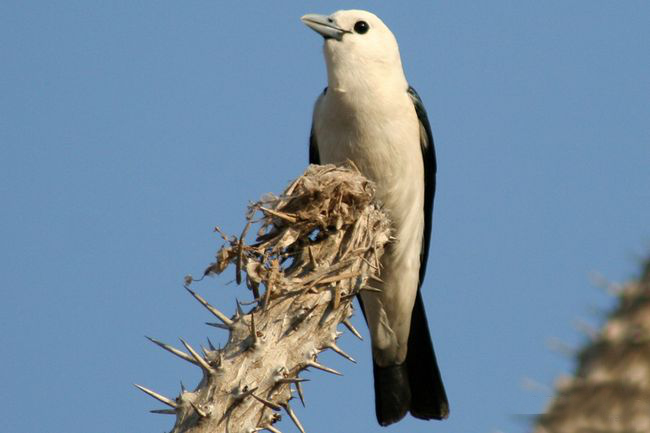
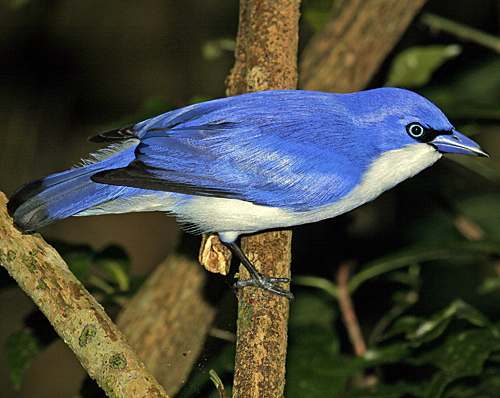
Adult Bernier's Vanga showcases a striking contrast between its glossy black upperparts and bright white underparts. The male and female are similar in appearance, although subtle differences exist in size, with males being slightly larger. The bird's head is characterized by a prominent black crown and nape, tapering into a sleek, robust bill designed for efficient foraging. Juveniles, in contrast, display a duller version of the adult's plumage, with a more muted black and grayish-white combination, which transitions into adult coloration over their first year.
Observers might confuse Bernier's Vanga with other black-and-white forest birds, yet its stout, hooked bill and distinctive eye ring provide reliable identification markers. In flight, its broad wings and short tail create a compact silhouette, often observed as the bird maneuvers through the dense canopy. When perching, the vanga maintains a confident, upright posture, frequently tilting its head in curiosity as it surveys its surroundings.
Field identification is further aided by the bird's unique vocalizations, a series of clear, repeated calls that distinguish it from sympatric species. These vocalizations, alongside its visual traits, make Bernier's Vanga a rewarding subject for birders and researchers alike.
Having trouble telling birds apart? Upload a photo to our bird identification tool for an instant species match.
Bernier's Vanga Habitat and Range
Preferred Habitat
Bernier's Vanga thrives primarily in the humid evergreen forests of eastern Madagascar, where dense foliage provides ample shelter and food resources. These forests, often at elevations ranging from sea level up to 1,200 meters, offer a rich tapestry of vegetation, including towering canopy trees and a diverse understory. The vanga shows a marked preference for primary forests, though it can occasionally be found in secondary growth areas, particularly those undergoing regeneration.
While the species is predominantly a forest dweller, it exhibits some adaptability, venturing into adjacent forest edges and clearings, especially during the non-breeding season when food sources in these areas become more abundant. Unlike some other vangas, Bernier's Vanga shows little inclination to inhabit urban or highly disturbed landscapes, underscoring its reliance on mature forest ecosystems for survival.
Seasonal shifts in habitat use are minimal, with the bird remaining largely within its established territories throughout the year. This consistency highlights the vanga's strong fidelity to its preferred habitat types, a trait critical for its conservation in the face of habitat fragmentation.
Geographic Range
Endemic to Madagascar, Bernier's Vanga occupies a specific range across the island's eastern rainforest corridor. This narrow strip, extending from the northeastern regions such as the Masoala Peninsula down to the southeastern parts including the Andohahela National Park, represents the bird's primary stronghold. Within this range, population densities vary, with notable concentrations in protected areas where suitable habitat remains intact.
The vanga's range is relatively restricted compared to more widespread Malagasy birds, highlighting its reliance on specific environmental conditions. Unlike some migratory species, Bernier's Vanga does not undertake long-distance migrations, instead exhibiting localized movements dictated by resource availability and breeding activities.
As a resident species, its absence from Madagascar's dry western and southern regions underscores its dependence on the humid, evergreen forests that define its ecological niche. Conservation efforts focus on preserving these critical habitats, ensuring the vanga's continued presence in its native range.
Want to know which birds visit your area? Browse our backyard birds by location guides for region-specific species lists.
What Does the Bernier's Vanga Eat?
The diet of Bernier's Vanga primarily consists of insects and small arthropods, supplemented by a variety of fruits. This insectivorous diet is crucial during the breeding season when the demand for protein-rich food increases to support chick development. The bird employs a methodical foraging technique, gleaning insects from foliage and occasionally employing aerial sallies to capture prey in flight.
During the dry season, when insect availability may decline, the vanga expands its diet to include more fruit, taking advantage of seasonal abundances. The fruits of native trees and shrubs provide essential nutrients, with the vanga often seen plucking berries and small fruits directly from branches.
Prey size varies, but typically includes small beetles, caterpillars, and spiders, which are easily handled by the vanga's robust bill. Feeding occurs primarily during the early morning and late afternoon, aligning with peak insect activity. This schedule, coupled with the bird's adaptable diet, underscores its resilience in the dynamic forest environment.
Bernier's Vanga Behavior and Social Structure
Bernier's Vanga exhibits a range of intriguing behaviors, particularly during the breeding season. The bird is generally monogamous, with pairs defending territories vigorously. Territorial disputes involve vocal displays and physical posturing, with males often engaging in song duels to establish dominance. Pair bonds are reinforced through mutual preening and feeding, behaviors that strengthen the partnership and enhance reproductive success.
Outside the breeding season, Bernier's Vanga adopts a more solitary or family-group oriented lifestyle. These small groups, typically consisting of a mated pair and their offspring, move through the forest in search of food. The vanga shows a remarkable ability to adapt its foraging strategy based on resource availability, often following mixed-species flocks to exploit diverse feeding opportunities.
In response to predators, the vanga employs a range of alarm calls to warn conspecifics and deter threats. These vocalizations vary in intensity and frequency, depending on the perceived danger. Daily activity patterns are diurnal, with peak activity occurring during the cooler parts of the day, allowing the vanga to avoid the midday heat while optimizing feeding efficiency.
Bernier's Vanga Nesting and Reproduction
Nesting for Bernier's Vanga occurs primarily during Madagascar's rainy season, with peak activity from November to April. The species constructs cup-shaped nests using an array of natural materials, including twigs, leaves, and fibers. These nests are typically situated in the fork of a tree, several meters above ground, offering protection from ground-based predators and weather elements.
Clutch size generally consists of two to three eggs, which both parents incubate over a period of approximately 14 days. The commitment of both male and female to incubation duties demonstrates an equitable distribution of parental responsibilities. Upon hatching, the chicks remain in the nest for up to three weeks, during which time they are reliant on their parents for feeding and protection.
Fledging occurs around the fourth week post-hatching, with young birds gaining independence shortly thereafter. The vanga typically raises one brood per season, although favorable conditions may allow for a second. The species' nesting behavior reflects its adaptation to the fluctuating resources and climatic conditions of Madagascar's forest habitats.
Bernier's Vanga Sounds and Vocalizations
The vocal repertoire of Bernier's Vanga is distinctive, with its primary song consisting of a series of clear, melodious whistles. These whistles often follow a simple, repetitive pattern that resonates through the forest, serving both territorial and mate attraction purposes. The song's rhythm and pitch remain fairly constant, providing a reliable auditory cue for identification.
In addition to the primary song, the vanga produces a variety of call notes, including sharp, staccato chips used in communication between mates and group members. Alarm calls are more urgent, consisting of rapid, harsh notes designed to alert others to potential threats. During the dawn chorus, Bernier's Vanga participates actively, its song contributing to the symphony of forest sounds that mark the start of a new day.
These vocalizations, while varied, maintain a consistent quality and tone, making them a critical aspect of the vanga's behavioral ecology and an important tool for birdwatchers and researchers in the field.
Interesting Facts About the Bernier's Vanga
- 1Bernier's Vanga was first described in 1838 by French ornithologist Jules Verreaux, highlighting its long-standing allure to the scientific community.
- 2The bird's robust bill is perfectly adapted for its insectivorous diet, allowing it to efficiently capture and handle a wide range of prey items.
- 3Bernier's Vanga's preference for pristine forest habitats makes it an indicator species for ecosystem health, reflecting the broader condition of Madagascar's forests.
- 4Despite its striking appearance, Bernier's Vanga remains elusive, often heard more than seen, as it navigates the dense forest canopy.
- 5The vanga is part of a larger radiation of vangas in Madagascar, showcasing the island's unique evolutionary history and biodiversity.
- 6Bernier's Vanga contributes to seed dispersal in its habitat, playing a role in the regeneration and maintenance of forest plant diversity.
- 7The species' reliance on primary forest highlights the importance of protecting Madagascar's remaining intact forest areas for its survival.
Bernier's Vanga Conservation Status
Classified as Near Threatened by the IUCN, Bernier's Vanga faces several conservation challenges. The primary threat to its survival is habitat loss due to deforestation, driven by agricultural expansion, logging, and infrastructure development in Madagascar. These activities have significantly reduced the extent of the bird's natural habitat, leading to population declines. Conservation efforts focus on habitat protection and restoration, with several protected areas established to safeguard critical forest regions. Initiatives aimed at sustainable land use and community engagement in conservation practices also play a vital role in preserving the vanga's habitat. Historical population trends indicate a steady decline, underscoring the urgency of conservation measures. Despite these challenges, Bernier's Vanga benefits from ongoing research and monitoring efforts, which aim to better understand its ecological needs and inform future conservation strategies. Continued support for these initiatives is essential to ensure the survival of this remarkable species in its native range.