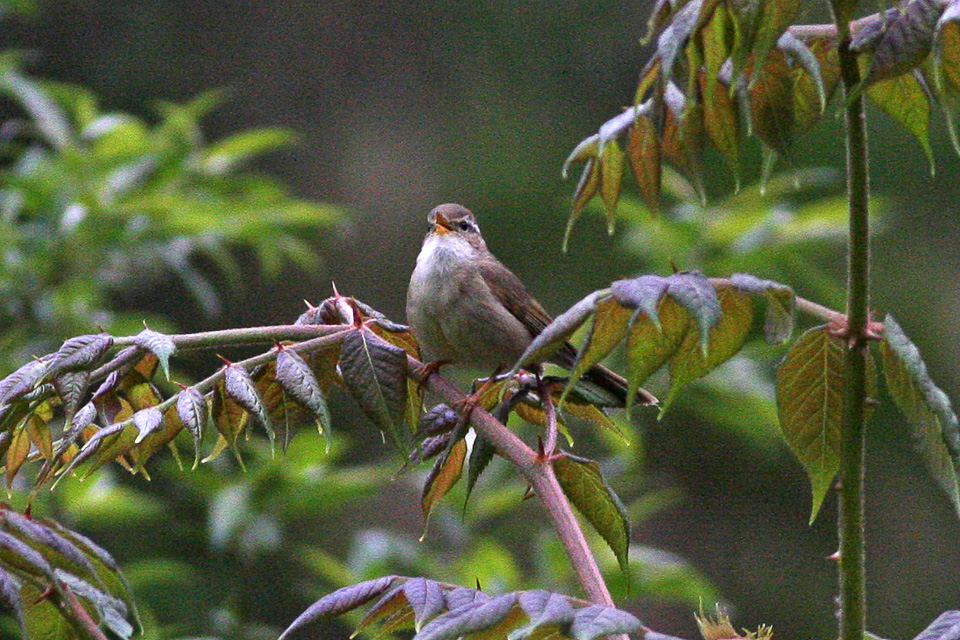
Bianchi's Warbler
Seicercus valentini
Order: Passeriformes / Family: Phylloscopidae

Wikimedia Commons
About the Bianchi's Warbler
Bianchi's Warbler, scientifically named Seicercus valentini, is a small passerine bird belonging to the Phylloscopidae family. This vibrant species predominantly inhabits regions of China, Myanmar, and Vietnam, favoring subtropical and temperate montane forests. These warblers display a preference for elevations ranging from 1,500 to 3,000 meters, often found in the dense understory where they are most active. Their presence in these habitats plays a significant ecological role, contributing to insect population control and serving as prey for larger avian predators. Bianchi's Warbler is known for its migratory behavior, with populations in northern ranges moving to lower elevations during the colder months. These seasonal migrations ensure the species' survival and continued ecological impact across varying altitudes. The species' vibrant yellow underparts and olive-green upperparts make it a striking presence in its natural habitat, while its melodious song adds to the auditory landscape of these forested areas. Bianchi's Warbler's ecological significance extends beyond its role as an insect predator; it also contributes to seed dispersal through its varied diet, which includes small fruits and berries in addition to insects. This dietary flexibility aids in the maintenance of plant diversity within its habitat. Despite its small size, Bianchi's Warbler demonstrates considerable resilience, adapting to seasonal changes in food availability and habitat conditions. The species' adaptability and widespread presence across its range highlight its importance within the ecosystems it inhabits, making it a key species for conservation-focused studies in montane forest environments.
The Bianchi's Warbler belongs to the family Phylloscopidae, within the order Passeriformes. These birds typically live average 3-6 years, max recorded 9 years.
How to Identify a Bianchi's Warbler
Adult Bianchi's Warblers are easily recognized by their olive-green upperparts and yellow underparts, a contrast that aids in field identification. The underparts exhibit a soft, yellow hue, while a prominent olive crown stripe extends from the bill to the nape. They possess a narrow white eye ring and a subtle, yet distinct, yellow supercilium that enhances their facial markings. Juvenile Bianchi's Warblers resemble adults but may exhibit slightly duller plumage, lacking the full vibrancy of yellow. Sexual dimorphism is minimal, with males and females appearing similar. However, males may exhibit slightly brighter plumage during the breeding season. In-flight, Bianchi's Warblers display quick, agile movements with rapid wingbeats, a silhouette typical of small warblers. Perching postures often involve short, restless hops along branches, frequently flicking their wings and tails. This behavior, coupled with their vocalizations, distinguishes them from similar species such as the Yellow-browed Warbler. Distinguishing Bianchi's Warbler from similar species requires careful attention to their facial markings and the combination of their song with visual cues.
Having trouble telling birds apart? Upload a photo to our bird identification tool for an instant species match.
Bianchi's Warbler Habitat and Range
Preferred Habitat
Bianchi's Warbler primarily inhabits montane forests, specifically favoring subtropical and temperate regions. They thrive in areas with dense undergrowth, utilizing the cover for foraging and nesting. Their preferred elevation range spans from 1,500 to 3,000 meters, where they access abundant insect prey. While they are more common in rural and forested environments, they occasionally venture into secondary forests and clearings. Seasonal habitat shifts occur as populations migrate to lower altitudes during the winter, seeking milder climates and consistent food sources. The warbler's adaptability to various forest types, including mixed and broadleaf forests, underscores its resilience and ecological significance.
Geographic Range
Bianchi's Warbler has a distribution primarily across China, Myanmar, and Vietnam. During the breeding season, they occupy the montane forests of southern China and extend their range into northern parts of Vietnam and Myanmar. In winter, these warblers migrate to lower altitudes within their range, where they find suitable habitats that offer milder conditions and food availability. Their migratory routes often traverse through mountainous corridors that link breeding and wintering grounds, facilitating seasonal movement. Population density hotspots include montane regions of Yunnan in China and areas of northern Vietnam, where suitable forest habitats are abundant.
Want to know which birds visit your area? Browse our backyard birds by location guides for region-specific species lists.
What Does the Bianchi's Warbler Eat?
The diet of Bianchi's Warbler primarily consists of insects, including caterpillars, beetles, and flies, which they expertly glean from leaves and branches. During the breeding season, when protein-rich food is essential, their diet heavily leans towards insect prey. In contrast, during the non-breeding season, they incorporate more plant material, such as small fruits and berries, into their diet. This seasonal dietary shift reflects their adaptability to available resources. Bianchi's Warblers employ agile foraging techniques, flitting through the foliage to capture insects mid-air or picking them from the underside of leaves. Their feeding schedule peaks in the early morning and late afternoon when insect activity is highest.
Bianchi's Warbler Behavior and Social Structure
Bianchi's Warbler exhibits a solitary or paired lifestyle during the breeding season, maintaining small territories where they engage in courtship displays. These displays often involve song and flight patterns to attract mates and establish territory boundaries. Outside the breeding season, they may join loose flocks with other warbler species, enhancing foraging efficiency. Their response to predators includes a series of alarm calls and discreet movements through dense foliage to evade detection. Daily activity patterns of Bianchi's Warbler involve active foraging during dawn and dusk, with periods of rest during midday when temperatures peak. Territorial behavior during breeding involves aggressive defense of nesting sites, especially by the males.
Bianchi's Warbler Nesting and Reproduction
Bianchi's Warbler constructs cup-shaped nests made from moss, leaves, and twigs, strategically positioned within dense shrubbery or low tree branches for concealment. Nest locations favor areas with abundant cover to protect against predators. A typical clutch consists of three to four eggs, with both parents participating in incubation, which lasts approximately 12 to 14 days. After hatching, fledging occurs in another 12 to 14 days, during which both parents feed and care for the young. Bianchi's Warbler usually raises one brood per year, although in optimal conditions, they may attempt a second.
Bianchi's Warbler Sounds and Vocalizations
The primary song of Bianchi's Warbler is a melodious series of sweet, high-pitched notes that rise and fall smoothly, resembling a musical trill. These songs are most frequently heard during the breeding season when males use them to establish territory and attract mates. In addition to their song, they emit sharp call notes that serve as communication signals within pairs or flocks. Alarm calls are more abrupt and urgent, alerting other birds to potential threats. During the dawn chorus, their songs blend with other avian species, contributing to the vibrant soundscape of montane forests.
Interesting Facts About the Bianchi's Warbler
- 1Bianchi's Warbler is named after the Italian ornithologist Guido Bianchi, who contributed significantly to bird studies in Asia.
- 2Despite their small size, weighing only around 7-8 grams, Bianchi's Warblers undertake significant altitudinal migrations.
- 3Their plumage helps them blend seamlessly into the forest canopy, offering excellent camouflage from predators.
- 4Bianchi's Warbler's song has been likened to the tinkling of a tiny bell, a sound often used to identify them in dense forests.
- 5These warblers are known for their energetic and agile foraging style, often seen darting quickly among tree branches.
Bianchi's Warbler Conservation Status
Currently, Bianchi's Warbler holds a status of Least Concern on the IUCN Red List, with stable population trends observed across its range. The primary threats include habitat loss due to deforestation and land conversion for agriculture. Conservation efforts focus on preserving montane forest habitats and establishing protected areas to mitigate these threats. Historically, the species has shown resilience in adapting to changing environments, but continued monitoring is essential to ensure its long-term survival amidst increasing human activities.