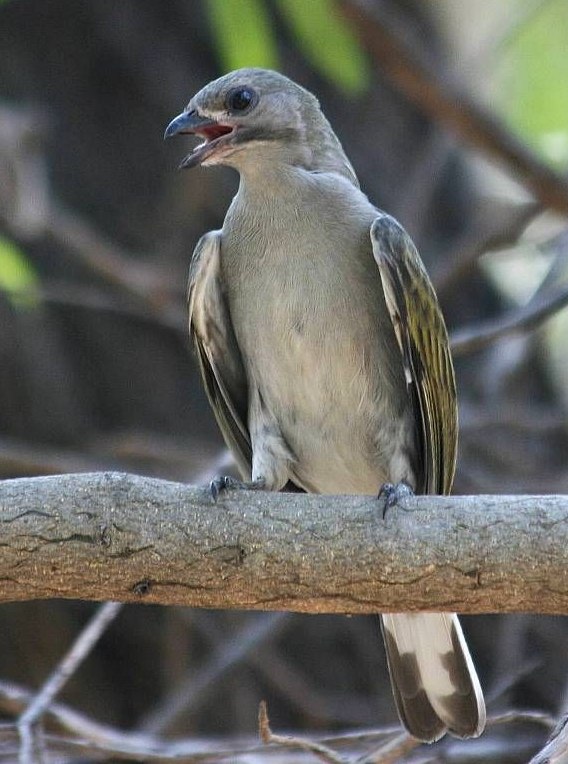
Black Bee-eater
Merops gularis
Order: Coraciiformes / Family: Meropidae

Wikimedia Commons
About the Black Bee-eater
The Black Bee-eater (Merops gularis) is a small, vibrant bird renowned for its deep black plumage contrasted by a brilliant blue throat and breast, making it a striking presence in the forests of sub-Saharan Africa. This species forms a part of the Meropidae family, known for their slender bodies and striking colors. Black Bee-eaters are primarily found in the dense tropical and subtropical forests of West and Central Africa, preferring areas with ample tree cover that provide both sanctuary and hunting grounds. They are most frequently encountered in countries such as Liberia, Ghana, Nigeria, Cameroon, and extending into the Democratic Republic of the Congo. These regions offer the warm and humid climate that suits their lifestyle.
Beyond their visual appeal, Black Bee-eaters play a significant ecological role in their habitats. Like other bee-eaters, they help control insect populations, especially bees and wasps, which they adeptly catch in mid-air. This feeding behavior not only aids in maintaining ecological balance but also supports agricultural activities by limiting pest numbers. Their presence indicates a healthy ecosystem rich in biodiversity, as they require a constant supply of prey and undisturbed nesting areas.
Throughout the year, Black Bee-eaters exhibit some seasonal behaviors. During the breeding season, which generally occurs in the dry months when food is plentiful, these birds become more territorial, often seen displaying courtship behaviors and defending their nesting sites with vigor. Outside of the breeding season, their behavior becomes more relaxed, and they are less frequently observed in pairs or small family groups, sometimes joining mixed-species flocks. Their adaptability to various forest types, from lowland rainforests to montane regions, underlines their resilience, although they remain highly sensitive to habitat destruction and deforestation.
The Black Bee-eater belongs to the family Meropidae, within the order Coraciiformes. These birds typically live average 5-8 years, with a maximum recorded of 10 years..
How to Identify a Black Bee-eater
The Black Bee-eater's appearance is unmistakable due to its distinctive coloration. Adults feature a predominantly black plumage with a strikingly bright blue throat and breast, which stand out against the rest of their body. This blue extends into a band across the chest, sometimes giving an iridescent appearance in good lighting. Juveniles, on the other hand, exhibit duller colors with a more muted blue, and their black feathers may have brownish edges, making it easier to distinguish them from adults.
Male Black Bee-eaters are generally similar in appearance to females, although males may exhibit slightly more vivid plumage during the breeding season, a subtle yet notable difference to the trained observer. Despite these differences, the sexes are not easily distinguishable in the field without close observation.
In flight, the Black Bee-eater presents a graceful silhouette with long, pointed wings and a slightly forked tail, characteristic of the bee-eater family. Their flying style is agile, often seen making quick, darting movements as they pursue insects. When perched, they tend to sit upright on exposed branches, providing birders with excellent viewing opportunities. They can sometimes be confused with the Blue-headed Bee-eater, but the latter has a distinctly blue head and lacks the extensive black plumage.
Having trouble telling birds apart? Upload a photo to our bird identification tool for an instant species match.
Black Bee-eater Habitat and Range
Preferred Habitat
Black Bee-eaters thrive in dense tropical and subtropical forests, showing a strong preference for moist lowland rainforests. They are often found at elevations ranging from sea level up to about 1,500 meters, although they can occasionally be seen at higher altitudes in montane forests. These birds favor regions with rich biodiversity, where the canopy offers ample hunting opportunities and protection from predators.
While they primarily inhabit undisturbed forests, Black Bee-eaters can sometimes be found in secondary growth forests and forest edges, especially when these areas are adjacent to primary forest. However, they are less common in heavily fragmented landscapes and urban areas, as they rely on large tracts of uninterrupted forest for nesting and feeding.
Seasonal habitat shifts are relatively minor for this species, but during the breeding season, they may move to areas with specific nesting sites such as riverbanks and other sandy substrates capable of supporting their burrows.
Geographic Range
The Black Bee-eater has a relatively wide distribution across the rainforests of West and Central Africa. Its breeding range extends from Sierra Leone and Liberia in the west, through Ghana and Nigeria, and into Cameroon and the Congo Basin. They are also found in the Democratic Republic of the Congo, where dense forest habitats are prevalent.
These bee-eaters are not migratory, remaining within their established range year-round. However, they may exhibit some local movements, particularly during the non-breeding season when food resources fluctuate. Within their range, certain areas such as the forests of Southeast Nigeria and the eastern parts of the Democratic Republic of the Congo are known hotspots for observing this species due to favorable environmental conditions.
Population density tends to be higher in regions where forest habitats remain largely intact and where human disturbance is minimal, underscoring the importance of conservation efforts in these areas.
Want to know which birds visit your area? Browse our backyard birds by location guides for region-specific species lists.
What Does the Black Bee-eater Eat?
The diet of the Black Bee-eater predominantly consists of flying insects, with a strong preference for bees and wasps. They are adept hunters, capturing prey in flight with remarkable precision. This bird employs a sit-and-wait strategy, perching in trees where they have a clear view of their surroundings before launching into the air to snatch their target.
Seasonal changes influence their diet, as they may consume a wider variety of insects, such as dragonflies and beetles, when bee populations are low. Their diet is opportunistic, and they adjust their foraging techniques according to prey availability, sometimes following swarms of insects or taking advantage of seasonal insect emergences.
These bee-eaters typically feed during daylight hours, with peak activity observed in the early morning and late afternoon. They return to their perches to consume their catch, often beating larger insects against the branch to remove stingers and wings before swallowing them whole.
Black Bee-eater Behavior and Social Structure
Black Bee-eaters exhibit fascinating social and territorial behaviors. During the breeding season, they become highly territorial, with males engaging in elaborate courtship displays to attract females. These displays often involve aerial acrobatics and vocalizations, showcasing the male's prowess and vitality.
Outside the breeding season, Black Bee-eaters are less territorial and more social, sometimes forming small family groups or joining mixed-species flocks. This behavior likely aids in foraging efficiency and predator detection. They maintain a diurnal activity pattern, with heightened foraging activity in the cooler hours of the morning and late afternoon.
Their response to potential threats includes loud, sharp calls to alert conspecifics and evasive flying maneuvers to avoid predators. Despite their social nature, these birds tend to roost individually or in small groups, often selecting the safety of dense foliage or tree hollows.
Black Bee-eater Nesting and Reproduction
Black Bee-eaters construct their nests in burrows, which they excavate in sandy banks or gently sloping terrain. These burrows can be up to a meter long, providing a safe and secure environment for raising their young. Nesting sites are often chosen based on the availability of suitable substrates, with riverbanks being a favored location.
A typical clutch consists of 3-5 eggs, which the female incubates for about 20-23 days. Both parents participate in feeding the chicks, regurgitating insects caught earlier in the day. The fledging period lasts approximately 30-35 days, after which the young birds gradually become independent, though they may continue to rely on parental support for a short time post-fledging.
Black Bee-eaters generally raise a single brood per year, although in regions with extended dry seasons and abundant food supply, they might attempt a second brood.
Black Bee-eater Sounds and Vocalizations
The Black Bee-eater is known for its distinctive vocalizations, which include a series of sharp, high-pitched calls often described as 'tsee-tsee-tsee.' These calls serve multiple purposes, from maintaining contact with other members of the species to signaling alarm when predators are nearby.
During the breeding season, males produce a more elaborate song, characterized by rapid sequences of notes delivered with a melodious and rhythmic quality. This song is an integral part of their courtship displays, aimed at attracting females and asserting territory.
While less vocal outside the breeding season, they occasionally engage in a dawn chorus, joining the forest's symphony of bird calls that heralds the start of a new day.
Interesting Facts About the Black Bee-eater
- 1Black Bee-eaters can catch and consume up to 250 flying insects each day, showcasing their remarkable hunting skills.
- 2Despite their name, Black Bee-eaters actually have a diet that includes a variety of insects, not just bees.
- 3Their burrows can reach depths of over a meter, providing protection from predators and environmental conditions.
- 4The Blue-headed Bee-eater, often confused with the Black Bee-eater, has a distinctly blue head, helping birders differentiate the two.
- 5During courtship, males perform aerial displays that include rapid dives and loops, accompanied by melodious calls.
- 6Their population density tends to be higher in the Democratic Republic of the Congo, thanks to its extensive forest cover.
- 7These birds are often seen perched at the forest edge, making them more accessible to birdwatchers than many other bee-eater species.
Black Bee-eater Conservation Status
The Black Bee-eater is currently classified as Least Concern by the IUCN, but its population is declining due to habitat loss and fragmentation. Deforestation, driven by logging, agriculture, and infrastructure development, poses the greatest threat to this species, as it relies heavily on intact forest environments for survival. Conservation efforts focus on preserving existing forest habitats and restoring degraded areas. Protected areas within their range play a crucial role in safeguarding populations, and transboundary conservation initiatives aim to maintain habitat connectivity across regions. Historically, Black Bee-eater populations have fluctuated with environmental changes, but ongoing deforestation presents a significant challenge to their long-term stability.