
Black Bushbird
Neoctantes niger
Order: Passeriformes / Family: Thamnophilidae

Wikimedia Commons
About the Black Bushbird
The Black Bushbird, scientifically known as Neoctantes niger, is a beguiling member of the Thamnophilidae family, uniquely adapted to life in the dense, shadowy undergrowth of tropical forests. This small bird, measuring about 15 centimeters in length, is primarily found in the Amazon Basin, including regions of Colombia, Venezuela, Ecuador, Peru, and Brazil. The Black Bushbird plays a crucial role in its ecosystem by controlling insect populations, which contributes to the intricate balance of the forest environment. Despite its unobtrusive presence, the bird's ecological significance is immense, as it aids in the regulation of arthropod communities and, indirectly, plant health.
In these complex jungle ecosystems, the Black Bushbird's preference for dense thickets and tangled vines allows it to occupy a niche that few other species can. This preference for dense cover not only provides it with abundant food resources but also offers protection from predators. The bird is an insectivore, primarily feeding on ants, beetles, and other small invertebrates, which it skillfully picks from leaves and branches. During the wet season, when insect activity is at its peak, the Black Bushbird is particularly active, taking advantage of the bounty to rear its young.
In addition to its foraging role, the Black Bushbird contributes to seed dispersal indirectly, as it often disturbs insects that are feeding on the seeds of various plants, thereby promoting the growth of new vegetation. As climate change and deforestation threaten the Amazon's biodiversity, the Black Bushbird's survival becomes increasingly precarious, highlighting the importance of conservation efforts in these critical habitats. Its presence is a testament to the rich biodiversity of the Amazon Basin, and its continued existence depends heavily on the preservation of these forested areas.
The Black Bushbird belongs to the family Thamnophilidae, within the order Passeriformes. These birds typically live estimated to live up to 5 years in the wild, with limited data on maximum lifespan..
How to Identify a Black Bushbird
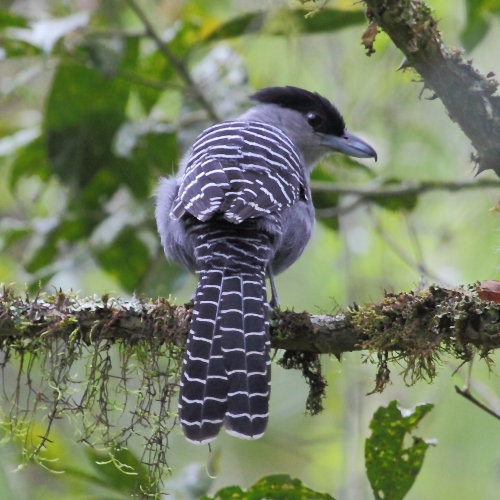
The Black Bushbird is easily recognized by its strikingly uniform black plumage, which provides effective camouflage in the dimly lit forest undergrowth. Its feathers have a slightly glossy appearance, especially noticeable in males, which can help in distinguishing them from females that are typically a duller black. The bird's eyes are a deep brown, blending seamlessly with its dark plumage, while its beak is relatively short and sturdy, adapted for its insectivorous diet.
Juvenile Black Bushbirds resemble their adult counterparts but can be identified by their slightly fluffier and duller plumage. This subtle distinction can be crucial for researchers conducting field studies. The Black Bushbird bears some resemblance to other dark-colored forest birds, such as the Black Antbird, but can be differentiated by its behavior and habitat preferences, as well as its slightly smaller size.
In flight, the Black Bushbird presents a compact silhouette with rapid, direct wingbeats, which is typical of many understory-dwelling birds. When perched, it often maintains a horizontal posture with its tail slightly cocked, a stance that aids in its inconspicuousness within the dense foliage.
Having trouble telling birds apart? Upload a photo to our bird identification tool for an instant species match.
Black Bushbird Habitat and Range
Preferred Habitat
The Black Bushbird exclusively inhabits the dense, humid undergrowth of tropical lowland forests, particularly within the Amazon Basin. This preference for dense habitat is critical for its survival, providing ample cover and feeding opportunities. These birds thrive at elevations ranging from sea level to about 1000 meters, rarely venturing into higher altitudes where the forest canopy opens up.
Seasonal shifts in habitat use are minimal for the Black Bushbird, as it remains in its preferred dense undergrowth year-round. Unlike some other bird species, it does not adapt well to fragmented landscapes or urban environments, relying instead on large stretches of uninterrupted forest. Conservation of these habitats, therefore, is crucial for maintaining healthy populations of this elusive bird.
Geographic Range
The Black Bushbird's range is centered in the Amazon Basin, spanning several countries, including Colombia, Venezuela, Ecuador, Peru, and Brazil. Within these regions, it is predominantly found in primary forest areas that remain largely untouched by human activity. The bird does not engage in long-distance migrations, instead maintaining a relatively stable home range throughout the year.
Population density is highest in areas where dense undergrowth is abundant, such as the lower Amazon in Brazil and parts of eastern Peru. In these regions, the bird can be more readily observed, though its cryptic nature often makes sightings challenging. Despite its stable range, habitat destruction from logging and agricultural expansion poses a significant threat to its population.
Want to know which birds visit your area? Browse our backyard birds by location guides for region-specific species lists.
What Does the Black Bushbird Eat?
As a dedicated insectivore, the Black Bushbird primarily feeds on ants, beetles, and other small arthropods. Its feeding strategy involves a methodical search through leaf litter and foliage, where it uses its short, robust beak to extract hidden prey. This foraging method is especially effective in the dense understory, where insect populations are plentiful.
Seasonal variations in diet are minimal, as the Amazon's climate provides a relatively constant supply of insects year-round. However, the wet season sees a notable increase in insect activity, allowing the Black Bushbird to capitalize on this abundance to feed its young. The bird's feeding schedule is diurnal, with peak activity occurring in the early morning and late afternoon, periods when insect activity is also typically highest.
Black Bushbird Behavior and Social Structure
The Black Bushbird typically exhibits solitary or paired behavior, rarely forming larger groups. It is highly territorial, with pairs maintaining and defending small territories within the dense forest undergrowth. Territorial disputes can involve vocalizations and displays, though physical confrontations are uncommon.
During courtship, males perform subtle displays to attract females, which include fluttering flights and short, soft calls. Once paired, the birds remain monogamous, sharing responsibilities in territory defense and, later, in raising their young. In response to predators, the Black Bushbird relies on its cryptic coloration and dense habitat to evade detection, often freezing or slowly retreating into thicker cover.
Daily activity patterns show a preference for the cooler parts of the day, with most foraging occurring during dawn and dusk. The bird remains relatively inactive during the hottest midday hours, when it seeks shelter in the cool depths of the undergrowth.
Black Bushbird Nesting and Reproduction
The Black Bushbird constructs its nest low within the dense thickets, typically no more than a meter above the ground. The nest is a small, cup-shaped structure, intricately woven with fine twigs, leaves, and fibrous materials, providing both camouflage and stability. Preferred nesting sites are well-hidden, often in the heart of dense vegetation, to minimize the risk of predation.
During the breeding season, which coincides with the early wet season, the female lays a clutch of two to three eggs. Both parents participate in the incubation, which lasts approximately 14 days. After hatching, the chicks remain in the nest for about two weeks before fledging. Parental care continues post-fledging, with both adults involved in feeding and guiding the young until they are fully independent.
The Black Bushbird typically raises one brood per year, although in regions with particularly favorable conditions, a second brood may occasionally occur.
Black Bushbird Sounds and Vocalizations
The Black Bushbird's vocal repertoire includes a primary song that consists of a series of soft, melodious whistles, often delivered in a slow, deliberate rhythm. This song serves both as a territorial call and a mating signal. Call notes are generally short and sharp, used primarily for communication between mates or to signal alarm.
Alarm calls are a series of brisk, repetitive notes that increase in intensity when a threat is near, alerting not only its mate but also other birds in the vicinity. During the dawn chorus, the Black Bushbird's song blends into the symphony of the forest, its soft whistles a gentle contrast to the more boisterous calls of other species.
Interesting Facts About the Black Bushbird
- 1The Black Bushbird is so elusive that even experienced birders often struggle to spot it despite its widespread range.
- 2Unlike many birds, the Black Bushbird does not migrate, maintaining its territory year-round within the Amazon rainforest.
- 3The bird's preference for dense undergrowth makes it a crucial player in controlling insect populations within its habitat.
- 4The Black Bushbird's nest is often so well-hidden that it can be nearly impossible to find without disturbing the vegetation.
- 5Despite its small size, the Black Bushbird's territory can span several acres, ensuring ample food resources are available.
- 6The Black Bushbird's song is a gentle, melodious whistle, which contrasts with the often harsh calls of other jungle birds.
- 7Its cryptic black plumage not only aids in camouflage but also helps the bird regulate its body temperature in the humid forest.
Black Bushbird Conservation Status
Currently, the Black Bushbird is listed as Least Concern by the IUCN, but its population trend is showing a decline. The primary threat to its survival is habitat destruction due to deforestation and land conversion for agriculture in the Amazon Basin. Conservation efforts focus on preserving large tracts of intact forest, which are vital for maintaining this species' habitat. Historically, the Black Bushbird's population was more stable, but increased human activity in its range has led to habitat fragmentation. Efforts by conservation organizations to curb deforestation and promote sustainable land use are crucial for the bird's long-term survival. Protecting key habitats will not only benefit the Black Bushbird but also countless other species that share its environment.
Other Thamnophilidae Species



Birds Similar to the Black Bushbird
These species are often confused with the Black Bushbird due to similar appearance or overlapping range.

