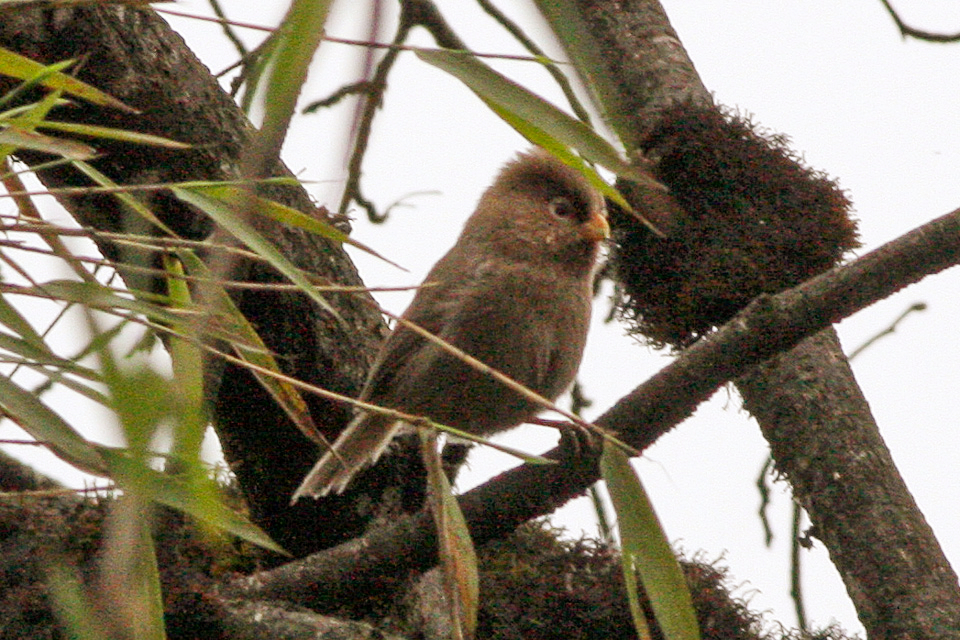
Black-headed Parrotbill
Psittiparus margaritae
Order: Passeriformes / Family: Sylviidae

Wikimedia Commons
About the Black-headed Parrotbill
The Black-headed Parrotbill, scientifically known as Psittiparus margaritae, is a captivating species that captivates bird enthusiasts and ecologists alike. This small passerine is notable for its contrasting black head, which starkly stands out against its olive-brown body. Members of the Sylviidae family, Black-headed Parrotbills inhabit the lush, temperate forests of Southeast Asia, particularly in regions such as Vietnam and Laos. These birds have adapted remarkably well to the dense undergrowth of these forests, where they play a pivotal role in the ecosystem by aiding in seed dispersal and helping to control insect populations.
Their ecological significance extends beyond their immediate environment. By consuming a variety of seeds and berries, Black-headed Parrotbills contribute to the propagation of plant species, thus maintaining the health and diversity of their forest habitats. Additionally, their insectivorous diet helps in keeping the insect population in check, which can be crucial for agricultural areas adjacent to their natural habitats. As a result, they indirectly support local economies by promoting healthier crop yields.
During breeding season, which typically occurs in the spring, these birds exhibit fascinating behaviors. Black-headed Parrotbills are known for their unique nesting habits, often constructing intricate nests within bamboo thickets or dense shrubs. These nests serve as a safe haven for their young, protecting them from predators and harsh weather conditions. Outside of the breeding season, they may exhibit different behaviors, including forming small flocks that forage together, enhancing their chances of finding food and warding off potential threats.
In terms of their broader ecological role, Black-headed Parrotbills serve as a key species for studying avian adaptation and survival strategies in changing environments. Their presence or absence can provide valuable insights into the health of their ecosystems, making them important indicators for conservationists monitoring the impacts of deforestation and climate change in the region.
The Black-headed Parrotbill belongs to the family Sylviidae, within the order Passeriformes. These birds typically live 6-8 years with a maximum recorded of 10 years.
How to Identify a Black-headed Parrotbill
The Black-headed Parrotbill is easily recognizable by its distinct coloration. Adult Black-headed Parrotbills exhibit a striking black head, which is complemented by a lighter, olive-brown body. This stark contrast is a key field mark that birders use to identify them. Their wings and tail feathers possess a slightly darker hue compared to their body, which adds to their unique appearance. Juvenile Black-headed Parrotbills, on the other hand, may display a more muted color palette, with their heads appearing dark gray rather than black, which can sometimes lead to confusion with similar species.
Sexual dimorphism is not pronounced in this species, meaning that males and females appear quite similar in plumage. However, experienced birders might notice subtle differences in size, with males typically being slightly larger than females. When observing these birds in flight, their silhouette is compact with rounded wings, which is characteristic of many passerines. On perches, the Black-headed Parrotbill often adopts a slightly hunched posture, making it appear smaller than it actually is.
A potential source of confusion could be with other parrotbill species, which share a similar body shape and size. However, the distinct black head of Psittiparus margaritae is a reliable distinguishing feature. Additionally, their calls, which consist of a series of sharp, musical notes, can help in identification when visual observation is challenging.
Having trouble telling birds apart? Upload a photo to our bird identification tool for an instant species match.
Black-headed Parrotbill Habitat and Range
Preferred Habitat
Black-headed Parrotbills thrive in dense, subtropical, and temperate forests primarily in Southeast Asia. These birds prefer habitats with thick undergrowth, often found in bamboo thickets and secondary growth forests. Such environments provide ample cover and food resources, making them ideal for foraging and nesting.
These birds are predominantly found at elevations ranging from 300 to 1,500 meters, with a preference for mid-elevation forests where bamboo and shrubby vegetation are abundant. In regions like Vietnam and Laos, they are known to inhabit both lowland and montane forests, adapting to various microhabitats within these ecosystems.
Seasonal habitat shifts for Black-headed Parrotbills are relatively minimal compared to migratory species. While they do not typically venture into urban areas, they may occasionally be spotted on the fringes of rural landscapes, especially when natural forest habitats are encroached upon by human activities. Their strong preference for dense cover means they are less likely to be found in open or heavily disturbed areas.
Geographic Range
The range of the Black-headed Parrotbill primarily encompasses Southeast Asia, with their presence most strongly noted in Vietnam and Laos. These birds are residents rather than migratory, meaning they maintain a stable presence within their preferred habitats year-round.
In Vietnam, Black-headed Parrotbills are commonly found in the Annamite Range, a region known for its rich biodiversity and complex ecosystems. Similarly, in Laos, they inhabit the Bolaven Plateau and other forested regions that provide the dense vegetation they require. Despite their relatively narrow geographic range, they are considered stable in terms of population within these areas.
While not migratory, Black-headed Parrotbills may exhibit local movements in response to food availability and environmental conditions, particularly during breeding season when nesting sites become a priority. Population density hotspots are usually centered around areas with abundant bamboo growth, as these provide both food and ideal nesting conditions.
Want to know which birds visit your area? Browse our backyard birds by location guides for region-specific species lists.
What Does the Black-headed Parrotbill Eat?
The diet of the Black-headed Parrotbill is diverse, comprising primarily insects and seeds, a combination that supports their role as both insect controllers and seed dispersers in their ecosystem. Insects, including beetles, caterpillars, and other soft-bodied invertebrates, form a significant part of their diet, especially during the breeding season when protein demand is high for feeding their young.
Seasonal changes influence their dietary habits, with a shift towards consuming more seeds and berries during the non-breeding season when insect abundance may decline. Bamboo seeds are particularly favored, aligning with their habitat preferences in bamboo thickets.
Foraging techniques of the Black-headed Parrotbill involve deft movements through dense foliage, using their strong bills to crack open seeds and capture insects. They are primarily diurnal feeders, with peak foraging activity occurring in the early morning and late afternoon when temperatures are cooler and insect activity is high. Their ability to exploit a range of food resources underscores their adaptability in diverse forest environments.
Black-headed Parrotbill Behavior and Social Structure
The Black-headed Parrotbill exhibits intriguing social structures and behaviors that enhance its survival in dense forest environments. These birds are generally social, often found in small family groups or loose flocks, particularly outside of the breeding season. This flocking behavior assists in effective foraging and provides safety in numbers against predators.
Territorial behavior is most pronounced during the breeding season. Pairs establish territories within dense thickets, where they defend their nesting sites vigorously. Courtship displays include subtle vocalizations and mutual preening, behaviors that strengthen pair bonds.
Black-headed Parrotbills are primarily active during daylight hours, with peak activity in the mornings and late afternoons. Their response to predators involves a combination of vocal alarms and evasive maneuvers, often retreating deeper into dense cover. During the day, they engage in constant foraging, punctuated by periods of rest and social interactions within their group.
While not considered migratory, Black-headed Parrotbills may adjust their range locally in response to food availability and environmental changes, demonstrating a degree of behavioral flexibility that aids in their persistence in varying forest conditions.
Black-headed Parrotbill Nesting and Reproduction
Black-headed Parrotbills construct intricate nests, typically located within dense bamboo thickets or shrubby vegetation. These nests are cup-shaped, woven meticulously from grasses, leaves, and twigs, providing a secure environment for their eggs. The choice of dense, low vegetation for nesting helps in concealing their nests from predators, adding a layer of protection for their offspring.
A typical clutch consists of three to five eggs, which are pale in color and speckled with darker markings. Incubation duties are shared between both parents, with the incubation period lasting approximately 14 to 16 days. The cooperative nature of their nesting behavior extends to the feeding of the chicks, where both parents participate actively in providing nourishment.
Fledging occurs about 12 to 15 days after hatching, at which point the young birds begin to explore their surroundings, still under the watchful eyes of their parents. Black-headed Parrotbills usually manage one to two broods per year, depending on environmental conditions and food availability. This reproductive strategy ensures their continued presence in their preferred habitats despite environmental challenges.
Black-headed Parrotbill Sounds and Vocalizations
The Black-headed Parrotbill's vocalizations are characterized by a series of sharp, melodious notes that vary in pitch and rhythm. Their primary song consists of a repetitive sequence of whistles and chirps, which can be likened to the sound of a distant flute. These vocalizations serve multiple purposes, including territory establishment and mate attraction during the breeding season.
Apart from their primary song, Black-headed Parrotbills produce a variety of call notes, which range from short, sharp 'chip' sounds to more complex sequences used in social interactions within their flocks. Alarm calls are distinct and more rapid, intended to alert other group members to potential threats in the vicinity.
During the dawn chorus, Black-headed Parrotbills contribute their unique vocalizations to the symphony of forest sounds, their songs blending seamlessly with those of other avian species. Their calls, while not as loud or far-reaching as those of some other birds, play a crucial role in maintaining social bonds and coordinating group activities.
Interesting Facts About the Black-headed Parrotbill
- 1The Black-headed Parrotbill can be found at elevations up to 1,500 meters, showcasing its adaptability to various forest environments.
- 2Despite its striking appearance, the Black-headed Parrotbill is considered a common resident in its range, particularly in Vietnam and Laos.
- 3These birds are known for their strong, musical calls, which are often heard echoing through the forest during the dawn chorus.
- 4The Black-headed Parrotbill plays a vital role in seed dispersal, helping to maintain biodiversity in the forests they inhabit.
- 5With a clutch size of three to five eggs, Black-headed Parrotbills ensure their continued presence through cooperative breeding efforts.
- 6Their diet includes a variety of insects and seeds, highlighting their ecological versatility and adaptability.
- 7The dense bamboo thickets they favor for nesting also serve as crucial habitats for other forest bird species.
Black-headed Parrotbill Conservation Status
The International Union for Conservation of Nature (IUCN) currently lists the Black-headed Parrotbill as a species of Least Concern, indicating a stable population trend. Despite this favorable status, the species faces ongoing threats from habitat destruction due to logging, agriculture, and infrastructure development in Southeast Asia. Conservation efforts focus on habitat preservation and the establishment of protected areas within their range, particularly in Vietnam and Laos where much of their population resides. Historical population data suggest that while local declines have occurred due to deforestation, the species has maintained a level of resilience through its adaptability to secondary growth forests. Ongoing research and monitoring are essential to ensure that the Black-headed Parrotbill continues to thrive, highlighting the importance of sustainable land-use practices in their habitats. By supporting conservation initiatives that prioritize forest conservation, we can help secure the future of this unique bird species.